|
|
|
|
|
|
|
|
|
Robert Taylor Prints  US Air Force US Air Force  Thunderbolt Thunderbolt |
[UP] - Mustang - Flying Fortress - Tomahawk - Lightning - Liberator - Superfortress - Corsair - Mitchell - Warhawk - Hellcat - Dakota - Marauder - Viper - Phantom |
|
|
|
|
|
| Text for the above items : |
Hell Hawks Over Utah by Robert Taylor. Without air supremacy D-Day and the invasion of north-west Europe would never have happened, and the tactical Ninth Air Force played a huge part in securing that position. The Ninth had fought with distinction from the deserts of North Africa to the invasion of Sicily and the fighting in Italy. They had spearheaded the assault on Ploesti and, from humble beginnings, had grown into one of the finest and most formidable Air Forces in the USAAF. Then, in October 1943, the Ninth were sent to England for their greatest challenge so far - providing air support for the US First Army during the forthcoming invasion of Normandy. By the morning of 6th June 1944 the Ninth was the largest and most effective tactical air force in the world, with over a quarter of a million personnel and more than 3,500 fighters, bombers and troop-carriers under its command. Amongst them were the P-47s of the 365th Fighter Group - the fearsome Hell Hawks - a unit that by the end of World War Two would become legendary. Amongst the first to use P-47s as fighter-bombers, the Hell Hawks were hard at work softening up the enemy in the build up to D-Day, dive-bombing bridges, rail lines, gun positions and airfields. With two 1,000-pound bombs below their wings along with ten 5-in rockets and eight .50 calibre machine guns, their enormous firepower devastated the German defenses on D-Day. The Hell Hawks supported the army throughout the Normandy campaign, all the way across northern France to the Battle of the Bulge in December 1944, and beyond. It was a harsh nomadic life, eating and sleeping in tents and moving from one temporary strip to the next. By the end of hostilities in May 1945 the Hell Hawks had moved through 11 different airfields, more than any other fighter-bomber group in the Ninth Air Force. |
Thunderbolt Strike by Robert Taylor. A flight of P47 thunderbolts of the 404 Fighter group, 9th Air force, clear the target area after a low-level attack on the airfield inland from Le Havre, Normandy, 1944. Tracer winds up towards them from ground defences and almost all the aircraft have taken hits. Ground-attack pilots went in low, did the job and got our fast! |
The Wolfpack by Robert Taylor. The 56th Fighter Group was led by some of Americas greatest fighter leaders of World War II and was home to many of its leading fighter Aces. Under successive commanders Hub Zemke, Robert Landry and David Schilling, the 56th destroyed more enemy aircraft in combat than any other fighter group in the Eighth Air Force. Arriving in England in January 1943 under the command of Colonel Hub Zemke, a master tactician and fearless leader, the 56th quickly emerged as an outstanding fighting unit. The only Eighth Air Force Group to fly P-47 Thunderbolts throughout the war, the 56th spawned more fighter Aces than any other USAAF group - legends such as Gabby Gabreski, Robert Johnson and the colourful Ace Walker Bud Mahurin. Under Hub Zemkes mercurial leadership they became known and feared as Zemkes Wolfpack. On 26 November, 1943, the P-47s of the 56th Fighter Group were tasked to escort B-24 Liberators of the 392nd Bomb Group on a dangerous mission to attack the heavily defended industrial and dockyard facilities in the German port of Bremen. Zemke knew the Luftwaffe would be waiting for them as they approached the target, and they were - in force! It was to become a day of high drama. With the Luftwaffe throwing all the fighters they could muster at the American heavy bombers, a massive aerial battle ensued. In the running dogfights high over Bremen, the Wolfpack claimed their most successful action of the war with 23 confirmed kills, 3 probables, and 9 damaged, creating an all-time record in the European Theatre. The 392nds B-24 Liberators could not have been in safer hands on that eventful day. |
Outward Bound by Robert Taylor. 78th FG Thunderbolts preparing to depart Duxford - with two visiting 361st FG Mustangs in the background while overhead other 361st FG Mustangs climb away from Bottisham. |
Zemkes Wolfpack by Robert Taylor. Hub Zemke was a fighter pilot and commander who led from the front. A great tactician too, it was in no small measure due to the air combat tactics introduced to the 56th Fighter Group by its mercurial leader that by the end of WW2 it had become the top-scoring Fighter Group in the USAF. This highly successful unit spawned some of the top fighter aces in the European theatre : Gabby Gabreski with 34.5 victories, Robert Johnson with 28 victories, and the colourful Ace, Walker Bud Mahurin who shot down 21 German aircraft. High over Germany at the extremity of its range, the P-47 of Hub Zemke is seen leading his pilots in to defend a stricken B-17 against the persistent attacks of marauding Fw190s. Already damaged, the B-17 has dropped from the relative safety of the formation, and protection from the P-47s is now its only chance of survival. |
| Top Aces for : Thunderbolt | ||
| A list of all Aces from our database who are known to have flown this aircraft. A profile page is available by clicking the pilots name. | ||
| Name | Victories | Info |
| James Harry Ginger Lacey | 28.00 | The signature of James Harry Ginger Lacey features on some of our artwork - click here to see what is available. |
| Francis S Gabreski | 28.00 | The signature of Francis S Gabreski features on some of our artwork - click here to see what is available. |
| Robert S Johnson | 27.00 | The signature of Robert S Johnson features on some of our artwork - click here to see what is available. |
| Herschel H Green | 18.00 | The signature of Herschel H Green features on some of our artwork - click here to see what is available. |
| Hubert Zemke | 17.75 | The signature of Hubert Zemke features on some of our artwork - click here to see what is available. |
| James A Goodson | 15.00 | The signature of James A Goodson features on some of our artwork - click here to see what is available. |
| Donald J Strait | 13.50 | The signature of Donald J Strait features on some of our artwork - click here to see what is available. |
| Donald S Bryan | 13.33 | The signature of Donald S Bryan features on some of our artwork - click here to see what is available. |
| Kenneth A Jernstedt | 10.50 | The signature of Kenneth A Jernstedt features on some of our artwork - click here to see what is available. |
| George E Bostick | 9.00 | |
| Arthur C Fiedler Jr | 8.00 | The signature of Arthur C Fiedler Jr features on some of our artwork - click here to see what is available. |
| Paul P Douglas Jr | 8.00 | The signature of Paul P Douglas Jr features on some of our artwork - click here to see what is available. |
| Urban L Drew | 6.00 | The signature of Urban L Drew features on some of our artwork - click here to see what is available. |
| Wilbur R Scheible | 6.00 | The signature of Wilbur R Scheible features on some of our artwork - click here to see what is available. |
| James E Hill | 5.00 | The signature of James E Hill features on some of our artwork - click here to see what is available. |
| Joseph Z Matte | 5.00 | The signature of Joseph Z Matte features on some of our artwork - click here to see what is available. |
| Morton David Magoffin | 5.00 | The signature of Morton David Magoffin features on some of our artwork - click here to see what is available. |
| Robert Merrill Barkey | 5.00 | The signature of Robert Merrill Barkey features on some of our artwork - click here to see what is available. |
| Thunderbolt Pilot and aircrew signature details |
 Brigadier General Lyle Adrianse Our estimated value of this signature : £15 | Brigadier General Lyle Adrianse Joining the service in 1941, Lyle Adrianse was one of the early members of the 56th Fighter Group, arriving in England with them in early 1943 and flying P47s with the 63rd Fighter Squadron. He completed a total of 101 combat missions with the Group, and remained in Europe until the end of the war. |
 Colonel Jacksel M Broughton Our estimated value of this signature : £20 | Colonel Jacksel M Broughton Jacksel Broughton was born on January 4, 1925 in Utica, New York. Jacksel Broughton was a 1942 graduate of Brighton High School in Rochester, New York. Broughton entered the United States Military Acedemy on July 15th, 1942, in the wartime three-year curriculum that eliminated the cadet second class (junior) year. Graduating from West Point in 1945, he was commissioned into the United States Air Force. Jacksel Broughton was initially assigned to Europe, flying P-47s and P-51s. He converted to jets at Nellis AFB, he flew a combat tour in Korea in P-80s, and a second tour in F-84s. After various operational positions he led the USAF Thunderbirds for three years - the worlds first supersonic acrobatic team. Jacksel commanded 2 tours in south east Asia flying the F-105 during Rolling Thunder missions. In his long career he accomplished being combat ready in every Air Force Fighter from the P-47 to F-106. During 4 combat tours he flew over 216 combat missions. Jacksel has written two highly respected books - Thud Ridge and Going Downtown, both first hand accounts of the air war over South East Asia. He retired from the Air Force in 1968 with the rank of Colonel on August 31st, 1968, with 43 separate awards and decorations, including four Distinguished Flying Crosses two Silver Stars and the highest Air Force decoration, the presidentially-awarded Air Force Cross. |
 Lt Col Donald S Bryan Our estimated value of this signature : £40 Died : 2012 | Lt Col Donald S Bryan Originally a P-40 instructor with the 79th Fighter Squadron, 20th Fighter Group, Don Bryan then transferred to the 328th Fighter Squadron, 352nd Fighter Group as a flight leader flying P-47s. Moving to Bodney, England, in June, he flew with the group on its first combat mission in September, flying his P-47 'Little One', named after his girlfriend Frances Norman. In April 1944, he transferred to P-51s, 'Little One II' and 'Little One III', and completed his first combat tour in May 1944. He returned to the 328th Fighter Squadron in August, became an Ace two months later, and gained 'Ace in a Day' status on 2nd November when he downed five Fw190s in a single mission. Don flew 140 combat missions, never lost a wingman, and was awarded the Distinguished Service Cross, second only to the Medal of Honor. Lt Col Bryan died on 15th May 2012. |
Flying Officer John Byrne Our estimated value of this signature : £40 | Flying Officer John Byrne With the RAF since 1938, Byrne flew Hurricanes, Spitfires, P-47s, Tempests and Typhoons during WWII. Upon joining 197 Sqn in March 1944 he flew Typhoons during one the squadrons most hectic periods in the run up to D-Day and throughout the subsequent Allied invasion, mostly on low-level bombing missions. In total Byrne completed over 150 combat operations and finally left the RAF in 1946. |
 Lieutenant Colonel James E Carl Our estimated value of this signature : £10 | Lieutenant Colonel James E Carl After entering the USAAF in December 1941 he completed pilot training and was assigned to the 356th Fighter Squadron, 354th Fighter Group. Based at Boxted he undertook his first combat mission shortly after D-Day in June 1944 and flew P-51s in support of the Allied advance through Normandy. Converting to P-47s in November he flew in Bastogne and the Battle of the Bulge, completing a total of 86 combat missions. |
  Captain Wayne L Coleman Our estimated value of this signature : £40 Died : 2018 | Captain Wayne L Coleman Joining the service in January 1943, Wayne Coleman was posted to the 82nd Squadron, 78th Fighter Group at Duxford, near Cambridge in July 1944. He flew the first of his 75 combat missions a few days later on August 2nd in P-47s, dive-bombing and strafing in support of the Normandy invasion before converting to P-51s at the end of the year. Wayne shot down three Fw190s in a single mission and later on 31st March 1945, an Me262 jet. He flew continuously until the end of the war. He died on 1st January 2018. |
  General Paul Douglas Our estimated value of this signature : £35 Died : 2002 | General Paul Douglas After joining the military as a Private in 1940 Paul Douglas transferred to the USAAF for pilot training, arriving in Europe to join the 268th Fighter Group. Flying P-47 Thunderbolts, he was credited with 8 air victories and destroying 27 enemy aircraft on the ground. On two occasions he shot down three enemy aircraft on one mission. He commanded the 396th Fighter Squadron and became deputy commander of the 386th Fighter Group, flying a total of 136 combat missions in World War II. He later commanded the 36th Fighter Group in Belgium, France and Germany. Paul Douglas later flew 101 combat missions in the F-105 in Vietnam, and in all completed over 6000 flying hours as a command pilot, and is one of the most highly decorated Air Force pilots. Douglas died on December 26, 2002. He is buried in the Central Texas State Veteran's Cemetery in Killeen, Texas |
 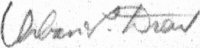 Maj Urban L Drew USAF Our estimated value of this signature : £40 Died : 2013 | Maj Urban L Drew USAF Urban 'Ben' Drew was born in Detroit, Michigan in 1924. Three months after the attack on Pearl Harbor, at the age of eighteen, Drew joined the USAAF and commenced pilot training. He earned his wings and a commission at Mariana, Florida in October 1943. He remained in the States honing his flying skills as an instructor pilot for the North American P-51 Mustang at Bartow, Florida. In May of 1944 he received his first overseas combat assignment, sailing to England on the Queen Elizabeth. He was assigned to the 375th Fighter Squadron 'Yellowjackets' of the 361st Fighter Group based in at Bottisham in Cambridgeshire. Later his squadron would be relocated to Little Walden in Essex. During his combat tour Drew would fly a total of seventy-five combat missions, rising to command of X Flight and later to command of the 375th squadron. Drew would be officially credited with six aerial victories during his combat tour. Notable was his downing of two Me-262 jets on October 7, 1944. He was the first fighter pilot to down two of the German jets, and he received the Air Force Cross for this achievement. Also of note was the ace's destruction of the largest aircraft to fly in WW 11, the BV-238, which he destroyed in a strafing pass with two wingman on Lake Schaal on September 18, 1944. Following his successful combat tour, Drew returned to the States where he again served as a flight instructor. In 1945 he was assigned to the 412 th Fighter Squadron of the 414 th Fighter Group based at lwo Jima flying the P-47 Jug. Drew's final victory tally included 6 confirmed aerial victories, 1 damaged, and 1 additional aircraft destroyed on the ground. In addition to the Air Force Cross, Drew was awarded two Distinguished Flying Crosses and 14 Air Medals. Following the War Drew helped organize the 127 th Fighter Group of the Michigan National Guard. He became Deputy Group Commander and later was appointed the first Air Adjutant General of the State of Michigan. After his retirement from the Air Force with the rank of Major, he established an aviation business in Britain and South Africa. He currently resides in Southern California, and remains active in matters involving the American Fighter Aces Association. Sadly we have learned that Ben Drew passed away on 3rd April 2013. |
  Colonel Arthur C Fiedler Our estimated value of this signature : £55 Died : 2016 | Colonel Arthur C Fiedler Arthur Charles Fiedler was born in Oak Park, Illinois on August 1, 1923. In April of 1942, five months after America entered WW 11, Fiedler enlisted in the Army Air Corps. He was sent to Avon Park, Florida for primary training, followed by basic training at Macon, Georgia, and advanced training at Marianna, Florida. He graduated with Class 43G in July of 1943, and was assigned as a flight instructor, flying Republic P-47 Thunderbolts at Dover, Delaware. In April of 1944 Second Lieutenant Feidler was assigned to combat duty, and was assigned to the 317th Fighter Squadron of the 325th Fighter Group (the 'Checkertails'), based in Lesina, Italy. He transitioned to the North American P-51 Mustang, naming his assigned aircraft after his wife 'Helen' whom he had married in 1943. On June 24, Fiedler claimed a probable. On June 28 he attained his first two aerial victories. At that morning's briefing Fiedler was elated to learn that his squadron's mission would be a fighter sweep over Polesti, Rumania, in advance of a bombing mission targeting the massive oil refining operations in that area.. When flying fighter escort for bombers the fighters were prohibited from flying below 15,000-feet. This gave the Germans a dog fighting advantage, as the early Allison-powered Mustangs were good performers at low altitudes but relatively poor performers at higher altitudes. Forty P-5 Is from the 325th 17G took off at 0725 hours for the fighter sweep. Sweeping the target area at 25,000-29,000 feet for about 45 minutes a total of 47 enemy aircraft were encountered. During this mission Fiedler would earn his first two victories. Fiedler became an ace on July 26 when he downed his fourth and fifth aircraft, a Fw- 190, south of Vienna, and a 109 several minutes later. Promoted to Captain, Fiedler attained his eighth and final victory on January 20, 1945 while escorting B-17s to Regerisbuurg. His flight of four P-51s broke-up an attacking force of 40 German fighters. Following the War Fiedler left the military and attended the University of Illinois, earning a bachelor's degree in mechanical engineering. He was recalled for active duty during the Korean War, and decided to make a career in the Air Force. In addition to his 66 combat missions flown in WW 11, Fiedler would fly 247 combat missions in C-130s during the Vietnam War Col. Fiedler retired from the USAF in 1975, and currently resides in Southern California. His decorations include the Silver Star, the Legion of Merit, the Distinguished Flying Cross with one OLC, the Air Medal with 22 OLCs, and the Partisan Star. He died on 11th May 2016. |
 Captain John Fitch Our estimated value of this signature : £20 | Captain John Fitch Joining the Army Air Corps in 1941 he began his service flying the A-20 Havoc in North Africa. Volunteering for a second tour in 1944 he joined the 335th Fighter Squadron, 4th Fighter Group initially flying P-47s and on 18th November 1944 he shot down an Me262 over Germany. Transferring to P-51s he was shot down in March 1945 whilst strafing a train, and was taken prisoner. After the war he became a successful Grand Prix racing driver and an icon of the racing industry. |
  Colonel Gabby Gabreski Our estimated value of this signature : £95 Died : 2002 | Colonel Gabby Gabreski Gabby Gabreski was the top scoring 8th Air Force fighter Ace in Europe with 28.5 victories in World War II, plus further 6.5 in Korea. Flying P47s with the 56th Fighter Group, his illustrious career in Europe came to a spectacular end, when, strafing an airfield his aircraft touched the ground. He crash landed and was taken prisoner. The story of this American hero from Oil City, Pennsylvania begins in 1942. Gabreski dropped out of his pre-med studies at the University of Notre Dame to become a flyer. Anxious to get into action quickly Francis Gabreski got himself assigned to the 3-1-5 Polish fighter squadron of the RAF in 1942. Although Gabreski flew many combat missions with the Polish fighter squadron he attained no victories. In February of 1943 he was reassigned to the U.S. Army's Eighth Air Force. On August 24, 1943 he got his first victory (a Focke-Wulf 190) over France. Flying the P-47 Thunderbolt or 'Jug', Gabreski continued to achieve victory after victory. He was officially credited with 28 confirmed aerial victories, and that excludes the scores of aircraft, tanks, and other vehicles destroyed by Gabreski during ground attack missions. For many weeks leading up to and following D-Day in June of 1944 Gabby had been on numerous missions involving the dive bombing and strafing of German trains, bridges, armored convoys, and gun emplacements. On July 20,1944 Gabby was scheduled to depart for a much-deserved leave, during which he planned to marry his girl, Kay Lochran. Shortly before his scheduled departure Gabreski was given the opportunity of leading the 61st Squadron of the 56th Fighter Group on an important mission. This was a challenge this ace could not resist. Near Cologne, Gabby spotted an airdrome and began a high-speed low-level attack. Defying his own axiom to 'hit them hard, hit them fast, hit them low, but never come around for a second pass,' Gabby made an ill-fated second pass over the field. On this second pass his propeller hit the tarmac, and Gabreski was forced to make a crash landing in a wheat field adjacent to the German airfield. For five days he was able to elude the German army, but he was finally captured and sent to Stalag Luft 1 in Barth Germany. In 1945 with the end of the War Gabby was released and he married Kay Cochran on June 11. Not long after the Korean War broke out, Gabby found himself in command of the 51st Fighter Wing, where he flew the F-86 Sabre jet. In Korea Gabreski attained 6.5 more confirmed aerial victories in engagements with Migs, earning the unique distinction of ace status in two different wars. Following his retirement from military service in 1967, Gabby worked for several years for Grumman Aircraft on Long Island. Later he was to become the President and General Manager of the Long Island Railroad. Two of his nine children are Air Force Academy graduates and pilots with the U.S. Air Force. At the time of his retirement from military service in 1967 Gabby is believed to have flown more combat missions than any other American fighter pilot. Gabreski lived in Long Island New York where the American flag proudly flew each day atop the Gabreski family flagpole. Colonel Francis 'Gabby' Gabreski passed away on 31st January 2002. |
 Major General Wayne C Gatlin Our estimated value of this signature : £20 | Major General Wayne C Gatlin Wayne Gatlin flew with the 360th Fighter Squadron, 356th Fighter Group based at Martlesham Heath. From September 1944 he undertook 55 combat missions before the end of the war, six in P-47s and the rest in P-51Ds. On 10 April 1945 he destroyed an Me262 jet before immediately damaging another. |
  Lieutenant Colonel Jim Goodson Our estimated value of this signature : £60 Died : 2014 | Lieutenant Colonel Jim Goodson Jim Goodson joined the RAF in 1940. Posted to re-form 133 Eagle Squadron RAF flying Spitfires, he transferred to the USAAF 4th fighter Group in September 1942, commanding 336 Squadron. Flying P47s and then P51s, Jim Goodson flew continuously until he was shot down ten months before the end of the war. He was one of the most highly decorated Aces in the USAAF, with 32 enemy aircraft to his credit. He died on 1st May 2014. |
  Major Herky Green Our estimated value of this signature : £65 Died : 2006 | Major Herky Green 'Herky' Green arrived in North Africa in January 1943 flying with the 325th Fighter Group. During his first action his P40 was so riddled with tracer that it had to be scrapped - but he still managed to shoot down one of his attackers. Flying from North Africa, and later Italy, 'Herky' flew P40s, P47s and P51s, scoring victories in all three types. In March 1944 he took command of the 317th Fighter Squadron, flew over 100 missions, ending the war with 18 air victories. Herky Green died 16th August 2006. |
 Captain Walter Groce Our estimated value of this signature : £25 | Captain Walter Groce Flying with the 63rd Fighter Squadron, 56th Fighter Group, Walter Groce flew the first of his 73 combat missions shortly after D-Day, 1944. He flew the longest combat mission in a P-47 without landing, after bailing out on his return. Scoring 3.5 victories he was one of the rare breed of fighter pilots to have shot down an Me262 jet in combat, claiming a share of one on 1st November 1944. |
  General James Hill Our estimated value of this signature : £40 Died : 1999 | General James Hill James Hill joined the Army Air Corps in March 1942, completing pilot training in February 1943. Assigned to the 388th Fighter Group in Europe he began his 400 combat mission career flying P-47s. At the end of his European tour, which included taking part in the D-Day operations, he had flown 127 combat missions and was credited with two Me109s and three Fw190s shot down. He continued active flying in the Korean conflict with the 8th Fighter Bomber Wing, flying a further 128 combat missions as an F-80 pilot, when he added to his air victory score by downing a MiG-15. He later joined headquarters 5th Air Force at Osan Air Base in Korea as Chief of Fighter Operations Division and Directorate of Operations. Back in the US, he was appointed Commander NORAD at Colorado Springs. Hill died on May 20th, 1999 |
 Lt Col Robert S Johnson Our estimated value of this signature : £80 Died : 1998 | Lt Col Robert S Johnson Robert Johnson arrived in England in 1943 and was quickly in the thick of the action, scoring his first aerial victory within a month of his initial combat flying. A year later, having flown 91 combat missions, he had taken his total of aerial victories to 27. Died 27th December 1998. |
  Lieutenant Colonel Robert A Karr Our estimated value of this signature : £55 Died : 2015 | Lieutenant Colonel Robert A Karr Robert Karr was born on January 11, 1924, in Waterloo, Iowa. Robert enlisted in the U.S. Army Reserve on July 31, 1942, and entered the Aviation Cadet Program of the U.S. Army Air Forces on February 8, 1943, receiving his commission as a 2d Lt and pilot wings at Spence Field, Georgia, on November 3, 1943. After completing P-47 Thunderbolt training and serving with the 536th Fighter Squadron of the 87th Fighter Group, Lt Karr was assigned as a P-51C Mustang pilot with the 5th Fighter Squadron of the 52nd Fighter Group in North Africa and Italy from May 1944 to June 1945. Operating out of Madna Airfield in Italy, he got his first victory when he downed an Me109 near Udine on 9th June, adding two more a few weeks later. On 17th July, leading a flight of P51Ds, he shot down three more Me109s in a day near Blata, Poland. A P51 Ace with 6 victories plus 2 more damaged in the air to his credit, he retired from the service in 1976. |
 Chief Warrant Officer Russell Kyler Our estimated value of this signature : £25 | Chief Warrant Officer Russell Kyler Joining up in September 1942, Russell Kyler flew 57 combat missions in P-47s with the 61st Fighter Squadron, 56th Fighter Group, from September 1944 until the end of World War II. Enlisting in the army after the war, he then flew two tours on Huey helicopters during the conflict in Vietnam. |
 Squadron Leader Ginger Lacey DFM Our estimated value of this signature : £90 Died : 1989 | Squadron Leader Ginger Lacey DFM James Harry Lacey, from Wetherby, who was destined to become the top scoring RAF fighter pilot in the Battle of Britain, joined the RAFVR. in 1937. After an instructors course in 1938 he became an instructor at the Yorkshire Aeroplane Club. Called up at the outbreak of war, he was posted to 501 Squadron, and in May 1940 was posted with the unit to France. On the 13th he set off late on an early patrol, and shot down a Bf 109 and a He 111. Later in the day he destroyed a Bf 110. On the 27th he destroyed two He 11 Is and then returned to the United Kingdom, in June, having made an emergency landing in a swamp on the 9th and overturned, nearly being drowned. On 20 July he shot down a 13f 109, and was then awarded a DFM. In the Battle of Britain, during August, he destroyed a Ju 87 and a probable on the 12th, damaged a Do 17 on the 15th, probably destroyed a Bf 109 on the 16th, and on the 24th shot down a Ju 88 and damaged a Do 17. On the 29th he destroyed a 13f 109 and next day claimed a He 111 and probablya Bf110. He shot down a Bf109 on the 31st and on 2 September got two Bf 109s and damaged a Do 17. Two days later he destroyed two more Bf 109s, and was then sent on leave for a few days. on his return, on the 13th, he took off in very bad weather to shoot down a lone He 111 which had just bombed Buckingham Palace. Having destroyed it, he found the cloud too thick to return to base and was forced to bale out. On the 15th he shot down another He 111 and two Bf 109s with a third damaged, on the 27th destroyed another Bf 109 and on the 30th damaged a Ju 88. During October he was in action frequently against Bf 109s, getting a probable on the 7th and destroying others on the 12th, 26th, and the 30th, damaging one also on this latter date. His score was now 23, and he had been shot down or forced to bale out nine times. Of his victories 18 were gained during the Battle of Britain, and this was the highest score of any pilot for this period. In December he received a Bar to his DFM and was commissioned the following month. He converted to Spitfires early in 1941, and in June became a flight commander. During July he destroyed a Bf 109 on the 10th, damaged one on the 14th, shot down a He 59 floatplane on the 17th and destroyed two more Bf 109s on the 24th, causing them to collide. He was then posted as an instructor to 57 OTU where he trained, among others, George Beurling. In March 1942 he was posted to 602 Squadron, and on 24th March damaged a Fw 190. On 25 April he damaged two more, but was then posted to HQ 81 Group as Tactics Officer, now as a Sqn. Ldr. He spent some while testing Hurricanes with rocket projectiles and 40 mm. anti-tank guns, and then became Chief Flying Instructor at Millfield. In March 1943 he was sent to India, and first was responsible for converting squadrons to Hurricanes at Madras. He then moved to Bangalore, where he converted Hurricane pilots to Thunderbolts. In September 1944 he was posted to 3 TAC at Komila as Sqn. Ldr. Tactics, and the following month attended an Air Fighting Instructors Course at Armarda Road, which was run by Wg. Cdr. F.R. Carey. In November he became temporary commanding officer of 155 Squadron, flying Spitfire 8s in Burma, but later that month took command of 17 Squadron, equipped with the same aircraft. His squadron was responsible for giving ground support to a Gurkha regiment, so he ordered his pilots to have their heads shaved in the Gurkha fashion, which proved to be a very popular move. On 19 February 1945 he shot down a Nakajima Ki 43 Oscar, his twenty-eighth and last victory. He died on 30th May 1989. |
 Lieutenant Colonel Huie Lamb Our estimated value of this signature : £30 | Lieutenant Colonel Huie Lamb Flying P-47s out of Duxford with the 82nd Fighter Squadron, 78th Fighter Group, he shot down an Me262 on 15th October 1944, one of the few P-47 pilots to achieve a jet victory. After converting to P51s he became one of an elite few by shooting down a second jet when he shared in the destruction of an Arado Ar234 blitz-bomber on 19th March 1945. |
Colonel Joe Matte Our estimated value of this signature : £40 Died : 2004 | Colonel Joe Matte Col. Joseph 'Joe' Zannet Matte was born on the 23rd July 1920 in Port Arthur, Texas and graduated from North Texas State University. Joe Matte joined the Army Air Corps in 1942, and flew the P-40 and P-47 in training before arriving in England and being assigned to the 362nd Fighter Group - one of the four original Fighter Groups making up the 9th Air Force in England. After flying 75 high altitude bomber escort and ground support missions over the entire European battle front, on August 20th, 1944, he scored his first air victory. Leading a flight of 8 aircraft on a German convoy strike, they were attacked by 12 Me109s. In the ensuing battle Joe Matte downed no fewer than four of the enemy aircraft. On November 8th, Matte was credited with another 3 aircraft, Fw190s, when leading 16 P-47s on a low-level dive bombing mission in support of General Pattons 3rd Army. To add to his air victories he was also credited with numerous aircraft destroyed on the ground by gunfire and bombs. Matte became senior advisor to the Military Assistance and Advisory Group (MAAG) in Taipei, Taiwan. His final assignment was as Chief of Maintenance, Air Training Command, Randolph AFB, Texas where he retired after 31 years of distinguished service to his country. His numerous decorations, medals, and citations include the Distinguished Service Cross, Distinguished Service Medal, Legion of Merit, Distinguished Flying Cross w/OLC, Bronze Star, Meritorious Service Medal, Air Medal w/18OLC, Air Force Commendation Medal w/OLC, Presidential Unit citation w/OLC, European Campaign Medal, WWII Victory Medal, National Defense Service Medal, and a special award of Chinese Pilots Wings presented to him by the Taiwanese Government. Matte lived in San Antonio where where he had a successful career in oil and gas exploration and residential home construction. Joe Matte was an active member of the American Fighter Aces Association, the 362nd Fighter Group Association, the 9th Air Force Association, the Air Force Association, and the Order of the Daedalions. Sadly Colonel Joe Matte, at the age of 83, passed away on February 10th 2004 in Fredericksburg. |
 Colonel Charles McGee Our estimated value of this signature : £55 Died : 2022 | Colonel Charles McGee Charles McGee graduated from flight school and shipped out to Italy in December 1943 as a flight Lieutenant in the 302nd fighter Squadron, 332nd Fighter Group. He flew missions in North Africa, Italy and Germany, and got his first victory on 24th August flying escort in the Ploesti oil field raid. After the war this outstanding flyer commanded fighter squadrons throughout the United States, Italy, the Philippines and Germany, logging up more than 6,100 hours in 409 combat missions spanning World War II, Korea and Vietnam. Serving in the armed forces for 30 years he holds the record of flying more combat missions than any other USAF pilot in history. Born in Cleveland, Ohio in 1919, Charles MeGee, who was to become a Command Aviator who would fly combat missions in three different military conflicts, spent his childhood in Ohio, Illinois, and Iowa. Following two years attending the University of Illinois, WW 11 began, and McGee was sworn into the US Army enlisted reserves on October 26, 1942. He was accepted for pilot training in November and entered the Army Air Corps Aviation Cadet Training Program. McGee earned his wings and was commissioned as a Second Lieutenant in June 1943, as a member of Class 43-F at Tuskegee Army Air Field. He was assigned along with many of the other black pilots who had earned their wings at Tuskegee to the 332 nd Fighter Group in Italy. With the 302nd Fighter Squadron McGee trained in the P-40 and would later fly more than 82 tactical missions in the P-39. His fighter group was then transferred into the Fifteenth Air Force and he first flew the P-47 and several weeks later the P-51 Mustang. In this duty, along with other 'Tuskegee Airmen,' McGee performed admirably surmounting many of the unfortunate hurdles placed in their path. The Tuskegee Ainnen became known for their superlative effort at protecting allied bombers from attacking German fighters. McGee is credited with downing one Fw- 190, and the destruction or damage of many others on the ground. He became a flight leader, was promoted to Captain, and after flying 54 more combat missions, returned to Alabama as a twin engine flight instructor. In 1950 McGee flew 100 more combat missions with the 67th Fighter Bomber Squadron of the 18th Fighter Group. He was then made Commander of the 44th Bomber Squadron flying out of Clark Field in the Philippines. Later he would serve with an F-89 Interceptor Squadron, and following a number of interesting operational and staff assignments he would serve as Commander of the 16th Tactical Reconnaissance Squadron deployed in Vietnam. In his year in Vietnam, McGee would fly another 173 missions. Later assignments included Air Liason Officer for USAEUR and 7th Army, Chief of Maintenance for the 50th Tactical Fighter Wing, Director of Maintenance Engineering for AF Communication Service, and Commander of Richards-Gebaur AFB, and the 1840 Air Base Wing. He retired from the USAF in 1973 with 6,300 flying hours, including 1,100 hours flown on fighter combat missions. Col. McGee earned a BA Degree in Business Administration and worked for many years in the real estate business with ISC Financial Corporation. He also served as Director of Administration forthe city of Prairie Village, Kanasas, and as Manager of the downtown Kansas City Airport. Now fully retired Charles lives with his wife, the former Frances Nelson of Champaign, Illinois. The McGees have three children, ten grandchildren, and five great grandchildren. His numerous decorations include the Legion of Merit with one cluster, the Distinguished Flying Cross with two clusters, the Bronze Star, the Air Medal with 25 clusters, the Army Commendation Medal, the Air Force Commendation Medal with one cluster, a Presidential Unit Citation, and the Korean Presidential Unit Citation, to name only a few. He died 16th January 2022. |
Lt General Joe Moore Our estimated value of this signature : £40 | Lt General Joe Moore Joining the service in 1937, Joe Moore flew P40 Tomahawks with the 323rd Tactical Fighter Wing out of Clark Field in the Philippines and accumulated over 100 combat missions in the Pacific, including two victories over Japanese Zeroes. He later transferred to fly P47s in Europe, taking part in the Normandy invasion. |
 Lieutenant Colonel Don Nee Our estimated value of this signature : £25 | Lieutenant Colonel Don Nee Don Nee flew Spitfires with 152 and 64 Squadrons RAF before being unified with other Americans into the first Eagle Squadron, No.71. He transferred to the 4th Fighter Group's 336th Fighter Squadron in September 1942 and flew 119 missions in P-47s and P-51s, becoming a flight commander. |
  Colonel Steve Pisanos Our estimated value of this signature : £45 Died : 2016 | Colonel Steve Pisanos Born Nov. 10, 1919, in the Athens suburb of Kolonos, Spiros Nicholas 'Steve' Pisanos, the son of a subway motorman, arrived in America in April 1938 as a crew member on a Greek merchant tramp steamer. Arriving in Baltimore speaking no English, he worked in a bakery and hotels to earn money for flying lessons at Floyd Bennett Field. In August 1940, he settled in Plainfield, New Jersey, and continued flying lessons at Westfield Airport. He earned a private pilot's license and, though still a Greek national, in October 1941 he joined the British Royal Air Force sponsored by the Clayton Knight Committee in New York City. Pisanos began his military flight training at Polaris Flight Academy in Glendale. Upon graduation, Pilot Officer Pisanos was transferred to England where he completed RAF Officers Training School at Cosford, England, and OTU (Operational Training Unit) at Old Sarum Aerodrome in Salisbury. Pisanos was posted to the 268 Fighter Squadron at Snailwell Aerodrome in Newmarket flying P-51A's. He later transferred to the 71 Eagle Squadron, one of three Eagle squadrons in the RAF, comprised of just 244 American volunteers flying Spitfires at Debden RAF Aerodrome. When the USAAF 4th Fighter Group absorbed the American members of the Eagle Squadrons in September and October 1942, Pisanos was commissioned a lieutenant in the U.S. Army Air Forces. Flying his first mission in his P-47 'Miss Plainfield' out of Debden Aerodrome with the 334th Fighter Squadron, 4th Fighter Group, Lt. Pisanos, 'The Flying Greek,' scored his first shootdown on May 21, 1943, when he targeted a German FW-190 over Ghent, Belgium. By Jan. 1, 1944, he had become an ace with five confirmed downings. On March 5, 1944, he obtained his 10th shootdown and while returning from that B-17 escort mission to Limoges and Bordeaux, France, Pisanos experienced engine failure in his P-51B and crash-landed south of Le Havre. For six months he evaded the Germans and fought with the French Resistance and the American OSS, sabotaging the German war machine in occupied France. Lt. Pisanos returned to England on Sept. 2, 1944, following the liberation of Paris. Because of his exposure and knowledge of the French Resistance operations, Pisanos was prohibited from flying additional combat missions because the Air Force could not risk him being captured. Upon returning to the United States, Capt. Pisanos was assigned to the Flight Test Division at Wright Field, Ohio. He attended the USAF Test Pilot School and served as a test pilot at Wright Field and Muroc Lake, California, testing the YP-80 jet aircraft, America's first operational jet. During his Air Force career, Pisanos graduated from the University of Maryland, attended the Air Command and Staff College and the Air War College. Pisanos also served tours of duty in Vietnam (1967-68) and with NORAD before retiring from the USAF with the rank of colonel in in December 1973. Colonel Steve Pisanos died on 6th June 2016. |
Colonel Wilbur R Scheible Our estimated value of this signature : £40 | Colonel Wilbur R Scheible After joining the USAAF in 1941, Wilbur completed flight training in 1942. Assigned to the 361st Fighter Squadron, 356th Fighter Group based at Martlesham Heath, England, he flew P47s and P-51s, primarily engaged in bomber escort work. During his combat career he had single, double, and triple air victories, ending his war an Ace with 6 air victories. |
 Brigadier General Leslie C Smith Our estimated value of this signature : £30 Died : 2016 | Brigadier General Leslie C Smith Les Smith was born on October 31, 1918, in Mitchell, South Dakota. He graduated from Fresno State College in May 1940, and entered the Aviation Cadet Program of the U.S. Army Air Forces on November 7, 1941. Smith was commissioned a 2d Lt and awarded his pilot wings at Kelly Field, Texas, on July 3, 1942, and then joined the 61st Fighter Squadron of the 56th Fighter Group, deploying with the group to England in January 1943. Arriving in England in February 1943, Les Smith flew two tours with the 56th Fighter Group, first as flight leader of the 61st Fighter Squadron, then as Commanding Officer of the 62nd Fighter Squadron. During that time he notched up 7 aerial victories,plus 4.5 on the ground while strafing enemy airfields. Les Smith became commander of the 62nd Fighter Squadron of the 56th Fighter Group in September 1944, and destroyed 1 more enemy aircraft in the air before becoming Deputy Commander of the 56th Fighter Group in January 1945 ending the war as Deputy Group Commanding Officer. He transferred to the 65th Fighter Wing in England and served as Air Inspector from April to June 1945. Col Les Smith left active duty and on the 10th of January 1946 joined the Air Force Reserve, serving until May 18, 1948, after which he joined the California Air National Guard. Col Les Smith served as Commander of the 144th Fighter Group from May to July 1948, and Commander of the 194th Fighter Squadron from July 1948 to April 1952, and Commander of the 144th Fighter Group from May 1952 to September 1955. Col Smith then served on the staff of the 144th Fighter Interceptor Wing from September 1955 to September 1957, followed by service as Deputy Commander of the 144th Air Defense Wing from September 1957 to January 1959. Gen Smiths final assignment was as Commander of the 144th Air Defense Wing from January 1959 and finally on 1st july 1963 he retired from the California Air National Guard. He was awarded the Medal of Honor in 2015. He died on 2nd September 2016. |
  Major General Donald Strait Our estimated value of this signature : £55 Died : 2015 | Major General Donald Strait Don Strait was born on April 28th, 1918 and grew up in Verona, New Jersey. From an early age Don Strait wanted to be a pilot, and after working for Prudential Insurance Company for a short period Don Strait enlisted in 1940 in the 119th Observation Squadron of the New Jersey National Guard. Initially Don Strait was an armorer and moved up to become an aerial gunner in the two-seater O-46 and O-47 observation planes. He qualified as an aviation cadet in early 1942 and started his training at Maxwell Field, Alabama. After Basic and in January 1943 Strait received his wings and his commission. Don Strait got his ambition to become a fighter pilot, he began flying the P-47 Thunderbolt at Westover Field, MA. After checking out in the P-47 and completing transition training he was assigned to the 356th Fighter Group, then at Bradley Field, CT. By August, 1943 Don Strait had been promoted to Captain before being transferred to England. Captain Don Strait with the 356th Fighter Group went to Martlesham Heath in England flying first the P-47 Thunderbolt. Martlesham Heath was just five miles from the North Sea, which made it relatively easy to find when returning from a mission in bad weather. The 356th made its first combat sorties in October, 1943, with sweeps over Holland and northern France; sightings of Luftwaffe planes were quite rare, and the group took over a month to score its first aerial victory. Strait's first combat occurred on February 6th, 1944, when his flight bounced a pair of Fw190s while on an escort mission. He immediately attacked. The 190s split apart and he chased one down to the deck. He scored hits on it and the pilot bailed out - Strait's first kill. But he and his wingman had used too much fuel, and barely made it back to base. He shot down a couple more Bf109s while flying Thunderbolts on February 10th and May 19th. Having completed well over 200 combat hours, he was entitled to rotate home, but agreed to continue front-line flying, provided that he was given command of the 361st Fighter Squadron. He took a 30-day leave and returned to Europe in September, 1944. He and Captain George May, the intelligence officer, reviewed daily sightings and disposition of the Luftwaffe, which helped him plan and lead the squadron's missions. Don Strait took part in long range bomber escort and ground support missions, taking part in all the D-Day operations, before converting to P51s. The group flew their first Mustang mission on November 20, the same day that Strait assumed command of the 361st FS. In two combat tours he flew a total of 122 missions. He led the squadron again on November 26, 1944, when it flew an escort mission over the heavily defended Ruhr. After linking up with the B-17s just east of Holland, the pilots were advised of 40 bandits approaching from the south. As Strait's sixteen Mustangs arrived in the Osnabruck area, they spotted the 40 Bf109s at 25,000 feet. They dropped tanks and attacked. Then Strait spotted about another 150 German fighters at various altitudes, preparing to attack the bombers. 'We've got the whole damn Luftwaffe!' he radioed. He closed to within 350 yards of an enemy airplane and fired - it dived away smoking. Strait's wingman saw it crash. Strait soon bounced another 109, but it eluded him. He spotted a third and closed to within 300 yards, and exploded it (a shared kill with Lt. Shelby Jett). After this dogfighting, fuel began to be a concern, so they headed home. That day the 356th FG destroyed 23 enemy aircraft without losing a single American. After two more victories on December 5th, Strait found more air combat on Christmas Day. In action again against Bf109s, he had a nasty moment when his first victim left oil and engine coolant all over his windscreen. Skidding away, Strait almost rammed his foe. He continued shooting down German planes in 1945 - an Fw190 on Jan. 14th, another Fw190 on Feb 14th, and three Fiesler Storch light observation planes on Feb 20th. Don Strait commanded the 361st Fighter Squadron, and became the Group's leading fighter Ace with 13 and a half air victories, all but three of these flying the P51. After the war he rejoined the NJ Air National Guard. He later commanded the 108th Tactical Wing in Korea, where he flew the F86, F84, and F105 jet. Participated in the Cuban Missile Crisis, and Vietnam. He retired from the Air Force in 1978 with the rank of Major General, and was inducted into the New Jersey Aviation Hall of Fame in 1989. Donald Strait died on 30th March 2015. |
 Captain Shirley Ulch Our estimated value of this signature : £35 | Captain Shirley Ulch Flying as a replacement pilot with the 62nd Fighter Squadron, he was one of the few pilots to fly the P-47M Thunderbolt. During his time with the 62nd he flew wingman to several of the squadrons top scoring Aces. |
 Lieutenant Colonel Edgar Whitley Our estimated value of this signature : £25 | Lieutenant Colonel Edgar Whitley Posted to fly P-47s with the 56th Fighter Group in England, ed Whitley was an original cadre member of the 63rd Fighter Squadron. His first combat mission came in April 1943, and another 35 were to follow. He was credited with two air victories, one of which came on 17th August 1943 - the famous Double Strike mission when the 8th Air Force bombed Schweinfurt and Regensberg. |
| Thunderbolt Squadron details |
332nd Fighter Group Country : US | 332nd Fighter Group |
354th Fighter Group Country : US | 354th Fighter Group |
356th Fighter Group Country : US | 356th Fighter Group |
56th Fighter Group Country : US | 56th Fighter Group |
78th Fighter Group Country : US Known Codes : , WZ, MX, | 78th Fighter Group The Duxford Eagles - included 82nd Fighter Squadron, 83rd Fighter Squadron and 84th Fighter Squadron The Duxford Eagles - included 82nd Fighter Squadron, 83rd Fighter Squadron and 84th Fighter Squadron |
|
Contact Details |
|
Sign Up To Our Newsletter!
This website is owned by Cranston Fine Arts. Torwood House, Torwoodhill Road, Rhu, Helensburgh, Scotland, G848LE Contact: Tel: (+44) (0) 1436 820269. Email: cranstonorders -at- outlook.com
|
 |





