|
|
|
|
|
|
|
|
|
Robert Taylor Prints  US Air Force US Air Force  Mustang Mustang |
[UP] |
| Navigation | |
| Page 1 of 2 | Page 1 .. Next |
|
|
|
|
|
|
|
|
|
|
|
|
|
|
|
|
|
|
|
|
|
| Navigation | |
| Page 1 of 2 | Page 1 .. Next |
| Text for the above items : |
Running the Gauntlet by Robert Taylor. Though some 1400 of Germanys remarkable Me262 jet aircraft were built, fewer than 300 ever saw action during its short 10 month combat career, the 550 mph fighter-bomber arriving in service too late to make any impression on the course of the war. Most famous of all Me262 units was Jagdverband 44, commanded by General Adolf Galland. Instructed by Hitler to set up a small defensive fighter unit to make the most of the new Me262, Gallands JV44 attracted other top-scoring pilots, including top aces Macky Steinhoff and Walter Krupinski, and the unit soon became dubbed Gallands Squadron of Experts. Though doing their best to repel daylight attacks on jet production plants in Southern Germany, JV44 were fighting a losing battle. During a raid on 9 April 1945 the unit lost nine aircraft - a pattern that was to continue. Also, American fighter pilots, unable to catch the 262 in the air, found success taking the jets out as they took off or landed, catching them while at their most vulnerable. With the Allies driving deeper and deeper into Germany, production of aircraft, spares, fuel, and ammunition, steadily dried up. The point came when JV44, Gallands now legendary Squadron of Experts, finally ground to a halt. Running the Gauntlet shows Me262s of JV44 returning to base in southern Germany, having come under attack from P-51 Mustangs of the 353rd Fighter Group. Almost out of fuel and ammunition, the Me262s have little option but to complete their landing sequence, hoping fervently they are not bounced by American fighters loitering in the area. They are out of luck on this occasion, and although Galland has organised a unit flying Focke-Wulf Fw190D-9s to provide air cover in the area of the airfield, they too have been caught by the 353rd Fighter Groups surprise attack. At the relatively slow speed required on final approach, the Me262s handling is sluggish and the pilot is having enough trouble without the attentions of a bunch of P-51 pilots. At this point the JV44 Me262 remains unscathed, and with the arrival of the Fw190s, there is the possibility this particular jet pilot will survive the day. |
Out of Fuel and Safely Home by Robert Taylor. Damaged by flak and enemy fighters, and almost out of fuel, after a gruelling eight hour mission the pilot of this B-17 Fortress makes a forced landing in the safety of an English cornfield. A pair of P-51 Mustangs have escorted the damaged aircraft back across the North Sea, and peel off as they see their charge safely back on friendly soil. |
Fighting Red Tails by Robert Taylor. With their distinctive red tails, P-51 Mustangs of the 332nd Fighter Group - the famed Tuskegee Airmen, climb to operational height as B17 Fortresses from the 483rd Bomb Group manoeuvre into formation at the start of another long and dangerous mission over Germany, Oct 1944. A welcome sight for the Fortress crews, the renowned all-black Tuskegee pilots were credited for never losing an escorted bomber to enemy aircraft. For the first time ever Robert pays tribute to the Tuskegee Fighter Pilots in this stunning portrait of one of the most famous fighter units of WWII. |
D-Day The Airborne Assault by Robert Taylor. It began in pitch darkness. June 6, 1944 was only a few minutes old when the Airborne Pathfinders drifted silently down from the sky above the fields of Normandy. At first their seemed nothing untoward about the drone of aircraft in the night sky. The German garrisons in Northern France were used to the noise of aircraft overhead after dark, but this night seemed particularly busy. Looking skyward a German sentry caught sight of parachutes floating down, clearly visible as the moon fleetingly broke through the clouds. For an instant he thought it was the crew jumping from a damaged bomber, but when he saw the mass of canopies floating earthwards, he knew it was no ordinary event. Within moments of raising the alarm the crackle of automatic gunfire confirmed his worst fears: The Invasion of France had begun. The first assault upon Hitlers Fortress Europe came from the sky. Shortly after midnight waves of aircraft and gliders delivered three Divisions of elite airborne troops into Normandy, their crucial objectives to seize vital bridges, secure strategic positions and clear the way for the coming aerial armada. As the first streaks of dawn came over the horizon on that historic day, and with American and British paratroops already engaged in furious fire fights, the mighty amphibious armada began landing on the beaches of Normandy. Above them waves of troop-carrying aircraft towing gliders stretched from the coast of France all the way back to England. Closely escorted by fighters, they delivered over 20,000 highly trained men into the battlefield of Northern France. By nightfall the first phase of the greatest military invasion in history was complete. Five Divisions were were ashore and the Allies had established a toehold in occupied Europe. For the Third Reich it was the beginning of the end. Without the advanced airborne assault, and the air supremacy achieved by the escort fighters, the amphibious landings could have been a disaster. Seen crossing the Normandy beaches are C-47 Dakotas of the 438th Troop Carrier Group towing CG-4 Waco gliders, closely escorted by P-51Bs of the 354 Fighter Group. Below, landing craft swarm ashore putting men and equipment on the beaches, and everything about this spectacular painting brings alive the events of that historic day a half a century ago. |
The Eagles Divide by Robert Taylor. P-51 Mustangs of the 357th Fighter Group clash with Me109s in close combat as they struggle for air superiority over the heart of Germany, during the desperate days of 1945. It had begun - the end game was inexorably in play. The final defeat of Germany and the end of Nazi tyranny was almost within sight but in the skies over Germany the defiant remnants of the Luftwaffe fought on with savage determination. Ever since the long-range American P-51 escort fighters had first appeared, the skies over the Reich had witnessed grim encounters with the Mustangs taking on the Luftwaffe as they tried to stop the heavy bombers of the USAAF reaching their targets. By early 1945 it was a losing battle, but still the Luftwaffe fought on and, in the resulting maelstrom of combat, the Mustang pilots still had their work cut out against these battle hardened, expert pilots. Robert Taylor's superb drawing dramatically reconstructs one such clash in early 1945 as P-51 Mustangs of the 357th Fighter Group have spotted a group of Bf109s heading their way. Without hesitation they dive head-on in an attempt to break-up the enemy formation and for the pilots on both sides the explosive encounter of close combat is suddenly upon them. Limited edition prints of this classic Robert Taylor Master Drawing have been signed over the last few years by some of the most respected USAAF P-51 and distinguished Luftwaffe pilots who duelled in those merciless skies over Europe. Since signing the prints some of these legendary names have very sadly passed away, making it one of the most collectible editions of recent years. |
Looking for Trouble by Robert Taylor. When Hitler invaded Poland the British found themselves at war - and isolated. Desperate for new fighters and with production at full capacity they turned to the US aircraft manufacturer North American Aviation who were convinced they had the answer for Britain's needs - but it was still on the drawing board. They were, however, sure they could meet the deadline and incredibly, within the space of just four months the company had their brand new machine in the air. The Mustang was a triumph - conceived and born in a shorter period than any other significant aircraft in history and testament to its designer Edgar Schmued, and the people who built it. Delivered to the RAF in October 1941, it was fast, manoeuvrable, hard-hitting and, by the time it was combined with the legendary Rolls-Royce Merlin engine, was capable of outperforming anything the enemy could throw at it. With the arrival of the long-range fighter the heavy bombers of the USAAF could now be escorted all the way to the German capital and back so whilst the RAF pounded Berlin at night, the Mighty Eighth would do the same by day. When P-51s first appeared in the skies over Berlin, Hermann Goering was reported to have announced that he knew then the war was lost. Like the Spitfire, a special new breed of men flew the Mustang as the Allies pushed for victory in Europe. Tough, supremely confident, determined, and gloriously brave; it was an era that belonged to them and the P-51 helped produce some of the greatest aces of the war. Such iconic pilots as George Preddy, John Meyer, Don Blakeslee, Kit Carson and Bud Anderson scored all or most of their victories in this thoroughbred fighter. In fact, the Mustang was responsible for more US victories than any other fighter of the war. In this painting, P-51Ds of the 352nd Fighter Group with full long-range tanks slung under their wings, head out from their forward base in Belgium on an extended sweep east of the Rhine crossing on the lookout for enemy aircraft, in the spring of 1945. |
Jet Hunters by Robert Taylor. On 10th April 1945, thirteen hundred bombers of the Mighty Eighth set out to destroy the last of the Luftwaffe's jet force. But, unknown to the bomber crews and their fighter escort, the enemy jets were already airborne and waiting to spring their deadly trap. As the war in mainland Europe entered its final, bloody phase, the German Armies defending Berlin fought on with a savage determination, slowly disintegrating before the mighty weapon of war unleashed against them. What remained of the Luftwaffe was mercilessly pounded from the air, their airfields hammered relentlessly. Aircraft, fuel, spare parts, ammunition and pilots all in short supply but still they fought on, with deadly effect. At the forefront of the German offensive and pivotal during the defence of the Reich, were the highly advanced jet fighters of the Luftwaffe, and in particular the legendary Me262. B17s of the First Air Division with streaming contrails in the cold clear air as they turn for home. Several Me262s have already torn through the massed formation, but a P-51 from the escorting 356th Fighter Group has quickly spotted his target and presses home his attack. The hunter becomes the hunted as the Mustang pilot, Wayne Gatlin, skillfully positions himself behind the Me262 ready for the kill. Throughout the final stages of the war there were many examples of the determination and skill of Allied pilots flying slower piston-engined fighters triumphing over the cream of the Luftwaffe in their highly advanced but often temperamental jet fighters. |
Bringing the Peacemaker Home by Robert Taylor. Badly marked by Focke-Wulf 190's the B-17 The Peacemaker of the 91st Bomb Group limps towards the sanctuary of the English coast escorted by P-51B Mustangs of the 361st Fighter Group. To keep her flying the crew are jettisoning everything that they can. The Peacemaker made it back to Bassingbourne that day, eight others did not. |
Opening Sky by Robert Taylor. With the morning sun glinting on their fuselages, P-51 Mustangs of the 78th Fighter Group cross the Dutch coastline far below, as they head back towards their base at Duxford, England at the end of a long sweep east of the Rhine crossing, Spring 1945. The final months of the war in Europe lie ahead, and for the P-51 pilots victory is within sight. Finally, after years of toil, the sky was theirs. |
Mustangs on the Prowl by Robert Taylor. Between 3 and 13 September 1944, the 55th Fighter Group flew eight arduous, highly successful, bomber escort missions to Germany for which the group received a Distinguished Unit Citation. Like those the group had flown before, and would fly again and again until the end of hostilities, each mission took them deep into enemy airspace, involved desperate combat with Luftwaffe fighters, and culminated in rapid descent to low level to strafe enemy airfields on the way home. In that ten day period of intense fighting the 55th covered themselves in glory, destroying large numbers of enemy fighters in the air and on the ground, one of their pilots becoming the top-scoring ground attack pilot of the campaign. Long-range combat missions were typical of the assignments flown by the fighters of the 8th Air Force during that period of the air war. Not content with dog-fighting at altitude, when escort duty was complete, the Eighths aggressive fighter pilots relished the opportunity to hurtle down to tree-top height and, ignoring the inevitable barrage of anti-aircraft fire, shoot up any target of opportunity upon which they could bring their guns to bear. Robert Taylors spectacular new limited edition print, the third in his acclaimed Collector Portfolio commemorating the great Air Commands of World War II, depicts the king of the Eighths ground attack Aces, Colonel Elwyn Righetti. Flying his P-51D Mustang, the 55ths CO of 338 Squadron, already with 20 plus victories to his credit, leads his pilots through the Rhine Gorge, skimming the ancient Castle of Stahleck standing above Bacharach, as they seek out enemy targets on their way back to base at Wormingford, England, in the spring of 1945. A classic Robert Taylor edition endorsed with the signatures of Aces who flew and fought the legendary P-51 Mustang in the greatest air war in history. |
Eagles on the Rampage by Robert Taylor. Dominating the skies over Germany, P-51s of the 4th Fighter Group - The Eagles - sweep across the cloud tops, their pilots scanning the distant horizon for any signs of the Luftwaffe. They are ready for trouble should the enemy decide to chance their luck. The greatness of the Mustang is beyond doubt; it was the fighter pilot's ultimate machine. Tough, hard-hitting, it handled beautifully and - once the mighty Merlin engine had been included - possessed a performance unrivalled by any single piston-engined fighter of World War II. British inspired and American built, the P-51 was the aircraft the eager young pilots of the Eighth Air Force had been waiting for. Formed in September 1942 from the RAF Eagle Squadrons, the Fourth Fighter Group was the oldest fighter unit in the Eighth Air Force. Under the command of Don Blakeslee, described as probably the best fighter leader of the war, the combined air and ground victories notched up by 'The Eagles' during World War II surpassed any other fighter group. They were the first to penetrate German air space, and the first to engage the Luftwaffe over Berlin. Hermann Goering later remarked 'When I saw those Mustangs over Berlin, I knew that the war was lost'. Each print in this outstanding edition is signed by some of the most famous Mustang pilots that flew in the European Theatre during World War II. Every signatory in the edition has reached Ace status, creating a historic new collectors' edition which may never be surpassed. |
American Eagles by Robert Taylor. The 357th Fighter Group was thrown into action soon after arriving in England in February 1944. Being the first fighter group equipped with P-51 Mustangs, great things were expected of them, and they did not disappoint; in the final year of the war they achieved a faster rate of victories than any other group in the 8th Air Force, and the record for the highest number of enemy aircraft shot down in a single mission - in excess of 50 - during a great air battle on 14th January 1945. |
Heading Home to Raydon by Robert Taylor. After a grueling bomber escort mission late in WWII, P-51 Mustangs of the 353rd Fighter Group return to their base at Raydon, Suffolk. |
Air Superiority by Robert Taylor. It had taken almost six years of continual air fighting for the Allied forces to attain complete and total air superiority over the Luftwaffe. At the outbreak of World War II the mighty German Air Force had appeared invincible but the ensuing Battle of Britain gave the Luftwaffe its first taste of what was to come. When America joined the war, bringing with her to Europe new types of fighters and bombers, the writing must have been clearly chalked on the wall of Hitler's bunker. Unleashing the full power of the Eighth Air Force against the Third Reich by day, and with the RAF Bomber Command's constant attacks by night, production in Germany's aircraft and munitions factories became fatally depleted. In the air the Allied fighter pilots were beginning to dominate the skies, and by the spring of 1945, had achieved complete air superiority. It had been a long and bitter struggle, fought with great courage and sacrifice. |
Mustang Recce by Robert Taylor. Russ Berg flies his 10th Recce Group P51s in low and fast, dodging flak and enemy fighters, to get vital photographs for General Patons advancing forces. A superb study of World War IIs most outstanding tactical fighter in action, in the hands of one of the USAAFs most distinguished and highly decorated pilots. |
Towards the Home Fires by Robert Taylor. As the New Year of 1945 dawned, the snow had already spread to blanket the southern half of England. The festivities of Christmas had passed and the relentless pounding of German cities and industrial targets continued unabated. On every front Hitler's once-fabled armies were in full retreat. The endgame was now in play. With dusk approaching, Robin Olds, flying his P-51K Scat VI, leads a flight of Mustangs of the 434th Fighter Squadron, 479th Fighter Group low over the historic estuary town of Maldon in Essex as they head home to their base at Wattisham, 14 February 1945. The mission saw Olds add three more German fighters to his tally south of Berlin, making him one of the foremost Aces of the unit. |
Return to Duxford by Robert Taylor Flying low over the picturesque village of Thaxted, in the cold winter of 1944-45, the P-51D Mustangs of the 78th Fighter Group return to Duxford after a tiring eight hour escort mission. With dusk approaching, low on fuel, the fighters have about 20 miles to run. Catching the festive mood, the pilots have dropped to tree-top height to take in the spectacular countryside as they scurry back to base and some well-earned celebrations. |
Valor in the Pacific by Robert Taylor. Depicted are B-29s of the 499th Bomb Group, 73rd Wing of the 20th Air Force. After a daylight raid on Tokyo, showing all the telltale signs of combat over the target, a Wing of the worlds largest and fastest-ever piston-engined bombers make their long over-water journey home, still many hours away at Saipan Island. At the extremity of their range, little friends, very-long-range P-51 Mustang escort fighters, peel off and head for home - leaving the mighty bombers to fend for themselves. |
Eagles Over the Rhine by Robert Taylor. P-51 Mustangs of the 353rd Fighter Group make a low-level run over towns and villages along the Rhine. |
Fourth Fighter Patrol by Robert Taylor. SOLD OUT. |
Gathering of Eagles by Robert Taylor. SOLD OUT. |
| Top Aces for : Mustang | ||
| A list of all Aces from our database who are known to have flown this aircraft. A profile page is available by clicking the pilots name. | ||
| Name | Victories | Info |
| Walker M Mahurin | 20.75 | The signature of Walker M Mahurin features on some of our artwork - click here to see what is available. |
| Charles H Older | 18.50 | The signature of Charles H Older features on some of our artwork - click here to see what is available. |
| Leonard K Carson | 18.50 | The signature of Leonard K Carson features on some of our artwork - click here to see what is available. |
| Herschel H Green | 18.00 | The signature of Herschel H Green features on some of our artwork - click here to see what is available. |
| Robert W Foy | 17.00 | |
| Eugeniusz Horbaczewski | 16.50 | |
| Clarence E Bud Anderson | 16.25 | The signature of Clarence E Bud Anderson features on some of our artwork - click here to see what is available. |
| Agorastos John Plagis | 16.00 | |
| Richard A Peterson | 15.50 | The signature of Richard A Peterson features on some of our artwork - click here to see what is available. |
| Robert Francis Thomas Doe | 15.00 | The signature of Robert Francis Thomas Doe features on some of our artwork - click here to see what is available. |
| James A Goodson | 15.00 | The signature of James A Goodson features on some of our artwork - click here to see what is available. |
| Donald H Bochkay | 14.83 | |
| John D Landers | 14.50 | |
| Arthur F Jeffrey | 14.00 | The signature of Arthur F Jeffrey features on some of our artwork - click here to see what is available. |
| Robert C Curtis | 14.00 | The signature of Robert C Curtis features on some of our artwork - click here to see what is available. |
| Tom Neil | 14.00 | The signature of Tom Neil features on some of our artwork - click here to see what is available. |
| Donald J Strait | 13.50 | The signature of Donald J Strait features on some of our artwork - click here to see what is available. |
| Donald S Bryan | 13.33 | The signature of Donald S Bryan features on some of our artwork - click here to see what is available. |
| James L Brooks | 13.00 | The signature of James L Brooks features on some of our artwork - click here to see what is available. |
| Robin Olds | 13.00 | The signature of Robin Olds features on some of our artwork - click here to see what is available. |
| Clyde B East | 12.00 | The signature of Clyde B East features on some of our artwork - click here to see what is available. |
| Charles E Yeager | 11.50 | The signature of Charles E Yeager features on some of our artwork - click here to see what is available. |
| Werner Hosewinckel Christie | 11.00 | |
| Robert J Goebel | 11.00 | The signature of Robert J Goebel features on some of our artwork - click here to see what is available. |
| George F Ceuleers | 10.50 | |
| Raymond H Littge | 10.50 | |
| Robert H Anderson | 10.00 | |
| Spiros N Pisanos | 10.00 | The signature of Spiros N Pisanos features on some of our artwork - click here to see what is available. |
| Wayne K Blickenstaff | 10.00 | |
| Ernest C Fiebelkorn | 9.50 | |
| Robert T Smith | 8.67 | The signature of Robert T Smith features on some of our artwork - click here to see what is available. |
| Thomas Lloyd Hayes Jr | 8.50 | The signature of Thomas Lloyd Hayes Jr features on some of our artwork - click here to see what is available. |
| Arthur C Fiedler Jr | 8.00 | The signature of Arthur C Fiedler Jr features on some of our artwork - click here to see what is available. |
| Charles Elon Weaver | 8.00 | The signature of Charles Elon Weaver features on some of our artwork - click here to see what is available. |
| Paul Farnes | 8.00 | The signature of Paul Farnes features on some of our artwork - click here to see what is available. |
| Dale Ernest Karger | 7.50 | The signature of Dale Ernest Karger features on some of our artwork - click here to see what is available. |
| James Douglas Lindsay | 7.00 | The signature of James Douglas Lindsay features on some of our artwork - click here to see what is available. |
| Donald M Cummings | 6.50 | The signature of Donald M Cummings features on some of our artwork - click here to see what is available. |
| Arval J Roberson | 6.00 | The signature of Arval J Roberson features on some of our artwork - click here to see what is available. |
| Clayton K Gross | 6.00 | The signature of Clayton K Gross features on some of our artwork - click here to see what is available. |
| Fred F Ohr | 6.00 | |
| Robert A Karr | 6.00 | The signature of Robert A Karr features on some of our artwork - click here to see what is available. |
| Robert G Schimanski | 6.00 | The signature of Robert G Schimanski features on some of our artwork - click here to see what is available. |
| Urban L Drew | 6.00 | The signature of Urban L Drew features on some of our artwork - click here to see what is available. |
| Wilbur R Scheible | 6.00 | The signature of Wilbur R Scheible features on some of our artwork - click here to see what is available. |
| William J Dillard | 6.00 | |
| Clinton D Burdick | 5.50 | The signature of Clinton D Burdick features on some of our artwork - click here to see what is available. |
| Dudley M Amoss | 5.50 | |
| Gordon B Compton | 5.50 | |
| Maurice George Long | 5.50 | The signature of Maurice George Long features on some of our artwork - click here to see what is available. |
| Robert Paul Winks | 5.50 | The signature of Robert Paul Winks features on some of our artwork - click here to see what is available. |
| William R OBrien | 5.50 | The signature of William R OBrien features on some of our artwork - click here to see what is available. |
| Duerr H Schuh | 5.00 | The signature of Duerr H Schuh features on some of our artwork - click here to see what is available. |
| Gerald A Brown | 5.00 | The signature of Gerald A Brown features on some of our artwork - click here to see what is available. |
| Harrison Bruce Tordoff | 5.00 | |
| James W Empey | 5.00 | |
| Niven K Cranfill | 5.00 | |
| Robert Merrill Barkey | 5.00 | The signature of Robert Merrill Barkey features on some of our artwork - click here to see what is available. |
| Robert Wilson Abernathy | 5.00 | |
| Royce W Priest | 5.00 | The signature of Royce W Priest features on some of our artwork - click here to see what is available. |
| William A Daniel | 5.00 | |
| William H Allen | 5.00 | The signature of William H Allen features on some of our artwork - click here to see what is available. |
| Mustang Pilot and aircrew signature details |
 Major Bill Allen Our estimated value of this signature : £25 | Major Bill Allen Commissioned in November 1943, Bill Allen was posted to England, joining the 55th Fighter Group based at Wormingford, on May 15th 1944. Posted into the 343rd Fighter Squadron the following day, Bill flew his first combat mission on 14th June 1944. He flew both P38 Lightnings and P51 Mustangs through his tour, becoming an Ace in one day on 5th September 1944, when he shot down 5 German aircraft whilst flying his P51 'Pretty Patty II'. |
 First Lieutenant Stephen Ananian Our estimated value of this signature : £20 | First Lieutenant Stephen Ananian Flying with the 505th Fighter Squadron, 339th Fighter Group based at Fowlmere near Cambridge, Stephen Ananian shot down an Me262 on 9th February 1945 whilst flying a P-51 Mustang. In April 1945 the 339th became the only group in the 8th Air Force to claim over a hundred strafing victories on two separate occasions and Ananian notched up a tally of 4 air victories during 63 combat missions with the unit. |
  Colonel C E Bud Anderson Our estimated value of this signature : £55 Died : 2024 | Colonel C E Bud Anderson Bud Anderson went to England with the 357th Fighter Group in 1943, the first Eighth Air Force Group to be equipped with the P-51 Mustang. He got himself on the score sheet on one of the first Berlin missions, dog fighting with a bunch of Me109s who had set upon a straggling B-17. On 29th June 1944, leading his squadron on a mission to Leipzig, they ran into a formation of Fw190s. In the ensuing battle Anderson shot down the leader, and two more Fw190s. After a short rest in the U.S., Bud returned for a second tour, just in time for the 357th's big day on 27th November 1944. With the 353rd they took on a huge formation of some 200 enemy fighters, Anderson adding three more to his score. He finished the war with 16 air victories and many more probables. Sadly Bud passed away on the 17th of May 2024. |
Captain Murray Anderson DFC* Our estimated value of this signature : £20 Died : 2016 | Captain Murray Anderson DFC* Commissioned in the Royal Tank Regiment from RMA Woolwich in 1939, Murray Anderson was seconded to the Royal Air Force in 1940. He flew Spitfires with No.1 Photo Reconnaissance Unit at RAF Benson until 1943. He then joined 161 (Special Duties) Squadron flying Lysanders, and was the most successful pick up pilot for the whole of that year even though in May 1944 he was posted to 65 Squadron 2nd Tactical Air Force, flying Mustangs. After a rest period he was posted to 52 Sqn at Dum Dum in May 1945. Murray Anderson died in April 2016. |
Air Vice-Marshall H. Bird-Wilson. CBE.DSO.DFC.AFC. (BAR) Our estimated value of this signature : £65 Died : 2000 | Air Vice-Marshall H. Bird-Wilson. CBE.DSO.DFC.AFC. (BAR) Birdy-Wilson joined the R.A.F. in 1937 and fought with 17 squadron during the Battle of France. Active throughout the Battle of Britain, awarded the DFC in the September of 1940, the same date he was shot down by Major Adolph Galland of JG26, bailing out with severe burns. He took command of 152 squadron in April 1942 and promoted Wing Commander 1943 he led 121 wing then 122 wing. Rested in January 1944 he went to the US command and General Staff College at Fort Leavenworth. Throughout the rest of 1944 he flew Mustangs, being awarded the D.S.O. in January 1945. He added the Czech Medal of Merit, 1st Class and the Dutch DFC. He stayed in the R.A.F. after the war until his retirement in 1974. By 1987 he had flown no less than 213 different types, including an Airship, the James Bond Autogiro and during 1978 the F-15 Eagle Fighter. He died on 27th December 2000. |
  Captain Jim Brooks Our estimated value of this signature : £55 | Captain Jim Brooks Jim Brooks joined the 31st Fighter Group in Italy in early 1944, flying the P51 against Me109s, Fw190s, and the Italian Macchi Mc202. He scored his first victory on a mission to Ploesti. Later, leading the 307th Fighter Squadron on a Russian shuttle mission, they engaged a large formation of Ju87 Stukas, shooting down 27 enemy aircraft, Jim Brooks accounting for three of them. He ended his tour with 280 combat hours, and 13 confirmed victories. |
 Colonel Jacksel M Broughton Our estimated value of this signature : £20 | Colonel Jacksel M Broughton Jacksel Broughton was born on January 4, 1925 in Utica, New York. Jacksel Broughton was a 1942 graduate of Brighton High School in Rochester, New York. Broughton entered the United States Military Acedemy on July 15th, 1942, in the wartime three-year curriculum that eliminated the cadet second class (junior) year. Graduating from West Point in 1945, he was commissioned into the United States Air Force. Jacksel Broughton was initially assigned to Europe, flying P-47s and P-51s. He converted to jets at Nellis AFB, he flew a combat tour in Korea in P-80s, and a second tour in F-84s. After various operational positions he led the USAF Thunderbirds for three years - the worlds first supersonic acrobatic team. Jacksel commanded 2 tours in south east Asia flying the F-105 during Rolling Thunder missions. In his long career he accomplished being combat ready in every Air Force Fighter from the P-47 to F-106. During 4 combat tours he flew over 216 combat missions. Jacksel has written two highly respected books - Thud Ridge and Going Downtown, both first hand accounts of the air war over South East Asia. He retired from the Air Force in 1968 with the rank of Colonel on August 31st, 1968, with 43 separate awards and decorations, including four Distinguished Flying Crosses two Silver Stars and the highest Air Force decoration, the presidentially-awarded Air Force Cross. |
 Colonel Gerald Brown Our estimated value of this signature : £50 Died : 2007 | Colonel Gerald Brown Gerald Brown arrived in Europe in August 1943, completing his first tour with the 38th Fighter Squadron, 55th Fighter Group, becoming the first P38 Ace in the 8th Air Force. Volunteering for a second tour, this time flying P-51 Mustangs with the 334th FS, 4th Fighter Group at Debden. In September 1944 he was forced to bail out of his burning P-51 over enemy territory, but escaped to return to his squadron, and completed his second tour in November 1944. Gerry Brown later flew in Korea, but was shot down, spending three years in captivity. Sadly, he passed away on 9th December 2007. |
 Captain Roscoe Brown Our estimated value of this signature : £40 | Captain Roscoe Brown After graduating for pilot training from the Tuskegee Army Air base in March 1944, he was deployed to Italy to join the 100th Fighter Squadron, 332nd Fighter Group - the Tuskegee Airmen - flying their famous red tailed P-51 Mustangs on bomber escort duties. On 24th March 1945 whilst escorting B-17s on a bombing mission to Berlin he shot down an Me262 after the formation was attacked by the German jets and a week later also shot down an Me109. Promoted to command the 100th Fighter Squadron, he flew 68 combat missions. |
 Lt Col Donald S Bryan Our estimated value of this signature : £40 Died : 2012 | Lt Col Donald S Bryan Originally a P-40 instructor with the 79th Fighter Squadron, 20th Fighter Group, Don Bryan then transferred to the 328th Fighter Squadron, 352nd Fighter Group as a flight leader flying P-47s. Moving to Bodney, England, in June, he flew with the group on its first combat mission in September, flying his P-47 'Little One', named after his girlfriend Frances Norman. In April 1944, he transferred to P-51s, 'Little One II' and 'Little One III', and completed his first combat tour in May 1944. He returned to the 328th Fighter Squadron in August, became an Ace two months later, and gained 'Ace in a Day' status on 2nd November when he downed five Fw190s in a single mission. Don flew 140 combat missions, never lost a wingman, and was awarded the Distinguished Service Cross, second only to the Medal of Honor. Lt Col Bryan died on 15th May 2012. |
  Captain Clinton DeWitt Burdick Our estimated value of this signature : £45 Died : 2013 | Captain Clinton DeWitt Burdick Clinton Burdicks father, Lt Howard Burdick, had been an Ace with 8 victories during the First World War. So perhaps it was natural that Clinton signed up for the service on his 18th birthday in 1942. After pilot training he transferred to join the 361st Fighter Squadron, 356th Fighter Group at Martlesham Heath in England, in October 1944. Flying his first combat mission in Noveber, his first victory came quickly on the 25th of that month, and like his father, he too was to become an Ace. Clinton flew 53 combat missions during his tour with the 356th, his last coming on 20th February 1945, and with 6 victories was one of only five aerial Aces in the 356th. He died on 17th February 2013. |
 Lieutenant Joseph W Cannon Our estimated value of this signature : £10 | Lieutenant Joseph W Cannon He enlisted in the USAAF in 1942 and after completing training joined the 363rd Fighter Squadron, 357th Fightr Group based at Leiston, flying P-51s alongside such legendary aces as Bud Anderson and Chuck Yeager. From September 1944 he flew 303 combat hours in 72 missions over Europe in his Mustang Little Joe, twice force-landed in Belgium in October 1944 and damaged two aircraft in the air, including an Me262 jet over Leipzig in March 1945. |
 Lieutenant Colonel James E Carl Our estimated value of this signature : £10 | Lieutenant Colonel James E Carl After entering the USAAF in December 1941 he completed pilot training and was assigned to the 356th Fighter Squadron, 354th Fighter Group. Based at Boxted he undertook his first combat mission shortly after D-Day in June 1944 and flew P-51s in support of the Allied advance through Normandy. Converting to P-47s in November he flew in Bastogne and the Battle of the Bulge, completing a total of 86 combat missions. |
  Leonard Kit Carson Our estimated value of this signature : £75 Died : 1994 | Leonard Kit Carson Leonard 'Kit' Carson with 18.5 victories was the top ace of the 357th Fighter Group. His first victory was on April 8th 1944. He scored all his 18.5 victories flying five mustangs all named Nooky Booky. Kit Carson went onto to run the 357th's combat training school or 'Clobber College'. Captain Leonard K. Kit Carson, on the 38th mission of his second tour and having nine previous credits, became the second 357th pilot to become an ace in a day. He was squadron commander between 8 April 1945–1 November 1945. He died on 8th March 1994. |
  Group Captain Leonard Cheshire VC OM DSO** DFC* Our estimated value of this signature : £75 Died : 1992 | Group Captain Leonard Cheshire VC OM DSO** DFC* One of the most courageous and determined bomber leaders of World War II, Leonard Cheshire flew four operational tours, starting in June 1940 with 102 Squadron on Whitley bombers at RAF Driffield. In November 1940, he was awarded the DSO for getting his badly damaged aircraft back to base. He completed his first tour in January 1941, but immediately volunteered for a second tour, this time flying Halifaxes with 35 Squadron. He became Squadron Leader in 1942, and was appointed commanding officer of 76 Squadron later that year. Leonard Cheshire ordered that non-essential weight be removed from the Halifax bombers in a bid to increase speed and altitude, hoping to reduce the high casualty rates for this squadron. Mid-upper and nose turrets were removed, and exhaust covers taken off, successfully reducing the loss rate. In July 1943 he took command of 617 Squadron. During this time he led the squadron personally on every occasion. In September he was awarded the Victoria Cross for four and a half years of sustained bravery during a total of 102 operations, leading his crews with careful planning, brilliant execution and contempt for danger, which gained him a reputation second to none in Bomber Command. Sadly, Leonard Cheshire died of motor neuron disease on 31st July 1992, aged 74. |
  Captain Wayne L Coleman Our estimated value of this signature : £40 Died : 2018 | Captain Wayne L Coleman Joining the service in January 1943, Wayne Coleman was posted to the 82nd Squadron, 78th Fighter Group at Duxford, near Cambridge in July 1944. He flew the first of his 75 combat missions a few days later on August 2nd in P-47s, dive-bombing and strafing in support of the Normandy invasion before converting to P-51s at the end of the year. Wayne shot down three Fw190s in a single mission and later on 31st March 1945, an Me262 jet. He flew continuously until the end of the war. He died on 1st January 2018. |
  First Lieutenant Raymond T Conlin Our estimated value of this signature : £45 Died : 2012 | First Lieutenant Raymond T Conlin 'Ted' Conlin joined the service in July 1942, arriving in england in March 1944 to join the 362nd Squadron, 357th Fighter Group, flying P-51s. He flew the first of his combat missions on 13th May 1944, and the next few weeks saw much activity in the build up to D-Day. In September he took part in the air operations in support of Market Garden, the airborne landings in Holland around Arnhem and Nijmegen, and also escort on the 'Russian Shuttle' missions. He finished his combat tour in November 1944. Ted Conlin died on 12th March 2012. |
 Colonel Donald Cummings Our estimated value of this signature : £50 Died : 2012 | Colonel Donald Cummings Joining the USAAF in 1941, Don Cummings saw action in England, Africa and Italy, taking part in the Battle of Anzio. Flying first with the 12th Air Force and then posted to the 8th Air Force in England, flying with the 39th Fighter Squadron, 55th Fighter Group out of Wormingford. Don Cummings flew a total of 150 combat missions and on 25th February, 1945, became one of only two fighter Aces to shoot down two Me262 jet fighters on a single mission. He then served in occupied Germany after the war ended. Sadly, we have learned Don Cummings passed away in November 2012. |
Flight Lieutenant Roy Daines DFM Our estimated value of this signature : £50 | Flight Lieutenant Roy Daines DFM Roy Daines joined the RAF as soon as he was able, and after completing his hurried training as a pilot, was posted to join 247 Squadron in the autumn of 1940. Here he flew Gladiators and Hurricanes on coastal patrols, 247 being the only squadron to fly Gladiators during the Battle of Britain, before converting to nightfighting Hurricanes. Later, in 1943, he flew Typhoons with 247 before being posted to join 65 Squadron flying Spitfires and Mustangs. |
 Colonel Barrie S Davis Our estimated value of this signature : £20 Died : 2014 | Colonel Barrie S Davis Mustang pilot with 6 victories. Commissioned and rated a pilot in August 1943, Barrie Davis was posted to Europe where he flew P-51s with the 317th Fighter Squadron, 325th Fighter Group. He got his first victory, an Fw190 over Bucharest, on 28th June 1944 followed by a couple of Me109s four days later. He became an Ace on 22nd August 1944 when he downed another Fw190 and ten minutes later got his sixth and final victory. He died on 19th August 2014. |
 Lieutenant Colonel Ralph Delgado Our estimated value of this signature : £20 | Lieutenant Colonel Ralph Delgado Called to active duty in January 1943, Ralph Delgado flew 49 missions in Europe with the 355th Fighter Squadron, 354th Fighter Group. Whilst flying a P-51 he shot down an Me262 on 2nd March 1945. |
  Wing Commander Bob Doe, DSO, DFC* Our estimated value of this signature : £60 Died : 2010 | Wing Commander Bob Doe, DSO, DFC* In 1939 he joined the R.A.F. and upon completion of his training was posted to 234 squadron. During the Battle of Britain he achieved great success. He was one of the very few pilots to successfully fly both Hurricanes and Spitfires and was one of the top scorers of the Battle with 14 and two shared victories. He was awarded the DFC in October and a BAR in November. He joined 66 squadron as a Flight Commander then moving to 130 squadron in August 1943 saw him in 613 squadron flying Mustangs. October 1943 he was posted out to the Far-East, forming 10 squadron, Indian Air Force, which he led on the Burma front. Awarded the DSO in 1945. He stayed on in the R.A.F. after the war, retirement in 1966 was followed by opening a Garage business which proved successful. Sadly, we have learned of the passing of Bob Doe on 21st February 2010. |
 Lieutenant Colonel Walter M Drake Our estimated value of this signature : £10 | Lieutenant Colonel Walter M Drake Entering the Air Force in March 1942, he joined the 479th Fighter Group at Wattisham in May 1944 equipped with P-38s. Flying alongside Robin Olds in the 434th Fighter Squadron, his first combat sortie was on 2nd June just in time for the D-Day missions. He later scored an aerial victory over an Me109 and completed a total of 68 combat missions. Converting to P-51s in September he destroyed three aircraft on the ground during the Group's epic raid on the Luftwaffe airfield at Nancy-Essey led by Hub Zemke. |
 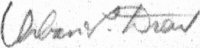 Maj Urban L Drew USAF Our estimated value of this signature : £40 Died : 2013 | Maj Urban L Drew USAF Urban 'Ben' Drew was born in Detroit, Michigan in 1924. Three months after the attack on Pearl Harbor, at the age of eighteen, Drew joined the USAAF and commenced pilot training. He earned his wings and a commission at Mariana, Florida in October 1943. He remained in the States honing his flying skills as an instructor pilot for the North American P-51 Mustang at Bartow, Florida. In May of 1944 he received his first overseas combat assignment, sailing to England on the Queen Elizabeth. He was assigned to the 375th Fighter Squadron 'Yellowjackets' of the 361st Fighter Group based in at Bottisham in Cambridgeshire. Later his squadron would be relocated to Little Walden in Essex. During his combat tour Drew would fly a total of seventy-five combat missions, rising to command of X Flight and later to command of the 375th squadron. Drew would be officially credited with six aerial victories during his combat tour. Notable was his downing of two Me-262 jets on October 7, 1944. He was the first fighter pilot to down two of the German jets, and he received the Air Force Cross for this achievement. Also of note was the ace's destruction of the largest aircraft to fly in WW 11, the BV-238, which he destroyed in a strafing pass with two wingman on Lake Schaal on September 18, 1944. Following his successful combat tour, Drew returned to the States where he again served as a flight instructor. In 1945 he was assigned to the 412 th Fighter Squadron of the 414 th Fighter Group based at lwo Jima flying the P-47 Jug. Drew's final victory tally included 6 confirmed aerial victories, 1 damaged, and 1 additional aircraft destroyed on the ground. In addition to the Air Force Cross, Drew was awarded two Distinguished Flying Crosses and 14 Air Medals. Following the War Drew helped organize the 127 th Fighter Group of the Michigan National Guard. He became Deputy Group Commander and later was appointed the first Air Adjutant General of the State of Michigan. After his retirement from the Air Force with the rank of Major, he established an aviation business in Britain and South Africa. He currently resides in Southern California, and remains active in matters involving the American Fighter Aces Association. Sadly we have learned that Ben Drew passed away on 3rd April 2013. |
  Lieutenant Colonel Clyde B East Our estimated value of this signature : £55 Died : 2014 | Lieutenant Colonel Clyde B East Born in Pittsylvania County, Virginia on July 19, 1921, raised on a rural family farm. At 19, Clyde East traveled to Hamilton, Ontario, Canada and enlisted into the Royal Canadian Air Force. Soon after, East was admitted to pilot training and completed his training in 1942. Clyde East went on active servcie to England, where he flew interdiction missions in the P-51A Mustang, attacking ground targets in France, Belgium, and Holland. He also searched for U-boats over the water. Clyde East flew P51 Mustangs with 414 Fighter / Reconnaissance Squadron RCAF in England, before transferring to the USAAF in January 1944. He joined the 15th Tactical Reconnaissance Squadron on 2nd February flying F-6C Mustangs. On June 6, 1944, East participated in the D-Day invasion of Normandy in the Mustang. It was during this mission that East and his wingman stumbled upon several FW-190s landing and promptly dispatched them with their .50 caliber machine guns, claiming the first aerial victories of the invasion. During one mission East claimed three aerial victories and, on another, was able to jump a German Messerschmitt 109 flying low. In late 1944, East fought against a German counteroffensive in what is now known as the Battle of the Bulge. Becoming a confirmed ace in March 1945, East would go on to claim a total of 13 aerial kills against the German Luftwaffe and flew over 200 combat missions with them during the war. He later served in Korea, flying 100 missions in RF-51s and RF-80s. After his return from Korea East was given command of several different tactical recon squadrons, one of which flew an additional 100 visual and photo missions over Cuba. He retired from the Air Force as a Lieutenant Colonel in February 1965. Clyde East died on 30th July 2014 aged 93. |
 Colonel Bill Edwards Our estimated value of this signature : £25 Died : 2009 | Colonel Bill Edwards Bill Edwards applied to the USAAF but was turned down because of two missing molars. He volunteered for the RAF in 1940, and was readily accepted and was shipped to Tulsa's Spartan School for RAF training. Upon graduation, he was sent to an OTU in England flying Hurricanes and Spitfires. He was assigned to the 133 Squadron, last of the famed 'Eagle Squadrons.' He flew convoy escort duty out of Northern Ireland and delivered all types of British aircraft to and from operational units. By September 1942, Lt. Edwards joined the USAAF along with most other Eagle Squadron pilots who wore the wings of both the RAF and USAAF. Assigned to the 8th Air Force Fighter Command, Bill's job was to ensure that newly arriving fighter units received first hand information on British navigating systems, aircraft, maps etc. As a Major, Bill commanded the first P-51 / P-38 OTU in England providing intensive flying in all combat and weather conditions. In June, 1944, Major Edwards was assigned with his Eagle Squadron friends to the Fourth Fighter Group flying P-51Ds escorting bombers on deep missions into Germany. During one escort mission to Munich, which bill was leading, Bill's Mustang was hit by German '88 flack' and downed near the French and German border. Bill spent the remainder of the war as a POW at Stalag Luft I, Barth, Germany until liberated in June 1945. Bill Edwards flew a total of 37 combat operations with 133 Squadron, the third Eagle Squadron to be formed. He retired from the USAF in 1968. Sadly Colonel Bill Edwards died on the 7th of August 2009. |
Warren Emerson Our estimated value of this signature : £25 | Warren Emerson P51 pilot who flew during the D-Day landings. 6 victories with the 354th Fighter Squadron, 355th Fighter Group. |
  Wing Commander Paul Farnes DFM Our estimated value of this signature : £55 Died : 2020 | Wing Commander Paul Farnes DFM Paul Farnes was born in Boscombe, Hampshire, July 16, 1918. He joined the RAFVR in April 1938 and is mobilized in July 1939 before being posted to 501 Squadron, 14 September 1939. He accompanied the Squadron when it was sent to France in May 1940, winning his first victories in the campaign of France and during the Battle of Britain. In October, he was awarded the DFM after eight victories and was promoted to officer the following month. In February 1941 he was transferred to 57 OTU as an instructor and then to 73 OTU in November, in Aden. In late February 1942, he was posted to 229 Squadron in North Africa as Flight Commander. On March 27, 1942, he flew to Malta with the rest of the Squadron aboard the Hurricane IIc BN122. After a period of intense and difficult battles in which defenders of the island will lose many fighters, during which he took command of the Squadron, he returned to Egypt with the survivors of his unit May 27, 1942. He then transferred to Iraq where he joined the Headquarters and remained there until March 1945. He then returned to Great Britain and three weeks after upgrading to the UTO 53, he took command of 124 Squadron, a position he held until the end of the war. He joined the Tangmere before making command of 611 Squadron equipped Mustang IV July 7, 1945. In August, the Squadron was disbanded and it supports the 164 Squadron with Spitfire IX. 63 Squadron was designated in August 1946. In January 1947, he became an officer of Liaison with training centres with the Air Ministry until October 1948. He then became an instructor in various centres. He continued his career in the RAF until 1958 and left active service with the rank of Wing Commander. He returned to his civilian career in the industry. He died on 28h January 2020. |
  Colonel Arthur C Fiedler Our estimated value of this signature : £55 Died : 2016 | Colonel Arthur C Fiedler Arthur Charles Fiedler was born in Oak Park, Illinois on August 1, 1923. In April of 1942, five months after America entered WW 11, Fiedler enlisted in the Army Air Corps. He was sent to Avon Park, Florida for primary training, followed by basic training at Macon, Georgia, and advanced training at Marianna, Florida. He graduated with Class 43G in July of 1943, and was assigned as a flight instructor, flying Republic P-47 Thunderbolts at Dover, Delaware. In April of 1944 Second Lieutenant Feidler was assigned to combat duty, and was assigned to the 317th Fighter Squadron of the 325th Fighter Group (the 'Checkertails'), based in Lesina, Italy. He transitioned to the North American P-51 Mustang, naming his assigned aircraft after his wife 'Helen' whom he had married in 1943. On June 24, Fiedler claimed a probable. On June 28 he attained his first two aerial victories. At that morning's briefing Fiedler was elated to learn that his squadron's mission would be a fighter sweep over Polesti, Rumania, in advance of a bombing mission targeting the massive oil refining operations in that area.. When flying fighter escort for bombers the fighters were prohibited from flying below 15,000-feet. This gave the Germans a dog fighting advantage, as the early Allison-powered Mustangs were good performers at low altitudes but relatively poor performers at higher altitudes. Forty P-5 Is from the 325th 17G took off at 0725 hours for the fighter sweep. Sweeping the target area at 25,000-29,000 feet for about 45 minutes a total of 47 enemy aircraft were encountered. During this mission Fiedler would earn his first two victories. Fiedler became an ace on July 26 when he downed his fourth and fifth aircraft, a Fw- 190, south of Vienna, and a 109 several minutes later. Promoted to Captain, Fiedler attained his eighth and final victory on January 20, 1945 while escorting B-17s to Regerisbuurg. His flight of four P-51s broke-up an attacking force of 40 German fighters. Following the War Fiedler left the military and attended the University of Illinois, earning a bachelor's degree in mechanical engineering. He was recalled for active duty during the Korean War, and decided to make a career in the Air Force. In addition to his 66 combat missions flown in WW 11, Fiedler would fly 247 combat missions in C-130s during the Vietnam War Col. Fiedler retired from the USAF in 1975, and currently resides in Southern California. His decorations include the Silver Star, the Legion of Merit, the Distinguished Flying Cross with one OLC, the Air Medal with 22 OLCs, and the Partisan Star. He died on 11th May 2016. |
 Captain John Fitch Our estimated value of this signature : £20 | Captain John Fitch Joining the Army Air Corps in 1941 he began his service flying the A-20 Havoc in North Africa. Volunteering for a second tour in 1944 he joined the 335th Fighter Squadron, 4th Fighter Group initially flying P-47s and on 18th November 1944 he shot down an Me262 over Germany. Transferring to P-51s he was shot down in March 1945 whilst strafing a train, and was taken prisoner. After the war he became a successful Grand Prix racing driver and an icon of the racing industry. |
Lieutenant Colonel William W Foard Our estimated value of this signature : £20 | Lieutenant Colonel William W Foard 27th February 1943 saw Bill Foard join the service and commence his pilot training, gaining his pilots wings, after which he was posted to the Eighth Air Force in England. Joining the 357th Fighter Group flying P51D Mustangs with the 364 Fighter Squadron based at Leiston in Suffolk, East Anglia, Bill flew his first combat mission on 21st February 1945. He took part in all of the Squadrons main escort raids and fighter actions during the final phase of the air war, until the end of hostilities. |
 Major General Wayne C Gatlin Our estimated value of this signature : £20 | Major General Wayne C Gatlin Wayne Gatlin flew with the 360th Fighter Squadron, 356th Fighter Group based at Martlesham Heath. From September 1944 he undertook 55 combat missions before the end of the war, six in P-47s and the rest in P-51Ds. On 10 April 1945 he destroyed an Me262 jet before immediately damaging another. |
 Major General Edward Giller Our estimated value of this signature : £25 | Major General Edward Giller Edward Giller flew P-51s with the 55th Fighter Group and commanded the 343rd Fighter Squadron. His P-51s were all named 'The Millie G' after his wife Mildred and his first Mustang is now a preserved and well known warbird. Flying 120 missions he scored 3 confirmed victories including an Me262 on 9th April 1945. |
Group Captain Ross H Glassop DFC* MID Our estimated value of this signature : £25 | Group Captain Ross H Glassop DFC* MID Joined the RAAF in March 1941 and trained in Australia. In November 1941, Sgt Glassop joined 22 Sqn and in January 1942 was posted to 24 Sqn based at Rabaul with Wirraways. He was en route to Townsville when 24 Sqn was decimated by the Japanese. Ross was attached to 76 Sqn at Townsville on 24th May and flew his first Kittyhawk that same day. Arriving at Milne Bay on 24th July, he shot down a Zero strafing No.1 strip on 24th August. Glassop participated in many successful strafing ops during the battle and remained with 76 until they withdrew to Australia on 22nd September. In March 1943 he was posted to 2 OTU as an instructor until November 1943. Ross joined 5 Sqn equipped with Boomerangs in June 1944 and in November moved to Bouganville until the end of the war. Flt Lt Ross Glassop was awarded the DFC in February 1945 and a bar and MID whilst serving in Korea flying Mustangs and Meteors with 77 Sqn RAAF. |
  Colonel Bob Goebel Our estimated value of this signature : £55 Died : 2011 | Colonel Bob Goebel December 1943 found Bob Goebel in North Africa flying Spitfires in preparation for joining the 31st Fighter Group. As soon as they arrived they re-equipped with P51 Mustangs and flew to Italy, where Bob flew a total of 62 combat missions, including 16 hazardous trips to the Romanian oilfields. During his combat operations he led his squadron into action seven times, and his entire Group twice, whilst still only aged 21. He ended the war with 11 air victories. Sadly, Bob Goebel passed away on 20th February 2011. |
  Lieutenant Colonel Jim Goodson Our estimated value of this signature : £60 Died : 2014 | Lieutenant Colonel Jim Goodson Jim Goodson joined the RAF in 1940. Posted to re-form 133 Eagle Squadron RAF flying Spitfires, he transferred to the USAAF 4th fighter Group in September 1942, commanding 336 Squadron. Flying P47s and then P51s, Jim Goodson flew continuously until he was shot down ten months before the end of the war. He was one of the most highly decorated Aces in the USAAF, with 32 enemy aircraft to his credit. He died on 1st May 2014. |
  Major Herky Green Our estimated value of this signature : £65 Died : 2006 | Major Herky Green 'Herky' Green arrived in North Africa in January 1943 flying with the 325th Fighter Group. During his first action his P40 was so riddled with tracer that it had to be scrapped - but he still managed to shoot down one of his attackers. Flying from North Africa, and later Italy, 'Herky' flew P40s, P47s and P51s, scoring victories in all three types. In March 1944 he took command of the 317th Fighter Squadron, flew over 100 missions, ending the war with 18 air victories. Herky Green died 16th August 2006. |
  Captian Clayton Gross Our estimated value of this signature : £50 Died : 2016 | Captian Clayton Gross Clayton Gross was one of 12 original pilots to fly with the 355th fighter Squadron, 354th Fighter Group. He first saw combat in 1943, and took part in the great D-Day air operations on 6th June 1944. He flew over 100 combat missions in two combat tours on P51s, was credited with 6 confirmed kills (including an Me262 jet), 14 damaged, multiple ground vehicles destroyed, including 8 locomotives. He survived one bail-out behind enemy lines, and flew continuously in the ETO until VE Day. Captain (Air Corps) Clayton Kelly Gross (ASN: 0-663512), United States Army Air Forces, was awarded the Silver Star for gallantry in action against the enemy as a P-51 Mustang Fighter Pilot of the 355th Fighter Squadron, 354th Fighter Group, NINTH Air Force, in action against the enemy in aerial combat in the European Theater of Operations during World War II. His gallant actions and dedicated devotion to duty, without regard for his own life, were in keeping with the highest traditions of military service and reflect great credit upon himself, his unit, and the United States Army Air Forces. Clayton Gross died on 10th January 2016. |
Second Lieutenant Elbert Hudson Our estimated value of this signature : £45 Died : 2014 | Second Lieutenant Elbert Hudson In September1942 Elbert Hudson joined up and went for pilot training at the Tuskegee Flight School, graduating as a fighter pilot on P51Bs. He soon found himself posted to the 332nd fighter Group in Europe, where he undertook his first of many combat missions in June 1944. Elbert flew with the 332nd escorting bombers on 23 combat missions in the Mediterranean theatre of operations right through until the end of hostilities in May 1945. After the war, he opened a private law practice in 1953 and over the course of his legal career represented many individuals, businesses and organizations in the Black community. He also mentored several young Black attorneys who worked in his office and who went on to become judges. In his later years, Al provided pro bono legal services to seniors at the Estelle Van Meter Multipurpose Center in South L.A. He was inducted into the Langston Bar Association Hall of Fame and was recognized as a Distinguished Alumnus by Loyola Law School. In 1961, Al was appointed to the Los Angeles Police Commission. He was serving on the Commission during the Watts Rebellion in 1965 and played an important role in working with the Police Department to improve police-community relations. During his tenure on the Commission, Al became its first Black President. Former Police Chief Bernard Parks remembered Hudson as a trailblazer and role model. |
  Colonel Arthur Jeffrey Our estimated value of this signature : £70 Died : 2015 | Colonel Arthur Jeffrey Colonel Arthur Jeffrey was born in Brewer, Arkansas on the 17th of November, 1919. Arthur Jeffrey enlisted in the Army on August 18th, 1939, and two years later in September, he entered aviation cadet training and graduated at Kelly Field, Texas in April of 1942. Jeffrey was assigned to the newly-formed 479th Fighter Group flying P-38s, and after a training period, his group was sent to England to become a part of the 8th Air Force. The year was 1944, and eleven days after arrival, the group began flying operational missions. Arthur Jeffrey became the top-scoring P-38 Ace with the 479th Fighter Group, and later became the Groups leading scorer after they converted to P-51s. Jeffrey was a captain in the 434th Fighter Squadron, and scored his first aerial victory over a Fw-200K heavy bomber downed over the Chateaubernard Airdrome near Cognac in July. Jeffrey went on to command the 434th Fighter Group. Arthur had the distinction of being the first pilot to shoot down the Luftwaffes jet-rocket aircraft - the Me163. He flew 82 combat missions and was credited with 14 aerial victories. Arthur Jeffrey ended his tour as a lieutenant colonel in command of the 434th Fighter Squadron, with a list of combat awards including the Silver Star, Distinguished Flying Cross with one Oak Leaf Cluster, and the Air Medal with 16 Oak Leaf Clusters. Arthur Jeffrey remained in the Air Force after the war and retired from the Air Force in September, 1968. Arthur Jeffrey died on 18th April 2015 aged 95. |
 Lieutenant Wayne G Johnson Our estimated value of this signature : £25 | Lieutenant Wayne G Johnson 23rd Fighter Group Flying Tigers pilot. Whitey Johnson enlisted in the Air Corps on 8th December 1941, the day after the Japanese attack on Pearl Harbor, and trained as a fighter pilot. After completing training he was posted to China to join the 23rd Fighter Group - The Flying Tigers - where he flew with the 188th Tactical Reconnaissance Squadron. He was one of the sixteen P-51 Mustang pilots who participated in the first strike against Japanese airfields near Shanghai, where they destroyed 97 planes on the ground without any losses. |
 Colonel Joseph H Joiner Our estimated value of this signature : £15 | Colonel Joseph H Joiner Completing pilot training in December 1943 he joined the 336th Fighter Squadron, 4th Fighter Group based at Debden flying P-51s. Following the unit's heavy losses he was made a Flight Commander after just 170 hours of combat flying and from May 1944 he completed 84 combat missions over Europe. One of the group's most respected pilots he led his squadron on 20 missions and the entire group on two. On his last mission in February 1945 he downed two Fw190s south of Nuremberg to finish the war with 3.5 aerial victories and 4.5 destroyed on the ground. |
 First Lieutenant Dale E Karger Our estimated value of this signature : £30 Died : 2008 | First Lieutenant Dale E Karger Born in 1925, Dale Karger joined the Army Reserves and was commissioned a 2nd Lt, and rated a pilot in February 1944. He transferred to the 357th Fighter Group on 18th September 1944, scoring his first two victories on 5th December, both against Fw190s north of Berlin, followed by his first Me109 on 24th December. On 20th January he achieved Ace status when he notched up an Me262 jet north of Munich. Dale finished his tour with a tally of 7.5 victories, and was the third youngest American fighter Ace of World War II. Sadly, he passed away on 5th October 2008. |
  Lieutenant Colonel Robert A Karr Our estimated value of this signature : £55 Died : 2015 | Lieutenant Colonel Robert A Karr Robert Karr was born on January 11, 1924, in Waterloo, Iowa. Robert enlisted in the U.S. Army Reserve on July 31, 1942, and entered the Aviation Cadet Program of the U.S. Army Air Forces on February 8, 1943, receiving his commission as a 2d Lt and pilot wings at Spence Field, Georgia, on November 3, 1943. After completing P-47 Thunderbolt training and serving with the 536th Fighter Squadron of the 87th Fighter Group, Lt Karr was assigned as a P-51C Mustang pilot with the 5th Fighter Squadron of the 52nd Fighter Group in North Africa and Italy from May 1944 to June 1945. Operating out of Madna Airfield in Italy, he got his first victory when he downed an Me109 near Udine on 9th June, adding two more a few weeks later. On 17th July, leading a flight of P51Ds, he shot down three more Me109s in a day near Blata, Poland. A P51 Ace with 6 victories plus 2 more damaged in the air to his credit, he retired from the service in 1976. |
 Lieutenant Colonel Huie Lamb Our estimated value of this signature : £30 | Lieutenant Colonel Huie Lamb Flying P-47s out of Duxford with the 82nd Fighter Squadron, 78th Fighter Group, he shot down an Me262 on 15th October 1944, one of the few P-47 pilots to achieve a jet victory. After converting to P51s he became one of an elite few by shooting down a second jet when he shared in the destruction of an Arado Ar234 blitz-bomber on 19th March 1945. |
  Colonel Maurice Long Our estimated value of this signature : £50 Died : 2008 | Colonel Maurice Long Maurice Long arrived in England in 1943, assigned to the 355th Fighter Squadron, 354th Fighter Group. Flying the P51B Mustang he served as a Flight Commander, operations Officer and Squadron Commander, achieving 8 and a half victories. In the ETO he took part in the vital D-Day missions over Normandy, later moving with the Squadron to French soil. In a long career he took part in 140 combat missions flying P51s in the ETO, and later F84s in Korea. Sadly, we have learned that Maurice Long passed away on 31st March 2008. |
Captain Harvey Mace Our estimated value of this signature : £25 | Captain Harvey Mace Harvey Mace arrived in England at the end of 1943 to join the 357th Fighter Group who were then stationed at Raydon.He flew all his 59 combat missions in P51 Mustangs with the 362nd Fighter Squadron, notching up three victories over Me109s along the way. Flying primarily on B17 bomber escort missions, Harvey went to nearly all the major strategic bombing targets in Europe, including the Shuttle missions from England to Russia, Italy and back again.Towards the end of his tour he was appointed Squadron Operations Officer, and then assigned as Fighter Controller of the 3rd Bomb Group. |
  Colonel Walker Bud Mahurin Our estimated value of this signature : £70 Died : 2010 | Colonel Walker Bud Mahurin Walker Melville 'Bud' Mahurin was born in Ann Arbor, Michigan on 5th December 1918. He joined the Army reserves on 29th September 1941 and entered flight training, being commissioned as a pilot on the 29th of April 1942 at Ellington Field Texas. 'Bud' Mahurin gained a reputation as one of the USAAF's most colourful fighter Aces. Arriving in the European theatre, flying with the 56th Fighter Group at Boxted, England, on the 17th of August the 56th Fighter group flew escort for the Eighth Air Force Bombers whose mission was to bomb Schweinfurt and Regensburg. They encountered a large force of German fighters and Bud Mahurin shot down two Fw190s. He went on to become an Ace on the 4th of October, and by the end of November he had achieved 10 kills. Bud Mahurin was promoted to Major on the 21st of March 1944. On the 27th of March he shared a victory of a Do217 but was hit by the bomber and was forced to bail out of his Thunderbolt, when his aircraft was set ablaze by the gunfire. Mahurin evaded the Germans with help of the French resistance and returned to Britian. He had by this time shot down 20 German aircraft. He then transferred to the south west Pacific Commanding the 3rd Air Commando Squadron where he added a Japanese aircraft to his score, shooting down a KI-46 Dinah, making hinm one of very few American pilots to shoot down German and Japanese aircraft. Mahurin saw combat from New Guinea to Okinawa. After this tour he returned to the US and was promoted to Lieutenant-Colonel. After the war he spent two tours at the Pentagon and went on to obtain an aeronautical engineering degree. During the Korean War 'Bud' Mahurin commanded the 4th Fighter Interceptor Group in Korea where he added 3.5 MiG-15s to his tally before being shot down in his Sabre. He was shot down by ground fire on the 13th of May 1952, and bailed out for the last time, to spend a gruelling sixteen months as a POW in North Korea undergoing extensive torture. Mahurin returned to the US and stayed in the USAF until 1956 when he worked for the aerospace industry. Sadly, Bud Mahurin passed away on 11th May 2010. |
 Colonel Charles McGee Our estimated value of this signature : £55 Died : 2022 | Colonel Charles McGee Charles McGee graduated from flight school and shipped out to Italy in December 1943 as a flight Lieutenant in the 302nd fighter Squadron, 332nd Fighter Group. He flew missions in North Africa, Italy and Germany, and got his first victory on 24th August flying escort in the Ploesti oil field raid. After the war this outstanding flyer commanded fighter squadrons throughout the United States, Italy, the Philippines and Germany, logging up more than 6,100 hours in 409 combat missions spanning World War II, Korea and Vietnam. Serving in the armed forces for 30 years he holds the record of flying more combat missions than any other USAF pilot in history. Born in Cleveland, Ohio in 1919, Charles MeGee, who was to become a Command Aviator who would fly combat missions in three different military conflicts, spent his childhood in Ohio, Illinois, and Iowa. Following two years attending the University of Illinois, WW 11 began, and McGee was sworn into the US Army enlisted reserves on October 26, 1942. He was accepted for pilot training in November and entered the Army Air Corps Aviation Cadet Training Program. McGee earned his wings and was commissioned as a Second Lieutenant in June 1943, as a member of Class 43-F at Tuskegee Army Air Field. He was assigned along with many of the other black pilots who had earned their wings at Tuskegee to the 332 nd Fighter Group in Italy. With the 302nd Fighter Squadron McGee trained in the P-40 and would later fly more than 82 tactical missions in the P-39. His fighter group was then transferred into the Fifteenth Air Force and he first flew the P-47 and several weeks later the P-51 Mustang. In this duty, along with other 'Tuskegee Airmen,' McGee performed admirably surmounting many of the unfortunate hurdles placed in their path. The Tuskegee Ainnen became known for their superlative effort at protecting allied bombers from attacking German fighters. McGee is credited with downing one Fw- 190, and the destruction or damage of many others on the ground. He became a flight leader, was promoted to Captain, and after flying 54 more combat missions, returned to Alabama as a twin engine flight instructor. In 1950 McGee flew 100 more combat missions with the 67th Fighter Bomber Squadron of the 18th Fighter Group. He was then made Commander of the 44th Bomber Squadron flying out of Clark Field in the Philippines. Later he would serve with an F-89 Interceptor Squadron, and following a number of interesting operational and staff assignments he would serve as Commander of the 16th Tactical Reconnaissance Squadron deployed in Vietnam. In his year in Vietnam, McGee would fly another 173 missions. Later assignments included Air Liason Officer for USAEUR and 7th Army, Chief of Maintenance for the 50th Tactical Fighter Wing, Director of Maintenance Engineering for AF Communication Service, and Commander of Richards-Gebaur AFB, and the 1840 Air Base Wing. He retired from the USAF in 1973 with 6,300 flying hours, including 1,100 hours flown on fighter combat missions. Col. McGee earned a BA Degree in Business Administration and worked for many years in the real estate business with ISC Financial Corporation. He also served as Director of Administration forthe city of Prairie Village, Kanasas, and as Manager of the downtown Kansas City Airport. Now fully retired Charles lives with his wife, the former Frances Nelson of Champaign, Illinois. The McGees have three children, ten grandchildren, and five great grandchildren. His numerous decorations include the Legion of Merit with one cluster, the Distinguished Flying Cross with two clusters, the Bronze Star, the Air Medal with 25 clusters, the Army Commendation Medal, the Air Force Commendation Medal with one cluster, a Presidential Unit Citation, and the Korean Presidential Unit Citation, to name only a few. He died 16th January 2022. |
 Major James McLane Our estimated value of this signature : £25 Died : 2012 | Major James McLane Flew P-51 Mustangs with the 357th Fighter Group. James C. McLane Jr. left Clemson College in 1943 to join the Army Air Corp. He graduated in Class 44B at Marianna, Florida, being commissioned a 2nd Lt. Rated Pilot. He instructed Advanced Single Engine student pilots for two classes, and then at Punta Gorda in the Fighter Pilot Replacement Unit he received 6 months training in P-40 aircraft. Early in 1945 McLane was assigned to fly P-51s with the famed 357th fighter group, the 'Yoxford Boys' stationed in Leiston England. He was placed in the 362nd fighter squadron led by 3 times ace Leonard K. 'Kit' Carson. Initially he flew borrowed aircraft, but then was assigned G4-V, tail number 414798. This plane had seen lots of action, first as Master Mike and later as Butch Baby, the mount of Col. Joseph Broadhead and Lt. Julian H. Bertram respectively. The P-51 was stripped of paint and re-identified on the nose as Dainty Dotty in honor of his wife Dorothy. McLane flew bomber escort and experienced a memorable mission as Carson's wingman hunting for ME-262's. After the war, he flew C-123 and C-130 aircraft in the Air Force Reserves, retiring as a Major. He died on 7th November 2012. |
 Sqn Ldr Jurek Mencel DFC, KM*** AFM*** Our estimated value of this signature : £40 | Sqn Ldr Jurek Mencel DFC, KM*** AFM*** Flying with the French Air Force he fought in the Battle of France but was hospitalised after breaking his back in a crash in mid-1940. Returning to operations with 317 Polish Sqn, his first mission was on Spitfires escorting the RAF Bombers taking part in the engagement that lead to the German 'Channel Dash'. He flew Spitfires throughout the Normandy Invasion also flying Hurricanes and Mustangs with 308 and 309 Sqn's scoring victories against Me109's and Me108's and on the 9th April 1945 he shot down an Me262 Jet over Hamburg. |
 Lieutenant Colonel Don Nee Our estimated value of this signature : £25 | Lieutenant Colonel Don Nee Don Nee flew Spitfires with 152 and 64 Squadrons RAF before being unified with other Americans into the first Eagle Squadron, No.71. He transferred to the 4th Fighter Group's 336th Fighter Squadron in September 1942 and flew 119 missions in P-47s and P-51s, becoming a flight commander. |
  Wing Commander Tom Neil DFC* AFC Our estimated value of this signature : £50 Died : 2018 | Wing Commander Tom Neil DFC* AFC Tom Neil was born on 14th July 1920 in Bootle, Lancashire. Tom Neil (also to become known in the RAF as 'Ginger') joined the RAFVR in October 1938 and began his flying training at 17 E and RFTS, Barton, Manchester. Tom Neil was called up on the 2nd os September 1939 being sent to 4 ITW, Bexhill in early November. On 1st December 1939, he was posted to 8 FTS and on completion of the course he was commissioned and posted to 249 Squadron in May 1940 flying Hurricanes just before the start of the Battle of Britain flying from North Weald. On 7th September 1940, Tom Neil encountered and claimed a Bf109 destroyed. On the 11th an He111, on the 15th two Bf109s and a Do17 destroyed and another Do17 shared, on the 18th an He111 damaged and on the 27th a Bf110 and a Ju88 destroyed, a Bf110 probably destroyed and a Ju88 shared. On 6th October Tom Neil shared a Do17, on the 25th claimed a Bf109 destroyed, on the 27th a Do17 probably destroyed, on the 28th a Ju88 shared and on 7th November a Ju87 and two Bf109s destroyed. He was awarded a DFC on 8 October, but on 7 November, after claiming 3 victories over the North Sea off the Essex coast, he collided in mid-air with Wing Commander Francis Beamish and his aircraft lost its tail. He baled out of his Hurricane unhurt, Beamish force-landing unscathed. Tom received a Bar to his DFC on 26 November, and on 13 December was promoted flight Commander. The squadron was posted to Malta in May 1941, flying off HMS Ark Royal on the 21st. During a summer of frequent scrambles, he claimed one further victory in June, while on 7th October he led a fighter-bomber attack on Gela station, Sicily. He departed the island in December 1941, returning to the UK via the Middle East, South and West Africa, and Canada, finally arriving in March 1942, when he became tactics officer with 81 Group. A spell as an instructor at 56 OTU, before being posted as a flying liaison officer with the 100th Fighter Wing of the US 9th Air Force in January 1944. He managed to get some flying in over France with this unit, claiming a share in 6 aircraft destroyed on the ground before D-Day, and a dozen or so more later, plus a number of other ground targets. In January 1945 he was sent to the school of Land/Air Warfare as an instructor. In March 1945 he was posted out to Burma, where he undertook some operations with 1 Wing, Indian Air Force, to gain experience of the operations in this area. Returning to the UK in April, he resumed instructing at the school until the end of the year. In January 1946 he attended the Empire Test Pilots School, undertaking No.4 short course and No.5 course, a total of 18 months. Posted briefly to Farnborough, he sought a move to Boscombe Down, where he stayed for some 3 years. In 1948 in went to Wright-Patterson AFB, Dayton, Ohio, to take part in the first high altitude pressure suit experiments, as a precursor to the aerospace programme. 1950-51 he was a staff officer at HQ, Fighter Command, while in 1952 he attended the staff college at Bracknell. He was then given command of 208 Squadron in Egypt, which he led until 1956, leaving just before the Suez operation. He returned to the UK to become W/Cdr Operations, Metropolitan sector, until 1958, when he attended the flying college at Manby. He went to the British Embassy in Washington for 3 years from 1959, returning to the Ministry of Defence but retiring from the service as a Wing Commander in 1964. Meanwhile he had added the US Bronze Star to his decorations in august 1947, and an AFC in January 1956. Tom Neil died on 11th July 2018. |
  Captain William Bee OBrien Our estimated value of this signature : £55 Died : 2006 | Captain William Bee OBrien William O'Brien was born in Tulsa, Oklahoma. His father Terence O'Brien was an oil-field worker, and his mother, Agnes, was a nurse. Obee O'Brien graduated from Oklahoma Military Academy and trained as a pilot before joining the U.S. Army Air Corps service in 1942. He took flight training at Luke Field in Phoenix and in Nevada before arriving in England in late 1943. Willaim OBee O'Brien flew P-51 Mustangs with the 357th Fighter Group, scoring his first enemy plane on March 6th, 1944, during a bomber escort mission to Berlin. He flew 77 combat missions, most with the 363rd Fighter Squadron, and became an Ace, with 5 victories. During his service with the 357th Fighter Group's 363th Fighter Squadron of the 8th US Air Force, O'Brien also earned eight Air Medals, including Distinguished Flying Crosses and the French Croix de Guerre. The French decoration was a unit citation bestowed in recognition of the role of the 357th Fighter Group in the liberation of France. After the war, O'Brien earned bachelors and masters degrees at the University of Tulsa, becoming a geophysicist for Stabdard Oil Company. Sadly Captain William Bee O'Brien died on Sunday 5th March 2006 of heart problems. He was 84. |
  Colonel Charles Older Our estimated value of this signature : £70 Died : 2006 | Colonel Charles Older Charles Herman Older, born on 29 September 1917 in Hanford, California, graduated from the University of California in 1939 with a degree in political science. No the 1st April 1940 Charles Herman Older joined the Marine Corps for flight training, he received his wings and commission at Pensacola. Resigning from the Marine Corps in 1941 to join the A.V.G., Chuck Older took part in the great 'Christmas' air battles over Rangoon shooting down 5 Japanese aircraft. With 10.25 victories to his credit he joined the 23rd F G when the A.V.G. was disbanded, flying P-51s. He led the first strike against Shanghai resulting in the destruction of 77 Japanese aircraft. He completed the war with 18.25 air victories. After leaving the Air Force Colonel Chuck Older obtained a law degree from the University of Southern California and subsequently became a superior court judge in Los Angeles, California. He gained prominence as the presiding judge in the Charles Manson mass murder trial in 1970-71. Charles Older died on the 17th June 2006. |
  Brigadier General Robin Olds Our estimated value of this signature : £60 Died : 2007 | Brigadier General Robin Olds After leaving West Point in June 1943, Robin Olds was posted to the 479th Fighter Group in England, joining 434 Squadron. Based at Wattisham in East Anglia, and flying P-38s, he was involved in heavy bomber escort duties and fighter sweeps until the Normandy invasion, soon after which his Squadron converted to P51 Mustangs. by early 1945 Robin Olds was in command of 434 Squadron taking part in the Battle of the Bulge, flying escort missions, and providing air support to the airborne attack across the Rhine. At the end of World War II Robin Olds had 24.5 victories, of which 13 were in the air. Later in Vietnam Robin Olds gained four more victories, flying F4 Phantoms and flew with the 8th Tactical Fighter Wing. Sadly, Robin Olds passed away on 14th June 2007. |
  Captain William B. Overstreet Our estimated value of this signature : £45 Died : 2013 | Captain William B. Overstreet Posted to England in November 1943 to join the 363rd fighter Squadron, 357th Fighter Group at Leiston Bill Overstreet flew his P51 combat mission on 12th February 1944. He commanded nearly 50 combat missions during his tour with the 357th FS, taking part in escorting the big raids to Berlin, Frankfurt, Leipzeig and many other city targets as well as participating in escort missions to Russia from Italy. Shot down once he managed to escape to freedom after two days capacity. Returning stateside in October 1944. He died on 29th December 2013. |
 Flt Lt Joseph Peterburs Our estimated value of this signature : £45 | Flt Lt Joseph Peterburs Joe Peterburs enlisted in the US Army Air Corps on the 30th of November, 1942 and was called to active duty as an Aviation Cadet on 26th January, 1943. On 15th April, 1944 after a rigorous flying training program, he received his pilots wings and commission as a 2nd Lieutenant. After graduation he flew the P-40N and A-24 during combat replacement training. On 6th November, 1944 Lt. Peterburs arrived in England and was assigned to the 55th Fighter Squadron of the 20th Fighter Group. He was 19 years old. The unit was equipped with the P-51 Mustang fighter aircraft and he quickly checked out in a P-51B and accumulated about 20 hours in the B, C and D models before flying combat. He flew many memorable missions, the 49th and last of which was the most exciting. On this mission, 10 April, 1945, Joe Peterburs shot down German Ace Walter Schuck in his Me262 turbo jet. Later that day Joe Peterburs was also shot down by enemy ground fire while strafing an airfield. He was captured, escaped and fought with a Russian tank unit to the battle of Wittenberg on the Elbe. |
  Major Richard Bud Peterson Our estimated value of this signature : £55 Died : 2000 | Major Richard Bud Peterson Bud Peterson was born in Hancock in 1923 and attended the University of Minnesota before joining the Army Reserve. He went through the cadet program and became a second lieutenant. He was sent to Europe to join the 357th Fighter Group. He scored his first victory in March 1944, bringing down an Fw190 in his P-51 Mustang. He eventually became the top scorer in 364th Fighter Squadron, with a final tally of 15.5 victories, and was the 10th Ace of the 357th Fighter Group. All his victories were scored in the P-51 Mustang, and he also scored 3.5 ground victories, and has the distinction of scoring victories over every piston-engined Luftwaffe aircraft flown in WWII. Peterson flew 150 missions over Europe. Major Richard Bud Peterson became a major at age 21, at the time the youngest person to achieve that rank in the Army Air Force. He would later be awarded the Air Medal, the Silver Star and the Distinguished Flying Cross. Major Richard Bud Peterson also received the Croix de Guerre, one of France's highest honors for bravery. After the war he was selected as a staff officer to interview Adolf Galland, commander of the German Air Force fighter forces, on aerial combat tactics and strategy. He later pursued his architecture career and worked for such companies as Cerny Associates Inc. before co-founding Peterson, Clark & Griffith, Architects, in 1960. He was involved in the construction of many Twin Cities buildings and the Minnesota Zoo. Bud Peterson, died Sunday 4th of June 2000 of cancer at a Walker Methodist home in Minneapolis. He was 77. |
 Captain Ronald M Phillips Our estimated value of this signature : £25 | Captain Ronald M Phillips 23rd Fighter Group Flying Tigers pilot. Ron Philips was drafted a few months after Pearl Harbor, graduated from the Airplane and Engine School in Glendale, Caligornia and began training as a pilot. Commissioned in 1943 he was posted to the 23rd Fighter Group - The Flying Tigers - and part of the 14th Air Force. Arriving in Kweilin in the summer of 1944 he flew with the 118th Tactical Reconnaissance Squadron - the Black Lightnings - the fourth squadron of the 23rd Fighter Group, equipped with P-51 Mustangs. |
  Colonel Steve Pisanos Our estimated value of this signature : £45 Died : 2016 | Colonel Steve Pisanos Born Nov. 10, 1919, in the Athens suburb of Kolonos, Spiros Nicholas 'Steve' Pisanos, the son of a subway motorman, arrived in America in April 1938 as a crew member on a Greek merchant tramp steamer. Arriving in Baltimore speaking no English, he worked in a bakery and hotels to earn money for flying lessons at Floyd Bennett Field. In August 1940, he settled in Plainfield, New Jersey, and continued flying lessons at Westfield Airport. He earned a private pilot's license and, though still a Greek national, in October 1941 he joined the British Royal Air Force sponsored by the Clayton Knight Committee in New York City. Pisanos began his military flight training at Polaris Flight Academy in Glendale. Upon graduation, Pilot Officer Pisanos was transferred to England where he completed RAF Officers Training School at Cosford, England, and OTU (Operational Training Unit) at Old Sarum Aerodrome in Salisbury. Pisanos was posted to the 268 Fighter Squadron at Snailwell Aerodrome in Newmarket flying P-51A's. He later transferred to the 71 Eagle Squadron, one of three Eagle squadrons in the RAF, comprised of just 244 American volunteers flying Spitfires at Debden RAF Aerodrome. When the USAAF 4th Fighter Group absorbed the American members of the Eagle Squadrons in September and October 1942, Pisanos was commissioned a lieutenant in the U.S. Army Air Forces. Flying his first mission in his P-47 'Miss Plainfield' out of Debden Aerodrome with the 334th Fighter Squadron, 4th Fighter Group, Lt. Pisanos, 'The Flying Greek,' scored his first shootdown on May 21, 1943, when he targeted a German FW-190 over Ghent, Belgium. By Jan. 1, 1944, he had become an ace with five confirmed downings. On March 5, 1944, he obtained his 10th shootdown and while returning from that B-17 escort mission to Limoges and Bordeaux, France, Pisanos experienced engine failure in his P-51B and crash-landed south of Le Havre. For six months he evaded the Germans and fought with the French Resistance and the American OSS, sabotaging the German war machine in occupied France. Lt. Pisanos returned to England on Sept. 2, 1944, following the liberation of Paris. Because of his exposure and knowledge of the French Resistance operations, Pisanos was prohibited from flying additional combat missions because the Air Force could not risk him being captured. Upon returning to the United States, Capt. Pisanos was assigned to the Flight Test Division at Wright Field, Ohio. He attended the USAF Test Pilot School and served as a test pilot at Wright Field and Muroc Lake, California, testing the YP-80 jet aircraft, America's first operational jet. During his Air Force career, Pisanos graduated from the University of Maryland, attended the Air Command and Staff College and the Air War College. Pisanos also served tours of duty in Vietnam (1967-68) and with NORAD before retiring from the USAF with the rank of colonel in in December 1973. Colonel Steve Pisanos died on 6th June 2016. |
Colonel Royce W Priest Our estimated value of this signature : £40 | Colonel Royce W Priest 'Deacon' Priest arrived in England in May 1944, assigned to the 355th Fighter Group. Flying the P-51, combat missions comprised long-range escort, and intensive low-level ground attack. In August he landed behind the lines to pick up his C.O. downed by Ack-Ack fire. Within 6 months of his arrival in Europe he became an Ace, taking his fifth Luftwaffe fighter. |
Colonel Arval J. Roberson Our estimated value of this signature : £35 Died : 2007 | Colonel Arval J. Roberson Joining the Army Reserves in 1942, 'Robby' Roberson was commissioned and rated a pilot in May 1943. Transferring to the 362nd Fighter Squadron, 357th Fighter Group, he flew 76 combat missions on P51s, sharing his first victory against an Me110 over Berlin on 6th March 1944. He became an Ace on 19th September, and scored his 6th and final air victory at the same time. During the Korean War he flew an additional 100 combat hours with the 18th FBG, and in Vietnam managed to get in 26 support missions on C47s. He retired in 1973. Arval Roberson passed away on 7th December 2007. |
Pilot Officer Stefan Ryll Our estimated value of this signature : £35 | Pilot Officer Stefan Ryll Stefan Ryll went into operations with 306 Squadron flying both Hurricanes and Spitfires, and took part in the last raid of the war flying a P-51 Mustang on escort for the bombers flying to Berchtesgaden. |
Colonel Wilbur R Scheible Our estimated value of this signature : £40 | Colonel Wilbur R Scheible After joining the USAAF in 1941, Wilbur completed flight training in 1942. Assigned to the 361st Fighter Squadron, 356th Fighter Group based at Martlesham Heath, England, he flew P47s and P-51s, primarily engaged in bomber escort work. During his combat career he had single, double, and triple air victories, ending his war an Ace with 6 air victories. |
Lieutenant Colonel Robert G. Schimanski Our estimated value of this signature : £35 | Lieutenant Colonel Robert G. Schimanski Born in Spokane, Washington in 1920, Bob Schimanski graduated as a fighter pilot, and was posted to join the 364th Fighter Squadron, 357th Fighter Group in England. During his tour of duty on P51s at Leiston, he flew 70 combat missions, getting on the score sheet with the first of his victories on 13th September 1944. He became an Ace on 2 Match 1945 when he downed a Me109 south of Magdeburg. By the end of his tour had achieved 6 air victories, all but one against Me109s, plus a further two on the ground. |
Colonel Duerr J Schuh Our estimated value of this signature : £45 | Colonel Duerr J Schuh Duerr Schuh flew his first combat mission in July 1944. Flying 61 missions in the P-51 with the 352nd Fighter Group, he took part in the Battle of the Bulge. The day following Christmas, 1944, while covering a bombing run, he jumped a group of Me109s, shooting down three in a single action. He ended the war an Ace. |
  First Lieutenant John Skara Our estimated value of this signature : £40 | First Lieutenant John Skara John Skara joined the service in June 1942. After training he was posted to England to join the 357th Fighter Group at Leiston in Suffolk, flying both the P51B and later the P51D. He undertook his first combat mission in March 1944, and took part in the long and hazardous escort missions both to Russia, and to Italy. For most of his combat tour he flew as wingman to Bud Anderson |
 Colonel Robert T Smith Our estimated value of this signature : £55 Died : 1995 | Colonel Robert T Smith R T Smith was a flight instructor in the US Army Air Corps when he resigned his commission in July 1941 to join the AVG. Flying first as a wingman and then as a Flight Leader he took part in the great air battles over Rangoon on 23rd and 25th December 1941, and was credited with 8.66 air victories with the Flying Tigers. Recommissioned into the USAAF he flew a further combat tour in P-51s and commanded a squadron of B-52s. After the war he became Vice-President of the Flying Tigers Line in the Far East. Robert T Smith passed away on 21st August 1995. |
 Second Lieutenant Lowell Steward Our estimated value of this signature : £30 Died : 2014 | Second Lieutenant Lowell Steward Entering the Tuskegee flight school for training in July 1942, Lowell Steward graduated as a fighter and was sent to Italy in 1944 with the 100th Fighter Squadron, 332nd Fighter Group. From Capodichino Air Base in Naples he flew a number of missions in Bell P-39 Airacobras and Curtiss P-40 Warhawks. He was subsequently based in Ramitelli Airfield where he flew many more missions in North American P-51 Mustangs. In total, he flew 143 missions and remained in the service until July 1946. After the war and upon his return to Los Angeles, he helped to organize the Los Angeles chapter of Tuskegee Airmen, Inc. and to found a scholarship foundation in the name of the Tuskegee Airmen. In 2007, Steward attended President George W. Bush's presentation of the Tuskegee Airmen with the Congressional Gold Medal. On December 14 2014 Lowell came down with a cold that led to pneumonia and sadly died on December 17th in the Community Memorial Hospital of natural causes at the age of 95. |
  Major General Donald Strait Our estimated value of this signature : £55 Died : 2015 | Major General Donald Strait Don Strait was born on April 28th, 1918 and grew up in Verona, New Jersey. From an early age Don Strait wanted to be a pilot, and after working for Prudential Insurance Company for a short period Don Strait enlisted in 1940 in the 119th Observation Squadron of the New Jersey National Guard. Initially Don Strait was an armorer and moved up to become an aerial gunner in the two-seater O-46 and O-47 observation planes. He qualified as an aviation cadet in early 1942 and started his training at Maxwell Field, Alabama. After Basic and in January 1943 Strait received his wings and his commission. Don Strait got his ambition to become a fighter pilot, he began flying the P-47 Thunderbolt at Westover Field, MA. After checking out in the P-47 and completing transition training he was assigned to the 356th Fighter Group, then at Bradley Field, CT. By August, 1943 Don Strait had been promoted to Captain before being transferred to England. Captain Don Strait with the 356th Fighter Group went to Martlesham Heath in England flying first the P-47 Thunderbolt. Martlesham Heath was just five miles from the North Sea, which made it relatively easy to find when returning from a mission in bad weather. The 356th made its first combat sorties in October, 1943, with sweeps over Holland and northern France; sightings of Luftwaffe planes were quite rare, and the group took over a month to score its first aerial victory. Strait's first combat occurred on February 6th, 1944, when his flight bounced a pair of Fw190s while on an escort mission. He immediately attacked. The 190s split apart and he chased one down to the deck. He scored hits on it and the pilot bailed out - Strait's first kill. But he and his wingman had used too much fuel, and barely made it back to base. He shot down a couple more Bf109s while flying Thunderbolts on February 10th and May 19th. Having completed well over 200 combat hours, he was entitled to rotate home, but agreed to continue front-line flying, provided that he was given command of the 361st Fighter Squadron. He took a 30-day leave and returned to Europe in September, 1944. He and Captain George May, the intelligence officer, reviewed daily sightings and disposition of the Luftwaffe, which helped him plan and lead the squadron's missions. Don Strait took part in long range bomber escort and ground support missions, taking part in all the D-Day operations, before converting to P51s. The group flew their first Mustang mission on November 20, the same day that Strait assumed command of the 361st FS. In two combat tours he flew a total of 122 missions. He led the squadron again on November 26, 1944, when it flew an escort mission over the heavily defended Ruhr. After linking up with the B-17s just east of Holland, the pilots were advised of 40 bandits approaching from the south. As Strait's sixteen Mustangs arrived in the Osnabruck area, they spotted the 40 Bf109s at 25,000 feet. They dropped tanks and attacked. Then Strait spotted about another 150 German fighters at various altitudes, preparing to attack the bombers. 'We've got the whole damn Luftwaffe!' he radioed. He closed to within 350 yards of an enemy airplane and fired - it dived away smoking. Strait's wingman saw it crash. Strait soon bounced another 109, but it eluded him. He spotted a third and closed to within 300 yards, and exploded it (a shared kill with Lt. Shelby Jett). After this dogfighting, fuel began to be a concern, so they headed home. That day the 356th FG destroyed 23 enemy aircraft without losing a single American. After two more victories on December 5th, Strait found more air combat on Christmas Day. In action again against Bf109s, he had a nasty moment when his first victim left oil and engine coolant all over his windscreen. Skidding away, Strait almost rammed his foe. He continued shooting down German planes in 1945 - an Fw190 on Jan. 14th, another Fw190 on Feb 14th, and three Fiesler Storch light observation planes on Feb 20th. Don Strait commanded the 361st Fighter Squadron, and became the Group's leading fighter Ace with 13 and a half air victories, all but three of these flying the P51. After the war he rejoined the NJ Air National Guard. He later commanded the 108th Tactical Wing in Korea, where he flew the F86, F84, and F105 jet. Participated in the Cuban Missile Crisis, and Vietnam. He retired from the Air Force in 1978 with the rank of Major General, and was inducted into the New Jersey Aviation Hall of Fame in 1989. Donald Strait died on 30th March 2015. |
 Captain Charles E Weaver Our estimated value of this signature : £35 Died : 2008 | Captain Charles E Weaver American WW2 pilot with eight victories, including : 19th Sep 1944, an Me109; 17th Nov 1944, 2 Fw190s; 23rd Dec 1944, an Me109; 14th January 1945, an Me109 and an Fw190; 24th Mar 1945, an Me109; 18th Apr 1945, an Me262. He died 19th November 2008. |
First Lieutenant Clint White Our estimated value of this signature : £25 | First Lieutenant Clint White Clint white joined up in November 1942 and after training as a pilot, was posted over to Europe, joining the 15th Air Force in the Mediterranean flying P-51s with the 309th FS, 31st Fighter Group. The 15th Air Force was engaged in the strategic offensive against targets in Italy, Germany, and Eastern Europe. Clint flew his first combat mission in February 1944, and soon got into the action, including being jumped by two Me262 jets as he flew escort to bombers heading to Berlin and back. |
  Captain Robert P Winks Our estimated value of this signature : £45 Died : 2008 | Captain Robert P Winks Robert Winks joined the service in 1943, and after training was posted to England. Flying his first combat mission in July 1944, he served with the 364th Fighter Squadron, 357th Fighter Group. His year long tour in Europe took in the heavy fighting over the Battle of the Bulge, the missions to support the Arnhem operations, and the Battle of Berlin, when the 357th destroyed 56 enemy aircraft. During this time he flew some 69 combat missions. His personal P-51D was 'Trusty Rusty'. His victories included an Me262 jet fighter claimed on 15th January 1945. Sadly, he died on 19th May 2008. |
  Brigadier General Charles E Yeager Our estimated value of this signature : £80 Died : 2020 | Brigadier General Charles E Yeager Born February 13th 1923. He enlisted as a private in the United States Army. Chalres Yaeger became a aircraft mechanic at George Air Force Base in California. Yaeger showed a talent as a pilot and became a Flight Officer on March 10th 1943 and joined the 357th Fighter Group. He trained on the P-39 Airocobras and in November 1943 went to Britain with his Squadron. He was stationed at RAF Leiston and flew P 51 Mustangs, his aircraft being Glamoras Glen. His first air victory was on March 5th 1944 but he was shot down over France. With the help of the French Resistance he escaped through Spain and back to the UK. Chalres Yaeger was the first pilot in his group to become an ace in a day, by shooting down a total of 5 enemy aircraft in a single mission. In his total of 11.5 victories was one of the first Me262 jet fighter kills, claimed on 6th November 1944. After the war In 1947 at the age of only 24 Charles Yaeger became the first Pilot to travel faster than sound in level flight in the experimental Bell X-1 at 45,000 feet. In his career Yaeger commanded fighter squadrons in Germany and during the Vietnam war, being promoted to the rank of Bragadier General in 1969. He died on 7th December 2020. |
| Mustang Squadron details |
332nd Fighter Group Country : US | 332nd Fighter Group |
353rd Fighter Group Country : US Known Codes : , SX, | 353rd Fighter Group |
354th Fighter Group Country : US | 354th Fighter Group |
356th Fighter Group Country : US | 356th Fighter Group |
357th Fighter Group Country : US | 357th Fighter Group Yoxford Boys |
361st Fighter Group Country : US | 361st Fighter Group |
364th Fighter Group Country : US | 364th Fighter Group |
55th Fighter Group Country : US | 55th Fighter Group |
78th Fighter Group Country : US Known Codes : , WZ, MX, | 78th Fighter Group The Duxford Eagles - included 82nd Fighter Squadron, 83rd Fighter Squadron and 84th Fighter Squadron The Duxford Eagles - included 82nd Fighter Squadron, 83rd Fighter Squadron and 84th Fighter Squadron |
No.112 Sqn RAF Country : UK Disbanded 1st July 1957 Known Codes : , DY, GA, RT, XO, | No.112 Sqn RAF Swift in destruction |
No.126 Sqn RAF Country : UK Disbanded 10th March 1946 Known Codes : , 5J, MK, MT, TD, | No.126 Sqn RAF Persian Gulf Foremost in attack |
No.19 Sqn RAF Country : UK Known Codes : , QV, WZ, | No.19 Sqn RAF Possunt quia posse videntur - They can because they think they can |
No.234 Sqn RAF Country : UK Known Codes : , AZ, FX, | No.234 Sqn RAF Madras Presidency Ignem mortemque despuimu - We spit fire and death |
No.249 Sqn RAF Country : UK Disbanded 24th February 1969 Known Codes : , GN, | No.249 Sqn RAF Gold Coast Pugnis et cacibus - With fist and heels |
No.303 Sqn RAF Country : UK Disbanded 11th November 1946 Known Codes : , FR, JH, RF, PD, | No.303 Sqn RAF Polish - Kosciuszko Flew Mustangs from April 1945. |
|
Contact Details |
|
Sign Up To Our Newsletter!
This website is owned by Cranston Fine Arts. Torwood House, Torwoodhill Road, Rhu, Helensburgh, Scotland, G848LE Contact: Tel: (+44) (0) 1436 820269. Email: cranstonorders -at- outlook.com
|
 |





