|
|
|
|
|
|
|
|
|
No.602 Sqn RAF
Founded : 12th September 1925
Country : UK
Fate : Disbanded 10th March 1957
Known Aircraft Codes : LO, ZT, DU
City of Glasgow (Auxiliary)
Cave leonem cruciatum - Beware the tormented lion
We have been informed by pilot Ian Blair about one of the aircraft of this squadron : The Spitfire MkVII had the Squadron markings of 312 Sqdn (DU-G) but the aircraft was on the strength of 602 Sqn. and was inherited by 602 Sqn from the Station Flight at Skae Bray, after 312 Sqn had left the area. The time span did not permit the ground personnel sufficient time to paint new letters on the aircraft. This fact has led to the incorrect assumption that I, the pilot of the aircraft, was a member of 312 Sqn.
No.602 Sqn RAF
No.602 Sqn RAF Artwork Collection |
 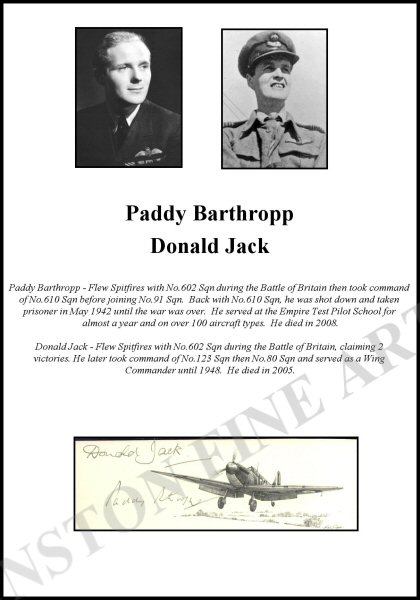 Clipped Signature - Paddy Barthropp. |   Clipped Signature - Sandy Johnstone. |   Clipped Signature - Micky Mount. |
  Clipped Signature - Stuart Nigel Rose. |   Clipped Signature - Paul Webb. |   Clipped Signature - Hector MacLean. |
  Clipped Signature - Hugh Niven. |   Clipped Signature - Donald Jack. |   Clipped Signature - Raymond Baxter. |
  Beware of the Lion by Geoff Lea. |   Gauntlet by Anthony Saunders. |   Combat Over Beachy Head by Nicolas Trudgian. |
  Head to Head by Nicolas Trudgian |  Spitfire Special Delivery by Michael Turner. |
| Aces for : No.602 Sqn RAF | ||
| A list of all Aces from our database who are known to have flown with this squadron. A profile page is available by clicking the pilots name. | ||
| Name | Victories | Info |
| James Harry Ginger Lacey | 28.00 | The signature of James Harry Ginger Lacey features on some of our artwork - click here to see what is available. |
| Pierre H Closterman | 26.00 | The signature of Pierre H Closterman features on some of our artwork - click here to see what is available. |
| Alan Christopher Deere | 22.00 | The signature of Alan Christopher Deere features on some of our artwork - click here to see what is available. |
| Archibald Ashmore Archie McKellar | 21.00 | |
| Andrew McDowall | 18.00 | |
| Peter Malam Brothers | 15.00 | The signature of Peter Malam Brothers features on some of our artwork - click here to see what is available. |
| John Connell Freeborn | 13.50 | The signature of John Connell Freeborn features on some of our artwork - click here to see what is available. |
| No.602 Sqn RAF Aircraft details |
 Hurricane Manufacturer : Hawker Built : 14533 | Hurricane Royal Air Force Fighter, the Hawker Hurricane had a top speed of 320mph, at 18,200 feet and 340mph at 17,500, ceiling of 34,200 and a range of 935 miles. The Hurricane was armed with eight fixed wing mounted .303 browning machine guns in the Mark I and twelve .303 browning's in the MKIIB in the Hurricane MKIIC it had four 20mm cannon. All time classic fighter the Hurricane was designed in 1933-1934, the first prototype flew in June 1936 and a contract for 600 for the Royal Air Force was placed. The first production model flew ion the 12th October 1937 and 111 squadron of the Royal Air Force received the first Hurricanes in January 1938. By the outbreak of World war two the Royal Air Force had 18 operational squadrons of Hurricanes. During the Battle of Britain a total of 1715 Hurricanes took part, (which was more than the rest of the aircraft of the Royal air force put together) and almost 75% of the Victories during the Battle of Britain went to hurricane pilots. The Hawker Hurricane was used in all theatres during World war two, and in many roles. in total 14,533 Hurricanes were built. |
 Spitfire Manufacturer : Supermarine Built : 20351 | Spitfire Royal Air Force fighter aircraft, maximum speed for mark I Supermarine Spitfire, 362mph up to The Seafire 47 with a top speed of 452mph. maximum ceiling for Mk I 34,000feet up to 44,500 for the mark XIV. Maximum range for MK I 575 miles . up to 1475 miles for the Seafire 47. Armament for the various Marks of Spitfire. for MK I, and II . eight fixed .303 browning Machine guns, for MKs V-IX and XVI two 20mm Hispano cannons and four .303 browning machine guns. and on later Marks, six to eight Rockets under the wings or a maximum bomb load of 1,000 lbs. Designed by R J Mitchell, The proto type Spitfire first flew on the 5th March 1936. and entered service with the Royal Air Force in August 1938, with 19 squadron based and RAF Duxford. by the outbreak of World war two, there were twelve squadrons with a total of 187 spitfires, with another 83 in store. Between 1939 and 1945, a large variety of modifications and developments produced a variety of MK,s from I to XVI. The mark II came into service in late 1940, and in March 1941, the Mk,V came into service. To counter the Improvements in fighters of the Luftwaffe especially the FW190, the MK,XII was introduced with its Griffin engine. The Fleet Air Arm used the Mk,I and II and were named Seafires. By the end of production in 1948 a total of 20,351 spitfires had been made and 2408 Seafires. The most produced variant was the Spitfire Mark V, with a total of 6479 spitfires produced. The Royal Air Force kept Spitfires in front line use until April 1954. |
| No.602 Sqn RAF Pilot and aircrew signature details |
  Wing Commander Paddy Barthropp DFC AFC Our estimated value of this signature : £60 Died : 2008 | Wing Commander Paddy Barthropp DFC AFC At the outbreak of war Paddy flew obsolete Hinds, Hectors and Lysanders in combat, but converted to Spitfires and joined 602 Squadron at Tangmere. During the Battle of Britain he flew with some of the great aces - Douglas Bader, Sailor Malan, and Bob Stanford Tuck. In 1941 he was a Flight Commander with 610 Squadron. Continuing to fly Spitfires, now with 122 Squadron based at Hornchurch, he flew fighter sweeps and escort missions. On 17th May 1942 he was shot down over St Omer. He baled out but was captured, spending the next three years as a POW. One of the RAFs best known and best loved characters, though the bane of certain senior officers, Paddy Barthropps RAF service spanned the period from bi-planes to supersonic jets. Joining the RAF in 1938, his first squadron was 613 flying Hinds, Hectors and Lysanders. In 1940 he was released to fly Spitfires with 602 Squadron where he shared in the destruction of two aircraft. He was posted to 610 Squadron, and then to 91 Squadron, shooting down two Bf 109s during summer 1941 and receiving the DFC. In August 1941 he returned to 610 Squadron as a flight commander. He was shot down three times, the third time being taken prisoner ofwar. He had by then brought his total to 9. Scraps in the air were accompanied by scrapes on the ground, and appearances in Magistrates Courts for disorderly conduct. Addicted to fast cars and lively ladies - and the sworn enemy of stuffed shirts everywhere - he was the irrepressible life and soul of any party, and a persistant thorn in the side of overweening authority as the Germans were to discover. The war over, he was posted to the Empire Test Pilots School where he flew over a hundred different types of plane in ten months. Soon, he was out in the Sudan and in serious trouble again - under arrest after taking a hippo to an upper-crust party. As a boy, he had been taught to ride by champion jockey Steve Donaghue and now, posted to Hong Kong, he rode winners on the track at Happy Valley, and seriously thought of turning professional. Then it was back to the U.K. to take up an appointment as a Fighter Station Commander, and to lead the Coronation fly-past over Buckingham Palace. He left the RAF to set up his own luxury car-hire firm. He died on 16th April 2008. |
  Squadron Leader Ian Blair DFM Our estimated value of this signature : £55 Died : 2016 | Squadron Leader Ian Blair DFM Ian Blair joined 113 Squadron in 1938 as a AC1/Armourer AG. on Hawker Hind and later Blenheim Mk 1s. He took part in the heavy fighting of the first Lybian campaign. He was forced to take control and fly the Blenheim airceaft after his pilot was killed following an attack by an Italian Fiat CR 42. Remarkably he managed not only to evade the enemy aircraft, but fly to fly the Blenheim 350 miles back to his base where he made a succesful textbook landing. This extraordinary action earned him the award of an immediate DFM. Ian Blair said about the event : The day before, we had been sent out to bomb an enemy airfield at Derna, about 400 miles west of Alexandria. We were in a Blenheim bomber, and I was the observer. That's the guy in the front who does the navigation and drops the bombs. But as soon as I had released the bombs, a fighter-plane attacked us. Glasgow-born Sqn Ldr Blair still has the blood-stained flight log he made that day. The pencil entries end suddenly. He said : There was an almighty bang. When I looked round, the pilot - a chap called Reynolds - was slumped forward on the controls. I think it was the very last round that killed him. It was really unfortunate. His luck had run out. Then the aircraft went into a steep dive. Despite having never flown an aircraft in his life before that moment, the young airman - paid one shilling and sixpence per day extra to fill in as part-time air crew - took charge. He said : From that moment the only thing going through my mind was survival. Everything happened so quickly, and we had to get the heck out of there. I managed to pull the pilot's body off his seat and get the aircraft under control. But we still had to get home and land the thing. My gunner, Hank, sent a message back to base saying: 'We're in dire trouble here, the observer is flying the aircraft.' Lo and behold, when we got back to base there was whole gallery of people, cars, ambulances and fire tenders all lined up waiting for the ultimate - but it didn't happen. I had spent a long time watching pilots, and made a textbook landing. We came down in a shower of dust. Perhaps I was a bit over-confident. The air officer commanding the base apparently said: 'If that guy can fly an aircraft without a pilot's course, let's send him on a pilot's course.' He was presented with his DFM by George VI. The experience led him to train as a pilot at No 4 SFTS RAF Habbaniya, where the No 6 War Course were heavily engaged in operations to raize the siege of the base from the Iraqi Army. He was finally awarded his wings in May 1941. On return to the UK he served with 501 Squadron on combat duties on Spitfire Mk V's until injured as a result of enemy action. On return to flying duties he was posted to 602 Squadron flying MkV's and MkIX's until June 1944. In February 1944, he claimed a high altitude victory by destroying a Me.109 F at an altitude of 35,000 feet, flying a Spitfire Mk.VII H.F. |
  Air Commodore Peter Brothers CBE, DSO, DFC* Our estimated value of this signature : £65 Died : 2008 | Air Commodore Peter Brothers CBE, DSO, DFC* Learnt to fly at the age of 16 and joined the RAF two years later in 1936. He first saw action in 1940 when as a Flight Commander in 32 Squadron, based at Biggin Hill, he flew his Hurricane against the fighters and bombers of the Luftwaffe. He recalls this as an intensely busy period, during which he shot down an Me109 - his first enemy aircraft; by the end of August that same year his tally of enemy aircraft shot down increased to eight. Awarded the DFC, he was transferred to 257 Squadron where he joined Bob-Stanford Tuck as a Flight Commander. Promoted in 1941 to Squadron Leader, Pete Brothers then took command of 457 Squadron RAAF, equipped with Spitfires. A year later when 457 Squadron returned to Australia, Pete took command of 602 Squadron. In the early autumn of 1942 he went on to become Wing Leader of the Tangmere Wing, succeeding his old friend, Douglas Bader. By the end of the war Pete Brothers had amassed 875 operational hours over a 44-month period. He was credited with having personally shot down 16 enemy aircraft and damaged many more. He later went on to command 57 Squadron during the Malaya campaign. Upon return to the UK Pete Brothers joined the V-Force, flying Valiant-4 jet bombers. He retired in 1973. Sadly, Pete Brothers died 18th December 2008. |
 Air Commodore Alan Deere DSO DFC* Our estimated value of this signature : £80 Died : 1995 | Air Commodore Alan Deere DSO DFC* Top scoring New Zealand Ace with 22 victories, Deere was born in Auckland on December 12th 1917. Alan Deere would become one of the RAFs finest pilots. Joining the RAF in 1937, in September 1938 Al Deere was posted to No.54 Sqn at the time flying Gloster Gladiators, then in early 1940 the Squadron converted to Spitfires. His first brush with death happened when his oxygen failed while at altitude and ke blacked out, coming to only in time to pull his aircraft out of a dive and certain death. At the beginning of May 1940 Deere took part in the intensive air war over Dunkirk and on 23rd May 1940 Deere took part in a daring rescue operation. He and Pilot Officer Allen escorted their flight commander, James Leathart, to France where he was to land a Miles Master trainer and pick up the CO of 74 Squadron who had made a forced landing on the airfield at Calais-Marck. While the pick up was made, Alan Deere was at low level with Pilot Officer Allen at 8000 feet. As Flight Commander James Leathart prepared for take off in the Master, Pilot Offcier Allen spotted a flight o Bf109s coming their way. Deere scored his first victory, as a strafing Bf109 pulled out of its dive, presenting a perfect target. Deere fired a short burst and the aircraft stalled and then crashed into the sea. Deere, climbing to help Allen, crossed the path of two 109s, one of which turned towards him. Deere also turned, firing at the second one, which rolled over and dived away. Pursuing the first one, he caught up at treetop height and pursued him, firing off his remaining ammunition before the German headed for home. During the whole event Deere and Allen accoutned for three Bf109s shot down and three damaged. All three aircraft returned to their base at RAF Hornchurch. During four days - 23rd to 29th May - Deere shot down three Bf109s and three Bf110s but his luck ran out and he was shot down over Dunkirk while attacking a Dornier Do17 and luckily managed a forced landing in Belgium where he optained a bicycle and cycled to Dunkirk where he managed to get on a destroyer and returned to Hornchurch within 30 hours of taking off. In June he was decorated with the DFC by the King at a special ceremony at Hornchurch. Alan Deere destroyed seven more enemy fighters and one bomber during the Battle of Britian and was awarded a Bar to the DFC. In January 1941 became an Operations Room Controller. He returned to operations on 7th May 1941, joining 602 Squadron in Scotland as a Flight Commander. On August 1st 1941 Alan Deere took command of 602 Squadron and on that day destroyed a Bf109. When his second operational tour ended in January 1942 Deere went to the USA to lecture on fighter tactics. In May 1942, he took command of 403 Squadron, commanding the squadron until August before being posted to staff duties. During a temporary attachment to 611 Squadron in February 1943 Deere destroyed an Fw190. Some days later he was appointed Wing Leader at Biggin Hill. He flew 121 sorties during his six months leadership and by this time his tally was twenty-two confirmed victories, ten probables and eighteen damaged. He was also awarded the DSO and a bar to his DFC. Alan Deere was also awarded the Croix de Guerre and the DFC (USA) and in May 1945 He was awarded an OBE. In December 1977 Air Commodore Deere retired form the Royal Air Force. Iin 1959 Air Commodore Alan Deere wrote of his experiences in his book, 'Nine Lives'. Sadly, he passed away on 21st September 1995. |
  Wing Commander John Freeborn DFC* Our estimated value of this signature : £70 Died : 2010 | Wing Commander John Freeborn DFC* Wing Commnader John. C. Freeborn was born on the 1st of December 1919 in Middleton, Yorkshire. John left grammar school at 16 and joined the RAF in 1938, where he made 14 shillings a week and shot pheasant in his spare time. He later visited his classmates after flight school by landing his plane on a nearby cricket pitch. In March 1938 John Freeborn was commissioned in the RAFO, and on the 9th of April 1938 went to Montrose and joined 8 FTS, where he completed his training before going to 74 'Tiger' Squadron at Hornchurch on 29th October. He relinquished his RAFO commission on being granted a short service one in the RAF in January 1939. Johnie Freeborn flew Spitfires with 74 Squadron over Dunkirk, and claimed a probable Ju 88 on May 21st 1940. On the 22nd of May 1940 he destroyed a Junkers 88, and a probable Bf 109 on the 24th of May followed soon after on the 27th by a Bf 109 destroyed and another probably destroyed. On one occasion his Spitfire was badly damaged over Dunkirk and he crash-landed on the beach near Calais but managed to get a lift home in a returning aircraft. His squadron flew relentlessly during the Battle of Britain. In one eight-hour period, its pilots flew into combat four times, destroying 23 enemy aircraft (three by John Freeborn) and damaging 14 more. Five kills denoted an Ace and by the end of the Battle of Britain, John had seven to his credit and won the DFC. John claimed a Bf 109 destroyed on 10th July, shared a probable Dornier 17 on the 24th, shot down a Bf 109 on the 28th, destroyed two Bf 110s, a Bf 109 and probably another on 11th August, destroyed a Do 17 on the 13th, destroyed another on 11th September and damaged an He 111 on the 14th. Freeborn was made a Flight Commander on 28th August. He shared a Bf 109 on 17th November, shot down two Bf 109s, shared another and damaged a fourth on 5th December, and damaged a Dornier 17 on 5th February and 4th March 1941. John Freeborn had been with his squadron longer, and flown more hours, than any other Battle of Britain pilot and on the 25th of February 1941 John freeborn was awarded a Bar to the DFC. In January, 1942 John Freeborn was posted to Army Air Force Base in Selma, Alababma which was home to the South East Training Command in America. After two months as RAF liaison officer he went to Eglin Field, Florida where he helped in testing various aircraft, including the new fighters the Thunderbolt and P-51 Mustang. He returned to the UK in December 1942 and went to Harrowbear, Exeter, and then to Bolt Head as Station Commander. John Freeborn joined 602 Squadron in 1942, and commanded 118 Squadron in June 1943 at Coltishall, leading it until January 1944. In June 1944 he was promoted Wing Commander (the youngest Wing Commander in the RAF) of 286 Wing in Italy. John Freeborn scored 17 victories and left the Royal Air Force in 1946. Sadly, we have learned that John Freeborn passed away on 28th August 2010. John Freeborn was truly one of the great Fighter Pilots of world war two and his autograph is certainly a major additon to any signature collection, as he did not sign a great deal of art pieces. |
 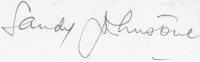 Air Vice Marshal Sandy Johnstone CB DFC AE DL Our estimated value of this signature : £60 Died : 2000 | Air Vice Marshal Sandy Johnstone CB DFC AE DL Early in 1938, Alexander Vallance Riddell Johnstone, known as Sandy, was a civilian navigation instructor at Scottish Aviation, moving later to the Civil Air Navigation School at Prestwick. In August 1939 he was called to full-time service with 602 Squadron. After some Spitfire engagements off the Scottish coast, he received command of 602 - he was still only 24 - and led it south to the tiny airfield at West Hampnett, in West Sussex, where it was stationed throughout the Battle of Britain. Sandy was in command of no. 602 squadron during the critical days of the Battle of Britain, flying with the squadron before the war though to 1941, when he was posted to the Middle east, he also served with 229 and 249 squadrons in Malta during the Islands most fateful days of the war. Sandy became a successful author and resided near Ipswich in Suffolk. Sandy Johnstone died 13th December 2000, aged 84. |
 Squadron Leader Ginger Lacey DFM Our estimated value of this signature : £90 Died : 1989 | Squadron Leader Ginger Lacey DFM James Harry Lacey, from Wetherby, who was destined to become the top scoring RAF fighter pilot in the Battle of Britain, joined the RAFVR. in 1937. After an instructors course in 1938 he became an instructor at the Yorkshire Aeroplane Club. Called up at the outbreak of war, he was posted to 501 Squadron, and in May 1940 was posted with the unit to France. On the 13th he set off late on an early patrol, and shot down a Bf 109 and a He 111. Later in the day he destroyed a Bf 110. On the 27th he destroyed two He 11 Is and then returned to the United Kingdom, in June, having made an emergency landing in a swamp on the 9th and overturned, nearly being drowned. On 20 July he shot down a 13f 109, and was then awarded a DFM. In the Battle of Britain, during August, he destroyed a Ju 87 and a probable on the 12th, damaged a Do 17 on the 15th, probably destroyed a Bf 109 on the 16th, and on the 24th shot down a Ju 88 and damaged a Do 17. On the 29th he destroyed a 13f 109 and next day claimed a He 111 and probablya Bf110. He shot down a Bf109 on the 31st and on 2 September got two Bf 109s and damaged a Do 17. Two days later he destroyed two more Bf 109s, and was then sent on leave for a few days. on his return, on the 13th, he took off in very bad weather to shoot down a lone He 111 which had just bombed Buckingham Palace. Having destroyed it, he found the cloud too thick to return to base and was forced to bale out. On the 15th he shot down another He 111 and two Bf 109s with a third damaged, on the 27th destroyed another Bf 109 and on the 30th damaged a Ju 88. During October he was in action frequently against Bf 109s, getting a probable on the 7th and destroying others on the 12th, 26th, and the 30th, damaging one also on this latter date. His score was now 23, and he had been shot down or forced to bale out nine times. Of his victories 18 were gained during the Battle of Britain, and this was the highest score of any pilot for this period. In December he received a Bar to his DFM and was commissioned the following month. He converted to Spitfires early in 1941, and in June became a flight commander. During July he destroyed a Bf 109 on the 10th, damaged one on the 14th, shot down a He 59 floatplane on the 17th and destroyed two more Bf 109s on the 24th, causing them to collide. He was then posted as an instructor to 57 OTU where he trained, among others, George Beurling. In March 1942 he was posted to 602 Squadron, and on 24th March damaged a Fw 190. On 25 April he damaged two more, but was then posted to HQ 81 Group as Tactics Officer, now as a Sqn. Ldr. He spent some while testing Hurricanes with rocket projectiles and 40 mm. anti-tank guns, and then became Chief Flying Instructor at Millfield. In March 1943 he was sent to India, and first was responsible for converting squadrons to Hurricanes at Madras. He then moved to Bangalore, where he converted Hurricane pilots to Thunderbolts. In September 1944 he was posted to 3 TAC at Komila as Sqn. Ldr. Tactics, and the following month attended an Air Fighting Instructors Course at Armarda Road, which was run by Wg. Cdr. F.R. Carey. In November he became temporary commanding officer of 155 Squadron, flying Spitfire 8s in Burma, but later that month took command of 17 Squadron, equipped with the same aircraft. His squadron was responsible for giving ground support to a Gurkha regiment, so he ordered his pilots to have their heads shaved in the Gurkha fashion, which proved to be a very popular move. On 19 February 1945 he shot down a Nakajima Ki 43 Oscar, his twenty-eighth and last victory. He died on 30th May 1989. |
  Air Commodore Micky Mount CBE DSO DFC Our estimated value of this signature : £65 Died : 2002 | Air Commodore Micky Mount CBE DSO DFC Flying Officer Christopher John (Micky) Mount joined NO.602 squadron on August 8th 1940 after a brief conversion course on Spitfires. On August 18th his Spitfire L1005 was severely damaged in combat with JU 87s and BF109s over Ford. Micky was unhurt. he again escaped injury when his Spitfire X4270 was damaged landing at Tangmere. he served in many of the theatres of WW2 and he flew Hurricanes in Malta and North Africa and Wellingtons in the Middle east. Micky retired and lived in Ascot in Berkshire. He died 23rd July 2002. |
  Flight Lieutenant Colin Parkinson DFC Our estimated value of this signature : £55 Died : 2006 | Flight Lieutenant Colin Parkinson DFC Australian Colin Parkinson joined the RAAF in 1940, arriving in England to join 19 Squadron flyin Spitfires. In March 1942 he shot down a Do217. In May he was posted to Malta, flying his Spitfire off HMS Eagle on 9th June, with 602 Squadron. After scoring several victories he flew to Gibraltar to lead in further Spitfires, taking off from HMS Furious to the island on 17th August. Commissioned, he now flew with 229 Squadron. On 9th October with Winco Donaldson and Screwball Beurling, he performed a low level beat up and acrobatics over the presentation of the George Cross to the people of Malta. He ended his tour of Malta in November 1942 with the DFC and 10.5 victories, plus probably 2 more. Colin Parkinson passed away aged 89 on 31st March 2006. |
  Squadron Leader Stuart Nigel Rose Our estimated value of this signature : £50 Died : 2017 | Squadron Leader Stuart Nigel Rose Originally from Elswick in the north east of England, Rose moved south to join the RAFVR in March 1939, called up at the outbreak of war he was commissioned in June 1940 joining No.602 Sqn in June 1940 flying Spitfires and serving with the unit throughout the Battle of Britain, claiming three victories. Squadron Leader Nigel Rose was then posted to 54 Sqn at Hornchurch in September 1941 before becoming an instructor in 1942, and also serving in the Middle East. Afterwards he moved to No.54 Sqn before taking on positions in training units. He died on 10th September 2017 aged 99. |
  Air Commodore Paul Webb CBE DFC AE Our estimated value of this signature : £60 Died : 2007 | Air Commodore Paul Webb CBE DFC AE Joining 602 Squadron Aux AF L in Scotland in late 1937, Paul Webb was called up full time in August 1939. After initial skirmishes off the Scottish East Coast, 602 came south to Tangmere / Westhampnett. During the Battle of Britain he claimed a Bf110 destroyed on August 16th, on the 25th two more, on the 26th a He59, on September 7th a Bf10 and on the 9th a Do17. In 1941 he was the first Commanding Officer of 416 Squadron RCAF, which he led until 1942 when posted to the Middle East and then Malta. He served later in Italy and with the Balkan Air Force in Yugoslavia. He died on 10th July 2007. |
|
Contact Details |
|
Sign Up To Our Newsletter!
This website is owned by Cranston Fine Arts. Torwood House, Torwoodhill Road, Rhu, Helensburgh, Scotland, G848LE Contact: Tel: (+44) (0) 1436 820269. Email: cranstonorders -at- outlook.com
|
 |



