|
|
|
|
|
|
|
|
|
412th Fighter Group
Founded :
Country : US
Fate :
Later became the 1st Fighter Group.
412th Fighter Group
| Aces for : 412th Fighter Group | ||
| A list of all Aces from our database who are known to have flown with this squadron. A profile page is available by clicking the pilots name. | ||
| Name | Victories | Info |
| David Lee Tex Hill | 18.25 | The signature of David Lee Tex Hill features on some of our artwork - click here to see what is available. |
| Urban L Drew | 6.00 | The signature of Urban L Drew features on some of our artwork - click here to see what is available. |
| Rex T Barber | 5.00 | The signature of Rex T Barber features on some of our artwork - click here to see what is available. |
| 412th Fighter Group Aircraft details |
 Thunderbolt Built : 15683 | Thunderbolt Alexander Kartveli was a engineer with Seversky Aircraft who designed the P-35, which first flew in 1937. With Republic Aviation Kartveli supervised the development of the P-43 Lancer. Neither of these aircraft were produced in large numbers, and neither was quite successful. However, the Republic Aviation P-47 Thunderbolt, also nicknamed the Jug, was quite a different story. The Jug was the jewel in Kartvelis design crown, and went on to become one of the most produced fighter aircraft of all time with 15,683 being manufactured. The P-47 was the largest and heaviest single seat fighter of WW II. The P-47 immediately demonstrated its excellent combat qualities, including speed, rate of climb, maneuverability, heavy fire power, and the ability to take a lot of punishment. With a wingspan of more than 40 feet and a weight of 19,400 pounds, this large aircraft was designed around the powerful 2000 HP Pratt and Whitney R-2800 Double Wasp radial engine. The first P-47 prototype flew in May of 1941, and the primary variant the P-47D went into service in 1943 with units of the U.S. Armys Eighth Air Force. The Jug had a maximum speed in excess of 400 MPH, a service ceiling in excess of 42,000 feet, and was heavily armed with either six or eight heavy caliber machine guns. With its ability to carry up to a 2,500 pound bomb load, the Jug saw lots of use in ground attack roles. Until the introduction of the N model, the P-47 lacked the long range required for fighter escort missions which were most often relegated to P-51 Mustangs or P-38 Lightnings. In his outstanding painting entitled Bridge Busting Jugs, noted aviation artist Stan Stokes depicts Eighth Air Force Jugs in a ground attack mission in the Alps in June of 1944. The top P-47 ace was Francis Gabreski who had flown with the 56th Fighter Group, the first unit to be equipped with the P-47. In August of 1943 Gabreski attained his first aerial combat victory (over an Fw-190) and by years end he had reached ace status with 8 confirmed victories. As Commander of the 61st Squadron, Gabreski continued to chalk up victory after victory, and on seven different occasions he achieved two victories during the same mission. However, in July of 1944 Gabreski damaged the prop on his Jug during a low level attack on an airfield near Coblenz. Forced to make a crash landing, he was captured and remained a prisoner of war until Wars end in 1945. Following the War Gabreski returned to military service with the Air Forces 4th Fighter-Interceptor Wing in Korea. Flying the F-86 Sabre Jet, Gabreski attained 6.5 more aerial victories in 1951 and 1952 becoming an ace in two different wars |
| 412th Fighter Group Pilot and aircrew signature details |
  Colonel Rex Barber Our estimated value of this signature : £65 Died : 2001 | Colonel Rex Barber Rex Theodore Barber was born in Culver, Oregon on May 6, 1917. Barber was accepted at Oregon State University and graduated from that University in 1940. In September of that year Barber enlisted in the Army Air Corps, and served as a private first class, prior to being accepted for flight training in March of 1941. Following graduation with Class 41-H from Mather Field in California in October of 1941, now Lt. Rex Barber was assigned to the 70th Fighter Squadron of the 35th Fighter Group. He arrived in the Fiji Islands with his new unit in January of 1942. Barber's only victory in 1942 was on December 28, 1942 when he downed a twin-engine Japanese 'Nell.' Early in 1943 the 70th Fighter Squadron was integrated into the 339th Fighter Group, and converted to the Lockheed P-38 Lightning fighter. The P-38 was an ideal aircraft given the long distances involved in combat in the Pacific. In April Rex got credit for downing two Zekes near Cape Esperance. On April 18, 1943 Rex participated in one of the most interesting missions of the War, the interception and destruction of the Betty bomber carrying Admiral lsoruko Yamamoto, the Commander of the Japanese Combined Fleet, and mastermind of the attack on Pearl Harbor. The mission was commanded by Major John Mitchell. While a total of sixteen aircraft were involved, only four were to actually attack the Betty. With Yamamoto noted for his punctuality, and American code-breakers having deciphered his intinerary, Mitchell's flight had a fighting chance of pulling off the mission. Yamamoto's flight arrived on schedule. There were two Betty bombers and only four escorting fighters. Barber, Lt. Frank Holmes and Captain Tom Lamphier got in the heat of the action. Barber got hits on both the Bettys and also bagged a Zeke. The Army Air Force decided after the mission to give equal credit to both Lamphier and Barber for downing the Betty which Yamamoto was a passenger in. Years later Tom Lamphier lobbied hard for getting sole credit for the Yamamoto victory. The Air Force's official investigation concluded that a shared victory was still appropriate. More recent evidence, including testimony from one of the Japanese Zero pilots and a survivor from one of the Bettys which was downed, were supportive of the thesis that Rex Barber should get full credit. A book published by noted aviation historian and author Carroll Glines favors this conclusion, and a recent review panel of the American Fighter Aces Association concluded that Rex Barber deserves the sole credit for downing Yamamoto's Betty. This unfortunate controversy tarnishes the fact that this mission was the longest successful interception of its kind, and all those who participated in all aspects of it deserve credit. Barber served a second combat tour in the Pacific with the 449th Fighter Squadron in China. Following the War, Rex commanded the 29th Fighter Squadron of the 412th Fighter Group. Later he would command one of the Air Force's early jet squadrons flying the P-59A Airacomet and the P-80. Rex retired from the Air Force in 1961. His numerous decorations include the Navy Cross, the Silver Star with one Oak Leaf Cluster, the Purple Heart, the Air Medal, and the Air Force Commendation Medal. In January 1945, he returned to duty with 412th Fighter Group, 29th Fighter Squadron, testing the Lockheed P-80 Shooting Star. He flew jet fighters in the Korean War and retired as a Colonel after a full Air Force career. By the end of WWII, Barber had five confirmed aerial victories and three probables. Awarded the Navy Cross, Silver Star, Purple Heart, Air Medal and Veteran of foreign Wars Gold Medal of Merit, he died peacefully in his home on July 26, 2001. |
 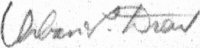 Maj Urban L Drew USAF Our estimated value of this signature : £40 Died : 2013 | Maj Urban L Drew USAF Urban 'Ben' Drew was born in Detroit, Michigan in 1924. Three months after the attack on Pearl Harbor, at the age of eighteen, Drew joined the USAAF and commenced pilot training. He earned his wings and a commission at Mariana, Florida in October 1943. He remained in the States honing his flying skills as an instructor pilot for the North American P-51 Mustang at Bartow, Florida. In May of 1944 he received his first overseas combat assignment, sailing to England on the Queen Elizabeth. He was assigned to the 375th Fighter Squadron 'Yellowjackets' of the 361st Fighter Group based in at Bottisham in Cambridgeshire. Later his squadron would be relocated to Little Walden in Essex. During his combat tour Drew would fly a total of seventy-five combat missions, rising to command of X Flight and later to command of the 375th squadron. Drew would be officially credited with six aerial victories during his combat tour. Notable was his downing of two Me-262 jets on October 7, 1944. He was the first fighter pilot to down two of the German jets, and he received the Air Force Cross for this achievement. Also of note was the ace's destruction of the largest aircraft to fly in WW 11, the BV-238, which he destroyed in a strafing pass with two wingman on Lake Schaal on September 18, 1944. Following his successful combat tour, Drew returned to the States where he again served as a flight instructor. In 1945 he was assigned to the 412 th Fighter Squadron of the 414 th Fighter Group based at lwo Jima flying the P-47 Jug. Drew's final victory tally included 6 confirmed aerial victories, 1 damaged, and 1 additional aircraft destroyed on the ground. In addition to the Air Force Cross, Drew was awarded two Distinguished Flying Crosses and 14 Air Medals. Following the War Drew helped organize the 127 th Fighter Group of the Michigan National Guard. He became Deputy Group Commander and later was appointed the first Air Adjutant General of the State of Michigan. After his retirement from the Air Force with the rank of Major, he established an aviation business in Britain and South Africa. He currently resides in Southern California, and remains active in matters involving the American Fighter Aces Association. Sadly we have learned that Ben Drew passed away on 3rd April 2013. |
  Colonel Tex Hill Our estimated value of this signature : £75 Died : 2007 | Colonel Tex Hill Tex Hill was born in Korea on 13th July 1915. Tex Hill graduated as a Naval Aviator in 1939, and after serving as a Navy Pilot, Tex Hill volunteered for the A.V.G., becoming Squadron Leader in the 2nd Sqn (Panda Bears) until disbandment in 1942, by which time he had 12.25 air victories, making him the second highest ranking Ace in the American Volunteer Group. He remained in China, as the first squadron commander of the 75th F S /23rd F G before returning to the U.S. He went back to China to command the 23rd F G, increasing his total to 18.25 victories. In late 1943 he led a group of 30 aircraft on the first strike against Formosa. During this mission, 42 enemy aircraft were confirmed destroyed, with a possible 12 more, while all 30 aircraft under Tex Hill's command returned safely. Returning to the US, he commanded the 412th Fighter Group, the first jet aircraft group. Here, he flew P-80 Shooting Stars and YP-59 Airacomets. His decorations include a Distinguished Service Cross, Silver Star, Legion of Merit, 4 Distinguished Flying Crosses, 2 Air Medals, 2 Presidential Unit Citations, 6 decorations awarded by China, and a Distinguished Flying Cross from the UK. Sadly, Tex Hill died on 11th October 2007. |
 Jay Robbins Our estimated value of this signature : £45 Died : 2001 | Jay Robbins Lt. General Jay Robbins who flew with the Fifth Air Force in the Southwest Pacific, rose to command the 8th Fighter Group and finished the war as a quadruple P-38 Ace with 22 air victories. Robbins graduated from Coolidge High School in 1936. He attended Texas A&M University, graduating in 1940 with a BS degree and a commission as second lieutenant through the Reserve Officers' Training Corps. He entered active USAAC duty at Randolph Field, Texas, in July 1941. He began flying training at Corsicana Air Field, at Randolph Field, and at Foster Field, Texas. He received his pilot's wings in July 1942, and began fighter-aircraft training in the 55th Fighter Squadron, 20th Pursuit Group, at Morris Field, NC and Drew Army Airfield in Florida. In September 1942, Robbins was assigned to 80th Fighter Squadron, 8th Fighter Group of the Fifth Air Force in the Southwest Pacific area. By September 1943, he had been credited with three aerial victories in two aerial combats. On 4th September 1943 he downed another four Japanese aircraft in one flight, becoming an ace. In January 1944, Robbins became commander of the squadron and in September 1944 became deputy commander of the group. He flew 607 hours on 181 combat missions in P-39 and then P-38 aircraft. He scored 22 aerial victories against Japanese fighter aircraft, the fourth highest number of enemy aircraft destroyed by an Army Air Corps pilot in the Pacific Theater of Operations. He twice destroyed four enemy fighters during single missions and was awarded the Distinguished Service Cross for each of these missions. After the war ended, Robbins remained in the Air Force. He commanded the 434th Army Air Forces Base Unit at Santa Rosa Field, California, from February to November 1945. He next served as squadron operations officer with the 412th Fighter Group (later redesignated the 1st Fighter Group), at March Field, California, the first organization in the Air Force to be equipped with the F-80 jet fighter, and later held several operational staff positions. In June 1947, he was assigned to Headquarters Tactical Air Command (TAC), Langley Air Force Base, Virginia, in plans and operations. In 1949, he was posted to Headquarters Twelfth Air Force, Brooks Air Force Base, Texas. He attended the Air Command and Staff School at Maxwell Air Force Base, Alabama, in early 1950 and, after graduation in June, returned to the Twelfth Air Force. In August 1950, he was assigned as assistant chief, Tactical Air Operations Branch, Headquarters Continental Air Command, Mitchel Air Force Base, New York, and in January 1951, joined the operational staff of the newly established Air Defense Command at Ent Air Force Base, Colorado. From June 1953 to September 1955, General Robbins served as plans and programs officer of the War Plans Division, Directorate of Plans, at Headquarters U.S. Air Force. He then became a member of the Joint Strategic Plans Group of the Joint Chiefs of Staff. While in this position, he represented the Joint Chiefs of Staff on a special continental defense subcommittee of the National Security Council. General Robbins was deputy commander and later commander of the 20th Tactical Fighter Wing in England from July 1957 to August 1961. In 1960, he led the U.S. Air Force European Gunnery Champions to the 'William Tell' weaponry meet in Nevada, flying F-100s aircraft across the Atlantic to participate. In July 1962, he graduated from the National War College and was named director of USAF flight safety. In January 1963, he became the director of aerospace safety at Norton Air Force Base. General Robbins became commander of the 313th Air Division in July 1965. In March 1967, he was named chief of staff, Pacific Air Forces, with headquarters at Hickam Air Force Base, Hawaii. From July 1968 to February 1970, General Robbins was the commander of the Twelfth Air Force at Bergstrom Air Force Base. In February 1970, he was named vice commander, Tactical Air Command at Langley Air Force Base. In August 1972, he became vice commander of Military Airlift Command (MAC). He retired from the Air Force in 1974. Robbins died on 3rd March 2001 at the age of 81. |
|
Contact Details |
|
Sign Up To Our Newsletter!
This website is owned by Cranston Fine Arts. Torwood House, Torwoodhill Road, Rhu, Helensburgh, Scotland, G848LE Contact: Tel: (+44) (0) 1436 820269. Email: cranstonorders -at- outlook.com
|
 |



