|
|
|
|
|
|
|
|
|
No.15 Sqn RAF
Founded : 1st March 1915
Country : UK
Fate :
Known Aircraft Codes : LS, DJ, EF, QR, ZA
Aim sure
On 1st March 1915, the officers and men who made up No.1 Reserve Squadron and the Recruits Depot, all of whom were based at South Farnborough, Hampshire, were brought together to form No.15 Squadron, Royal Flying Corps. Initially, the new squadron was equipped with a diverse range of flying machines, including Henri and Maurice Farmans, Avros, Bleriots, Moranes and BE2c aircraft. Having relocated to an airfield at Hounslow, west of London, where the squadron was allowed time to work up to operational status, it was, on 11th May, relocated to another airfield at Swingate Down, to the east of Dover, on the Kent coast. On 23rd December 1915, No.15 Squadron, RFC, deployed to France for operational duties. Throughout its time on the Western Front, during the First World War, the squadron was engaged in observation and reconnaissance duties, initially using BE2c aircraft but later, during June 1916, upgrading to R.E.8s. The work undertaken by the squadron, in its reconnaissance role, was recognised by higher authority, on a number of occasions, in the form of telegrams or communiqués. On 1st April 1918, No.15 Squadron became part of the newly formed Royal Air Force, which came into being with the amalgamation of the Royal Flying Corps and Royal Naval Air Service. With the end of hostilities in November 1918, came a reduction in the fighting strength of the RAF and, although not disbanded as a number of squadrons were, No.15 was reduced to a cadre. The axe finally fell on the final day of December 1919, when No.15 Squadron was disbanded.
It was to be approximately five years before No.15s number plate was to be resurrected when, on 20th March 1924, No.15 Squadron was reformed as part of the Aeroplane and Armament Experimental Establishment (A&AEE), at Martlesham Heath, Suffolk. Over a period of ten years, No.15 Squadron completed 12,100 flying hours on over seventy-five different types of airframe. Over that same period, it also saw five changes of commanding officer.
On 1st June 1934, No.15 was re-designated as a new unit, equipped with Hawker Hart Mk.I aircraft, undertaking daylight operations flying as part of Bomber Command. The new C.O. was Squadron Leader Thomas Elmhirst, who secured permission for his squadron to change the number plate to Roman numerals and have the XV applied to the fuselage on all the squadrons aircraft. This decision was to have a lasting effect and was only interrupted by the Second World War. Thomas Elmhirst also gave thought to the fact the squadron should have its own badge and motto, both of which were approved, during 1935. In early 1936, the squadron re-equipped with Hawker Hind bomber aircraft. These machines remained in service with No.XV until 13th July 1938, when the unit converted to Fairey Battle bomber aircraft. It was with the latter aircraft that the squadron prepared for war when, on 27th August 1939, a state of emergency was declared.
History repeated itself when the Squadron returned to France on a war footing, but it was forced to return to England in order to re-equip with the Bristol Blenheim bomber. The new aircraft was initially seen as a wonder aircraft, but No.XV Squadron was virtually decimated in strength following the German invasion of the Netherlands in May 1940. With the Blenheim being designated unsuitable for the task, the squadron began converting to the Vickers Wellington bomber, designed by Barnes Wallace, on 7th November 1940. This was really a stop-gap measure as on 30th April 1941 No.XV began converting to the Short Stirling, four-engine, heavy bomber. During the next couple of years, night after night, the squadron carried the fight back to the enemy, enduring many losses and exploits of valour in the process. It participated in all the 1,000 bomber raids against Germany.
As 1943 drew to a close, No.XV prepared to continue the fight with new equipment. Having converted to the Avro Lancaster bomber in late December 1943, the squadron went operational in mid-January 1944 with its new aircraft. By the time the war came to an end, No.XV was flying Lancaster B.1 Specials, which were specially adapted to carry 22,000lb Grand Slam bombs. February 1947 saw another change of equipment when the squadron converted to the Avro Lincoln bomber, whilst based at RAF Wyton in Huntingdonshire. However, by the end of that same year, No.XV found itself deploying aircraft to Shallufa, Egypt, as part of Operation Sunrise.
Another change of occurred at the end of November 1950, when No.XV Squadron was disbanded but immediately reformed with Boeing B29 Washington bomber aircraft. It was during the Washington period, in March 1951, that the squadrons code letters ‘LS’, which it had been adopted during late 1939, were removed from the aircraft fuselages. The new scheme called for a natural metal finish, adorned with only the RAF roundel, fin flash and aircraft serial. With technology advancing all the time, No.XV entered a new phase in its history in June 1953, when it was declared fully operational flying English Electric Canberra bombers. During the next couple of years, the squadron continued to train and undertook many navigational and bombing exercises, which proved fruitful in 1956 when the Suez crises erupted. No.XV was deployed to Nicosia, as part of Operation Accumulate, on 23rd October. During the short period of fighting that followed, No.XV dropped a higher concentration of bombs than any other squadron. Following a cease-fire, the squadron returned to England where, on 15th April 1957, it was disbanded.
The 1st of September 1958 saw the re-formation of No.XV as a V-Bomber squadron, equipped with Handley Page Victor B.I bombers. These aircraft were not only adorned with the official RAF insignia described above, but were also permitted to carry the squadron badge, together with the Roman XV numerals. The squadron retained these aircraft until 1964 when it was again disbanded. For a period of five years No.XV Squadron ceased to exist. However, this changed on 1st October 1970, when the squadron number plate and badge were resurrected and No.XV was reformed at RAF Honnington, in Suffolk. Equipped with Blackburn S.2B Buccaneer aircraft, the squadron departed for RAF Laarbruch, where, during January 1971, it officially became part of Royal Air Force Germany. After thirteen years service with the squadron, the Buccaneers were replaced with Panavia Tornado, swing-wing, bombers. On 1st September 1983, No.XV became the first RAF Squadron in Germany to be equipped with this type of aircraft. During the latter quarter of 1990, No.XV had deployed two flights, totalling twelve crews, to Muharraq Air Base, on Bahrain Island, in readiness for operations against the Iraqi dictator Saddam Hussein. During the following conflict, two aircraft crewed by XV Squadron personnel were shot down, resulting in the loss of Flt Lt Stephen Hicks and the capture of Flt Lts John Peters, John Nichol and Rupert Clark.
The squadron returned to RAF Laarbruch at the end of March 1991, where a number of awards, for service in the Gulf War were announced. Wing Commander John Broardbent was awarded a Distinguished Service Order, whilst Sqn Ldr Gordon Buckley and Sqn Ldr Nigel Risdale were both awarded Distinguished Flying Crosses. Senior Engineering Officer S/L Rob Torrence was awarded the Member of the British Empire. Following disbandment in January 1992, No.XV was reformed a few months later on 1st April, at RAF Honnington, where it took on the role of the Tornado Weapons Conversion Unit. It was also granted the status of a Reserve Squadron. No.XV (R) Squadron remained at Honnington until 1st November 1993, when it re-located to RAF Lossiemouth, Moray, Scotland. During January 1998, it was re-designated as the Tornado GR1 Operational Conversion Unit and equipped with the up-graded Tornado GR4 variant. In 2011, just four years away from its 100th anniversary, No.XV (R) Squadron still operates from RAF Lossiemouth, providing refresher crews and new crews to the front line squadrons.
Text by kind permission of Martyn Ford Jones
No.15 Sqn RAF
  Last One Away by Ivan Berryman. (PC) |  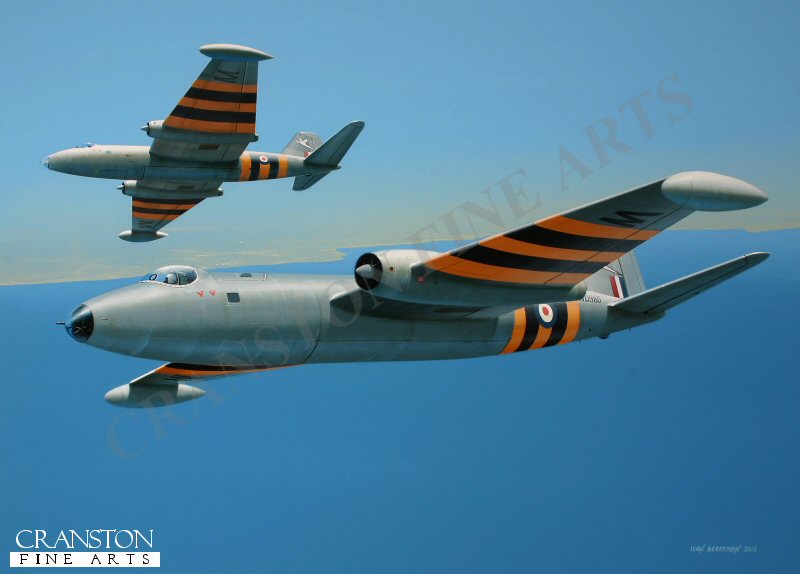 Musketeer Canberras by Ivan Berryman. (PC) |   MacRobert's Reply by Ivan Berryman. (PC) |   Teamwork by Ivan Berryman. (PC) |
No.15 Sqn RAF Artwork Collection |
  Incident over Mannheim by Ivan Berryman. |   Teamwork by Ivan Berryman. |   The Attack on Villers Bocage by Ivan Berryman. |
  MacRobert's Reply by Ivan Berryman. |   Last One Away by Ivan Berryman. |   Operation Manna by Ivan Berryman. |
  Clipped Signature - Peter Boggis. |   Clipped Signature - Michael Simmons. |   Clipped Signature - Peter Oulton. |
  Clipped Signature - Sir Hughie Edwards VC. |   McRobert's Reply by Geoff Lea. |   Teamwork by Philip West. |
  The Homecoming by Keith Woodcock. |   Musketeer Canberras by Ivan Berryman. |   Outbound from Mildenhall by Ivan Berryman. |
 An Aerial Action In Which Corporal Nott. Acting As Gunner, Drove Off A Hostile Aeroplane After Being Seriously Wounded. |   Here Comes Another One, Skipper by Keith Aspinall. |
| Aces for : No.15 Sqn RAF | ||
| A list of all Aces from our database who are known to have flown with this squadron. A profile page is available by clicking the pilots name. | ||
| Name | Victories | Info |
| Frank Neville Hudson | 6.00 | |
| No.15 Sqn RAF Aircraft details |
 Blenheim Manufacturer : Bristol Built : 4422 | Blenheim The Bristol Blenheim, the most plentiful aircraft in the RAFs inventory when WWII began, was designed by Frank Barnwell, and when first flown in 1936 was unique with its all metal monoplane design incorporating a retractable undercarriage, wing flaps, metal props, and supercharged engines. A typical bomb load for a Blenheim was 1,000 pounds. In the early stages of the war Blenheims were used on many daylight bombing missions. On the day that war was declared on Germany, a Blenheim piloted by Flying Officer Andrew McPherson was the first British aircraft to cross the German coast and the following morning 15 Blenheims from three squadrons set off on one of the first bombing missions The Blenheim units operated throughout the battle, often taking heavy casualties, although they were never accorded the publicity of the fighter squadrons. The Blenheim units raided German occupied airfields throughout July to December 1940, both during daylight hours and at night. Although most of these raids were unproductive, there were some successes; on 1 August five out of 12 Blenheims sent to attack Haamstede and Evere (Brussels) were able to bomb, destroying or heavily damaging three Bf 109s of II./JG 27 and apparently killing a Staffelkapitän identified as Hauptmann Albrecht von Ankum-Frank. Two other 109s were claimed by Blenheim gunners. Another successful raid on Haamstede was made by a single Blenheim on 7 August which destroyed one 109 of 4./JG 54, heavily damaged another and caused lighter damage to four more. There were also some missions which produced an almost 100% casualty rate amongst the Blenheims. One such operation was mounted on 13 August 1940 against a Luftwaffe airfield near Aalborg in north-western Denmark by 12 aircraft of 82 Squadron. One Blenheim returned early (the pilot was later charged and due to appear before a court martial, but was killed on another operation); the other 11, which reached Denmark, were shot down, five by flak and six by Bf 109s. Blenheim-equipped units had been formed to carry out long-range strategic reconnaissance missions over Germany and German-occupied territories, as well as bombing operations. In this role, the Blenheims once again proved to be too slow and vulnerable against Luftwaffe fighters and they took constant casualties While great heroism was displayed by the air crews, tremendous losses were sustained during these missions. The Blenhiem was easy pickings at altitude for German Bf-109 fighters who quickly learned to attack from below. To protect the vulnerable bellies of the Blenheims many missions were shifted to low altitude, but this increased the aircrafts exposure to anti-aircraft fire. In the German night-bombing raid on London on 18 June 1940, Blenheims accounted for five German bombers, thus proving that they were better-suited for night fighting. In July, No. 600 Squadron, by then based at RAF Manston, had some of its Mk IFs equipped with AI Mk III radar. With this radar equipment, a Blenheim from the Fighter Interception Unit (FIU) at RAF Ford achieved the first success on the night of 2–3 July 1940, accounting for a Dornier Do 17 bomber. More successes came, and before long the Blenheim proved itself invaluable as a night fighter. One Blenheim pilot, Squadron Leader Arthur Scarf, was posthumously awarded the Victoria Cross for an attack on Singora, Thailand, on 9 December 1941. Another bomber of No. 60 Squadron RAF was credited with shooting down Lt Col Tateo Katō's Nakajima Ki-43 fighter and badly damaging two others in a single engagement on 22 May 1942, over the Bay of Bengal. Katō's death was a severe blow to the Imperial Japanese Army Air Force. |
 Canberra Manufacturer : English Electric | Canberra The English Electric Canberra first flew on Friday 13 May 1949 when its performance created a sensation. Such was the quality of the original design that in May 1951, when the first B2 Canberras entered service with No 101 Squadron at RAF Binbrook they could out manoeuvre all the fighters of the period and fly with impunity more than 10,000 feet above them. Operated by 17 airforces in more than 20 different variants, Canberras have been to war at Suez and in India, in Vietnam and the Falklands campaign, and in 1996 Canberra PR9s were engaged in operational reconnaissance flights over Bosnia and in other regions. It is widely and justifiably regarded as one of the greatest aircraft designs of all time. |
 Lancaster Manufacturer : Avro Built : 7377 | Lancaster The Avro Lancaster arose from the avro Manchester and the first prototype Lancaster was a converted Manchester with four engines. The Lancaster was first flown in January 1941, and started operations in March 1942. By March 1945 The Royal Air Force had 56 squadrons of Lancasters with the first squadron equipped being No.44 Squadron. During World War Two the Avro Lancaster flew 156,000 sorties and dropped 618,378 tonnes of bombs between 1942 and 1945. Lancaster Bomberss took part in the devastating round-the-clock raids on Hamburg during Air Marshall Harris' "Operation Gomorrah" in July 1943. Just 35 Lancasters completed more than 100 successful operations each, and 3,249 were lost in action. The most successful survivor completed 139 operations, and the Lancaster was scrapped after the war in 1947. A few Lancasters were converted into tankers and the two tanker aircraft were joined by another converted Lancaster and were used in the Berlin Airlift, achieving 757 tanker sorties. A famous Lancaster bombing raid was the 1943 mission, codenamed Operation Chastise, to destroy the dams of the Ruhr Valley. The operation was carried out by 617 Squadron in modified Mk IIIs carrying special drum shaped bouncing bombs designed by Barnes Wallis. Also famous was a series of Lancaster attacks using Tallboy bombs against the German battleship Tirpitz, which first disabled and later sank the ship. The Lancaster bomber was the basis of the new Avro Lincoln bomber, initially known as the Lancaster IV and Lancaster V. (Becoming Lincoln B1 and B2 respectively.) Their Lancastrian airliner was also based on the Lancaster but was not very successful. Other developments were the Avro York and the successful Shackleton which continued in airborne early warning service up to 1992. |
 Stirling Manufacturer : Short Built : 2381 | Stirling The Royal Air Force's first four engined monoplane Bomber, the Short Stirling first flew in May 1939 and entered front line service in August 1940 with no. 7 squadron. Due to its poor operational ceiling the aircraft sustained heavy losses and by mid 1942 the Stirling was beginning to be replaced by the Lancaster. Improved versions of the Short Stirling were built for Glider towing, paratroopers and heavy transport. also from 1943 many of the Stirling's were used for mine laying. A total of 2381 Stirling's were built for the Royal air Force and from this total 641 Stirling bombers were lost to enemy action. Crew 7 or 8: Speed: 260 mph (MK1) 275mph (MKIII) and 280mph (MKV)Service ceiling 17,000 feet Range: 2330 miles. (MK1) 2010 miles (MKIII) and 3,000 miles (MKV) Armament: two .303 Vickers machine guns. in nose turret, two .303 in browning machine guns in dorsal turret , Four .303 Browning machine guns in tail turret. Bomb Load 14,000 Lbs Engines: four 1150 Hp Bristol Hercules II (MK1) four 1650 hp Bristol Hercules XVI (MK111 and MKV) |
 Superfortress | Superfortress The largest and most powerful bomber of WW II, the Boeing B-29 Super Fortress, played a major role in bringing about the defeat of Japan. In addition to accelerating Japans surrender following the bombing of Hiroshima and Nagasaki with atomic bombs, thousands of B-29 crews flew tens of thousands of bombing missions against Japan from bases in China, India, and later in the War from recaptured islands in the Pacific. B-29s entered service in 1943 following a lengthy, problem-filled, development process of three years in response to the governments request for a long range strategic bomber. Only Boeing and Douglas (the B-32 Dominator) responded to the governments requests, and the B-32 had even greater development problems than the B-29. Powered by four giant Wright R-3350-23 radial engines generating a total horsepower of 8,924, the Super Fortresses typically carried crews of ten. They were capable of a top speed of 357-MPH, and at slower cruising speeds had a range of more than 3,200 miles. The B-29 was a large aircraft for its time with a wingspan in excess of 140 feet and a length of just under 100 feet. The Super Forts also had pressurized forward and aft hulls, which made the long distance missions a bit more comfortable for the flight crews. B-29s typically carried defensive armament which included ten machine guns and a single tail-mounted canon. Because of the pressurized hull, the guns were operated by remote control. The first operational B-29 wing was the 58th which flew out of the China-Burma-India theater. On March 9, 1945 General Curtis LeMay ordered an unusual low altitude attack on Tokyo by hundreds of B-29s carrying incendiary bombs. Five such low level missions were scheduled over a ten-day period, and the combined destruction of these missions exceeded that of either of the atomic bomb missions. B-29s were also effectively used to mine Japanese ports and shipping lanes. |
 Wellington Manufacturer : Vickers | Wellington The Vickers Wellington was a Bomber aircraft and also used for maritime reconnaissance. and had a normal crew of six except in the MKV and VI where a crew of three was used. Maximum speed was 235 mph (MK1c) 255 mph (MK III, X) and 299 mph (MK IIII), normal operating range of 1805 miles (except MK III which was 1470miles) The Wellington or Wimpy as it was known, was the major bomber of the Royal Air Force between 1939 and 1943. The Royal Air Force received its first Wellingtons in October 1938 to 99 squadron. and by the outbreak of World war two there were 6 squadrons equipped with the Vickers Wellington. Due to heavy losses on daylight raids, the Wellington became a night bomber and from 1940 was also used as a long range bomber in North Africa. and in 1942 also became a long range bomber for the royal Air Force in India. It was well used by Coastal Command as a U-Boat Hunter. The Wellington remained in service with the Royal Air Force until 1953. Probably due to its versatile use, The aircraft was also used for experimental work including the fitting of a pressure cabin for High altitude tests. The Vickers Wellington could sustain major damage and still fly, probably due to its construction of its geodesic structure and practical application of geodesic lines. Designed by Sir Barnes Wallis |
| No.15 Sqn RAF Pilot and aircrew signature details |
The Lord Mackie of Benshie CBE DSO DFC Our estimated value of this signature : £45 | The Lord Mackie of Benshie CBE DSO DFC George Mackie joined the RAF in February 1940, training as a Navigator in Bomber Command. He first joined 15 Squadron in 1941 flying Wellingtons, before going to the Middle East to join 148 Squadron. He later served with 149 Squadron on Stirlings, and 115 Squadron on Lancasters. Squadron Leader George Mackie completed three full tours on heavies, the last two as aircraft Captain. |
Squadron Leader Pat Carden DFC AE Our estimated value of this signature : £45 Died : 2008 | Squadron Leader Pat Carden DFC AE Joining the RAF in 1932, after qualifying as a pilot, he served as an instructor until 1942, when he joined 15 Squadron at Mildenhall, flying Lancasters. Volunteering for the Pathfinder Force he joined 35 Squadron at Gravely on Halifaxes, followed by 582 Squadron on Lancasters, taking part in many bombing sorties over Normandy, including two missions on D-Day. He finished the war having completed 66 operations. Pat Carden sadly died 28th June 2008, aged 96. |
Fred Coney Our estimated value of this signature : £30 Died : 2010 | Fred Coney Fred Coney served with No.15 Sqn out of RAF Mildenhall during 1943 and 1944, including two ops on D-Day. He was the honorary chairman of the Mildenhall Registrar. He passed away in 2010. |
Warrant Officer Richard Basher Hearne Our estimated value of this signature : £20 | Warrant Officer Richard Basher Hearne 'Basher' Hearne joined the RAF in 1942 and trained as a Flight Engineer. His first operational posting was to 622 Squadron at Mildenhall in Suffolk, equipped with Stirlings, and then, in November 1943, he transferred to 15 Squadron, also flying from the same base. The squadron re-equipped with Lancasters the following month. |
Squadron Leader Reg Lewis DFC Our estimated value of this signature : £15 | Squadron Leader Reg Lewis DFC Reg Lewis was a navigator in Bomber Command, first with XV Squadron, and then 214 Squadron, both on Stirlings. In August 1943 he was posted to 138 (Special Duties) Squadron based at Tempsford. Here he flew Halifaxes, dropping agents and arms into occupied Europe. In February 1944, after flying agent Francis Cammaerts over France, Reg was shot down but evaded capture and made his way to and over the Pyrenees into Spain, and home. |
|
Contact Details |
|
Sign Up To Our Newsletter!
This website is owned by Cranston Fine Arts. Torwood House, Torwoodhill Road, Rhu, Helensburgh, Scotland, G848LE Contact: Tel: (+44) (0) 1436 820269. Email: cranstonorders -at- outlook.com
|
 |



