|
|
|
|
|
|
|
|
|

Wing Commander John Freeborn DFC*
Wing Commnader John. C. Freeborn was born on the 1st of December 1919 in Middleton, Yorkshire. John left grammar school at 16 and joined the RAF in 1938, where he made 14 shillings a week and shot pheasant in his spare time. He later visited his classmates after flight school by landing his plane on a nearby cricket pitch. In March 1938 John Freeborn was commissioned in the RAFO, and on the 9th of April 1938 went to Montrose and joined 8 FTS, where he completed his training before going to 74 'Tiger' Squadron at Hornchurch on 29th October. He relinquished his RAFO commission on being granted a short service one in the RAF in January 1939. Johnie Freeborn flew Spitfires with 74 Squadron over Dunkirk, and claimed a probable Ju 88 on May 21st 1940. On the 22nd of May 1940 he destroyed a Junkers 88, and a probable Bf 109 on the 24th of May followed soon after on the 27th by a Bf 109 destroyed and another probably destroyed. On one occasion his Spitfire was badly damaged over Dunkirk and he crash-landed on the beach near Calais but managed to get a lift home in a returning aircraft. His squadron flew relentlessly during the Battle of Britain. In one eight-hour period, its pilots flew into combat four times, destroying 23 enemy aircraft (three by John Freeborn) and damaging 14 more. Five kills denoted an Ace and by the end of the Battle of Britain, John had seven to his credit and won the DFC. John claimed a Bf 109 destroyed on 10th July, shared a probable Dornier 17 on the 24th, shot down a Bf 109 on the 28th, destroyed two Bf 110s, a Bf 109 and probably another on 11th August, destroyed a Do 17 on the 13th, destroyed another on 11th September and damaged an He 111 on the 14th. Freeborn was made a Flight Commander on 28th August. He shared a Bf 109 on 17th November, shot down two Bf 109s, shared another and damaged a fourth on 5th December, and damaged a Dornier 17 on 5th February and 4th March 1941. John Freeborn had been with his squadron longer, and flown more hours, than any other Battle of Britain pilot and on the 25th of February 1941 John freeborn was awarded a Bar to the DFC. In January, 1942 John Freeborn was posted to Army Air Force Base in Selma, Alababma which was home to the South East Training Command in America. After two months as RAF liaison officer he went to Eglin Field, Florida where he helped in testing various aircraft, including the new fighters the Thunderbolt and P-51 Mustang. He returned to the UK in December 1942 and went to Harrowbear, Exeter, and then to Bolt Head as Station Commander. John Freeborn joined 602 Squadron in 1942, and commanded 118 Squadron in June 1943 at Coltishall, leading it until January 1944. In June 1944 he was promoted Wing Commander (the youngest Wing Commander in the RAF) of 286 Wing in Italy. John Freeborn scored 17 victories and left the Royal Air Force in 1946. Sadly, we have learned that John Freeborn passed away on 28th August 2010. John Freeborn was truly one of the great Fighter Pilots of world war two and his autograph is certainly a major additon to any signature collection, as he did not sign a great deal of art pieces.
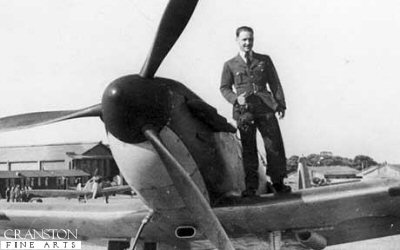
John Freeborn standing on his aircraft
|
| ||
John Freeborn with Bob Yeoman. |
John Freeborn with Cranston Fine Arts owner David Higgins. |
Cranston Fine Arts would like to thank Bob Yeoman for his help in carrying out this signing session with John Freeborn, and of course John Freeborn himself for taking the day (28/2/2010) to sign our art prints.
 | |
| Distinguished Flying Cross | Bar to the Distinguished Flying Cross |
|
|
|
|
| Text for the above items : |
This Sceptred Isle by Robert Taylor. For nearly a thousand years the white cliffs of southern England had taunted many a foreign army. These fortress walls of chalk, however, were defended by the moat-like waters of the Channel, and together they had shielded the British from her enemies. Alongside Drake they had defied the armies of Spain and her great Armada and, in 1805, had halted the march of Napoleon's Grand Armée. No enemy force since that of William the Conqueror in 1066 had successfully managed to cross the Channel in anger but, in May 1940, one of the most powerful armies the world had ever seen arrived at Calais. An invasion by Hitler's all-conquering Wehrmacht was imminent - or so it seemed. To cross the Channel and breach the English defences, the Luftwaffe simply had to gain control of the skies, and with massively superior numbers the outcom seemed inevitable. The fate of Britain lay in the hands of less than 3,000 young airmen from Fighter Command - Churhill's 'Few'. By July the most famous air battle in history was underway and, over the next three months under tranquil summer skies, the 'Few' battled to defend their Scpetred Isle. Impossibly outnumbered and flying daily to the point of exhaustion, by October these courageous young men had snatched victory from the jaws of defeat, emerging defiantly victorious. The threat of invasion might be over but a terrible price had been paid - during that long battle for the survival of Britain 544 had been killed and 422 wounded; and of those who survived a further 814 would be killed before the end of the war. This painting pays tribute to the valiant 'Few', portraying a fleeting moment of calm for the pilots of 74 (Tiger) Squadron during the height of the Battle of Britain. With his commanding officer Sailor Malan (ZP-A) to his right, Acting Flight Lieutenant John Freeborn (ZP-C) takes time to reflect on another day of intense combat while passing over the white cliffs and the familiar lighthouse at Beachy Head, as the squadron cross the English coast to head for home. |
Wings of Glory by Robert Taylor. Robert Taylors spellbinding painting, Wings of Glory, paying tribute to Mitchells immortal fighter, features the MkX1X Spitfire of the RAFs Battle of Britain Memorial Flight. Powered by the Rolls-Royce Griffin engine providing maximum speed of 450mph and a 44,000 feet operating ceiling, this lovingly restored aircraft thrills generations of aviation enthusiasts with her spectacular aerobatics at Europes summer air shows. This most beautiful of fighters gives a virtuoso performance, high among the clouds, alone in her magical element, she dances an aerial ballet like no other could. |
A Time for Heroes by Robert Taylor Royal Air Force and Royal Navy fighter aircrews flew combat throughout the six long years of World War Two. At the outbreak of war in 1939 four RAF Hurricane squadrons and two equipped with Gladiators went immediately to France where in short time New Zealander Cobber Kain became the first Allied Ace of the war. In April 1940 Hurricanes and Gladiators saw in action in Norway, when Rhodesian Caesar Hull of 263 Squadron became the second air Ace. By the fall of France the new Spitfire joined in the great air battles over the Channel as the British Expeditionary Force evacuated Dunkirk. Bob Stanford -Tuck, Douglas Bader, Peter Townsend, Sailor Malan, and many other great Aces gained their first victories, but with German forces massing on the French coast, the invasion of Britain looked imminent. Only RAF Fighter Command stood in Hitlers way. By July, the most famous of all air battles had begun. The next three months, under glorious summer skies, saw the most decisive and continual aerial fighting in history. The British victory in the Battle of Britain was to fundamentally change the course of the war and, ultimately, the course of history. But there were four and a half more years of air battles still to be fought and won -from the English Channel Front to the North African desert, from the Mediterranean to Far East Asia. It fell to Fleet Air Arm pilots to see the last air fighting for British and Commonwealth pilots, by then equipped with Seafires and American Corsairs and Hellcats, as they took part in the final assaults on the Japanese mainland. As the last embers of hostilities faded into history the centuries old doctrine of maritime supremacy had gone. Now the aircraft ruled. In his masterful painting A Time For Heroes Robert Taylor pays tribute to the World War II fighter aircrews of the RAF and Fleet Air Arm. A panoramic scene from the era of the Battle of Britain shows Mk I Spitfires of 234 Squadron, 10 Groups top scoring squadron, returning to St. Eval after intercepting heavy raids on south coast ports during the heaviest fighting, in September 1940. St. Michaels Mount, the castle built on the site of a 14th Century monastery to defend Britains shores from earlier enemies, provides a symbolic backdrop as once again a band of brothers is called upon to defend their Sceptred Isle. Sadly, since the passing of Mahinder Pujji in September 2010, all of the great pilots who signed any of the editions of this print have now passed away. |
Fight for the Sky by Robert Taylor. All through the long hot summer of 1940 they crossed the Channel from stolen bases in northern France, coming in mighty swarms to deliver their deadly cargo. Bombers and dive-bombers, single-seat fighters and fast twin-engined attack aircraft, their menacing shapes glinting with swastikas and black crosses, blackening the summer sky. Over 3000 aircraft were at the disposal of the boastful Luftwaffe supremo, Hermann Goering. Within just a matter of weeks, he promised Hitler, the RAF would be annihilated, allowing the invasion of Britain to proceed unhindered, and Britain would become the final piece of the jigsaw giving Nazi domination throughout Europe. Against the might of German airpower stood less than 600 Spitfire and Hurricane fighters, and as many young pilots determined to the man to defend their homeland. And so commenced the battle that was to develop into the greatest aerial conflict in history. Always outnumbered, often flying six sorties a day, the RAF's young fighter boys flew themselves to the point of exhaustion. Pilot losses forced desperate squadron commanders to take youngsters into combat, some with just a few hours on fighters. They flew and fought like tigers and they paid a heavy price, but never did they lose their spirit. Robert Taylor's wonderfully realistic painting captures the very essence of that epic battle. A Heinkel 111 has been brought down, one of many never to make it home on this bright and sunny day. As the Luftwaffe bomber's crew emerge from their broken aircraft, relieved to have survived the crash-landing, a Mk I Spitfire from No.66 Squadron roars low overhead to verify another victory. In the distance, Hurricanes from No 56 Squadron hurry back to North Weald to refuel and rearm. High above the battle rages, the vapour trails telling their own story. |
|
| ||
John Freeborn signing the print In Them We Trust by Ivan Berryman, assisted by Cranston Fine Arts owner David Higgins. |
John Freeborn signs the print Close Encounter at a signing session in February 2010. |
Cranston Fine Arts would like to extend our many thanks to Wing Commander John Freeborn for spending a day (28/2/2010) with us signing a number of our art prints.
| Wing Commander John Freeborn DFC* Aircraft details |
 Spitfire Manufacturer : Supermarine Built : 20351 | Spitfire Royal Air Force fighter aircraft, maximum speed for mark I Supermarine Spitfire, 362mph up to The Seafire 47 with a top speed of 452mph. maximum ceiling for Mk I 34,000feet up to 44,500 for the mark XIV. Maximum range for MK I 575 miles . up to 1475 miles for the Seafire 47. Armament for the various Marks of Spitfire. for MK I, and II . eight fixed .303 browning Machine guns, for MKs V-IX and XVI two 20mm Hispano cannons and four .303 browning machine guns. and on later Marks, six to eight Rockets under the wings or a maximum bomb load of 1,000 lbs. Designed by R J Mitchell, The proto type Spitfire first flew on the 5th March 1936. and entered service with the Royal Air Force in August 1938, with 19 squadron based and RAF Duxford. by the outbreak of World war two, there were twelve squadrons with a total of 187 spitfires, with another 83 in store. Between 1939 and 1945, a large variety of modifications and developments produced a variety of MK,s from I to XVI. The mark II came into service in late 1940, and in March 1941, the Mk,V came into service. To counter the Improvements in fighters of the Luftwaffe especially the FW190, the MK,XII was introduced with its Griffin engine. The Fleet Air Arm used the Mk,I and II and were named Seafires. By the end of production in 1948 a total of 20,351 spitfires had been made and 2408 Seafires. The most produced variant was the Spitfire Mark V, with a total of 6479 spitfires produced. The Royal Air Force kept Spitfires in front line use until April 1954. |
| Wing Commander John Freeborn DFC* Squadron details |
|
Contact Details |
|
Sign Up To Our Newsletter!
This website is owned by Cranston Fine Arts. Torwood House, Torwoodhill Road, Rhu, Helensburgh, Scotland, G848LE Contact: Tel: (+44) (0) 1436 820269. Email: cranstonorders -at- outlook.com
|
 |





