|
|
|
|
|
|
|
|
|

Oberst Wolfgang Falck
At the outbreak of war Wolfgang Falck was Staffelkapitan of 8,/JG132 flying the Bf110 Zerstorer in the Polish Campaign. In Feb 1940 he became Kommandeur 1./ZG1 and led it during the Western campaign. From June 1940 Falck was appointed Kommodore NJG1, the largest Geschwader in the Luftwaffe. During this time the greatest Luftwaffe night Aces were under his command. In July 1943 he joined the staff of Luftflotte Recih where he was responsible for the day and night fighter defence of the Reich. In the autumn of 1944 he was made Fighter Leader in the Balkans, and later became head of staff for flying training. Wolfgang Falck flew 90 operations and was awarded the Knight's Cross. Died 13th March 2007.
 |
| Knights Cross |
|
| Text for the above items : |
Duel in the Dark by Robert Taylor. The air war fought throughout World War II in the night skies above Europe raged six long years. RAF Hurricanes sent up to intercept the Luftwaffes nightly blitz on British cities had no more equipment than the fighters that fought the Battle of Britain during the day, but as the scale of nightly conflict developed, detection and navigation aids - primitive by todays standards - were at the cutting edge of World War II aviation technology. As the air war progressed the intensity of the RAFs nightly raids grew to epic proportions, and the Luftwaffe night-fighters became a critical last line of defence as their cities were pounded from above. By 1944 the Luftwaffe was operating sophisticated systems coordinating radar, searchlights and flak batteries, enabling effective guidance to increasingly wily aircrews flying equipment-laden aircraft. But the RAF had in turn developed their own detection equipment, and the nightly aerial contests between fighters and bombers were desperate affairs. Night-fighter pilots were men of special calibre, requiring a blend of all the best piloting and navigational qualities combined with patience, determination, and no small element of cunning. They were hunters in the purest sense, constantly honing their skills, and pitting their wits against a formidable foe. The young aircrews of the Luftwaffe fought a brave but losing battle in defence of their homeland, but their dedication never faltered, and their bravery is legend. Robert Taylor pays tribute to this courageous and skilled group of flyers with his new painting Duel in the Dark. It is August 1944. As Lancaster heavy bombers of 106 Squadron approach the target, Major Heinz-Wolfgang Schnaufer, Kommandeur of IV./ NJG1 and the Luftwaffes top-scoring night- fighter pilot, makes a daring attack passing feet below the mighty four-engine aircraft. Flying his Me110 night-fighter among the flak and searchlights he has scored hits on the bombers outer starboard engine. While his gunner fiercely returns fire from the bombers front turret gunner, the night-fighter Ace will slip into the shadows before selecting another quarry. His nights work is not yet done. |
|
|
|
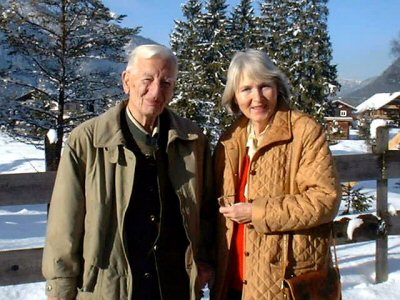
Wolfgang Falck with his wife - photograph taken c.2007 at his home in Austria. |
| Oberst Wolfgang Falck Aircraft details |
 Me110 Manufacturer : Messerschmitt | Me110 The Bf-110 grew out of Herman Gorings specifications for a multipurpose aircraft capable of penetrating deep into enemy airspace to clear the sky of enemy fighters in advance of German bomber formations. The aircraft would also be utilized as a long range interceptor, and as a ground support and ground attack bomber. The Bf-110 prototype first flew in 1936. The prototype was under powered with its Daimier Benz DB 600A engines. Several months passed before a go ahead was given for large scale production which commenced in 1938. Utilizing improved DB 601 engines, the early production 110s were as fast as any single engine fighter at that time, and had superior fire power. Their biggest apparent weakness was in the areas of armor protection for the crew, and in terms of maneuverability when compared to single seat fighters. The 110 was produced in large numbers and in many different variants. The 110D was the long range model. An additional belly tank was fitted to that aircraft, with several later variants having the more traditional drop tanks. The first serious test for the Bf-110 came during the Battle of Britain. About 300 Bf-110s were involved. They became easy prey for Hurricane and Spitfire pilots, and Bf-109s were often required to assist the 110s in their own defense. On August 15, 1940, which became known as Black Tuesday, the Bf-110s were ravaged by the RAF, and for the month over 100 aircraft were lost. On the Eastern Front the Bf-110 performed admirably in the early stages of Operation Barbarossa. With the Soviet Air Force weakened in the first several weeks of the attack, 110s were effectively utilized in a ground attack role. Ultimately, the Luftwaffe re-equipped a significant number of its 110s as night fighters. The aircraft performed well in this role because it was a good gun platform with sufficient speed to overtake the RAF night bombers. Such night missions were typically carried out with no Allied fighter escort, so the 110 night fighters would not have to engage or elude Allied fighters in this role. | ||||||
| Oberst Wolfgang Falck Squadron details |
Known Victory Claims - Wolfgang Falck | |||||||
DATE | PILOT | UNIT | JG | CLAIMED | LOCATION | TIME | FRONT |
| 05/09/1939 | Oblt. Wolfgang Falck | 1 | ZG 76 | PZL P-23 | Dalikow | 6.4 | Western Front |
| 11/09/1939 | Oblt. Wolfgang Falck | 1 | ZG 76 | Fokker F.IX | 8km SE Biala-Podlaska | 16.05 | Western Front |
| 11/09/1939 | Oblt. Wolfgang Falck | 1 | ZG 76 | 12km SW Biala-Podlaska | 16.1 | Western Front | |
| 18/12/1939 | Hptm. Wolfgang Falck | Stab I. | ZG 76 | Wellington | 20km SW Helgoland | 14.35 | Western Front |
| 18/12/1939 | Hptm. Wolfgang Falck | Stab I. | ZG 76 | Wellington | 20km SW Helgoland | 14.45 | Western Front |
| 10/01/1940 | Hptm. Wolfgang Falck | Stab I. | ZG 76 | Blenheim | Pl.Qu. 565 [Nordsee] | 12.57 | Western Front |
| 17/02/1940 | Hptm. Wolfgang Falck | Stab I. | ZG 76 | Blenheim | Pl.Qu. ID [Nordsee] | 16.1 | Western Front |
| 09/04/1940 | Hptm. Wolfgang Falck | Stab I. | ZG 76 | Fokker D.XXI | Vaerlöse, Dänemark | 6.38 | Western Front |
Known Claims : 8
Contact Details
Sign Up To Our Newsletter!
This website is owned by
Cranston Fine Arts. Torwood House, Torwoodhill Road, Rhu,
Helensburgh, Scotland, G848LE Contact: Tel: (+44) (0) 1436 820269. Email: cranstonorders -at- outlook.com
Shipping Info
Terms and Conditions
Cookie Policy
Privacy Policy

Stay up to date with all our latest offers, deals and events as well as new releases and exclusive subscriber content!