|
|
|
|
|
|
|
|
|

Oberleutnant Gunther Seeger
In February 1940, Gunther Seeger was an Unteroffizier with 3./JG2, scoring his first victory in the early days of the Battle of Britain. he served on the Channel Front until December 1942, including several months with the Geschwaderstabsschwarm. He transferred to the Mediterranean theatre with II./JG2 before joining 6./JG53. In February 1943 he joined 7./JG53 becoming Staffelkapitan in September 1944. Awarded the Knight's Cross, Gunther Seeger scored 56 victories.
 |
| Knights Cross |
|
|
|
|
|
|
|
|
|
| Text for the above items : |
Special Duties by Robert Taylor. A Junkers Ju52 of Luftflotte 2, escorted by Me109s of JG-53, transports important military personnel over the Dolomites in 1942. With the setting sun illuminating the mountain tops in a brilliant light, the panoramic vista is both chilling and spectacular. As the aircraft lumbers across the impressive mountain scenery, members of the High Command can be seen in conference in the cabin, while crew in the cockpit concentrate on their special duties flight plan. Behind them, unprotected from the elements, a lone gunner keeps a watchful eye. The Ju52 became the Luftwaffes primary wartime transport aircraft, taking part in every German army land operation during World War II. |
Valiant Response by Robert Taylor. The Spitfires of 54 Squadron, quickly scrambled from nearby Hornchurch, clash with the Me109s from 1./JG51 over Kent. Below, Me110s from KPRG210 are about to receive unwelcome attention as the rest of the Spitfires hurtle down upon them and in the distance, a group of Hurricanes rip through a dense formation of Do17s from KG76 as they struggle back to France. What clouds there are will be unlikely to give much sanctuary and, for the onlookers on the ground far below, the skies will soon be filled with weaving trails of smoke and debris. For nearly a week the Luftwaffe had thrown everything they had into the attack on southern England in order to annihilate RAF Fighter Command, in preparation for Operation Sealion, the invasion of Britain. And, heavily outnumbered, the young RAF Spitfire and Hurricane pilots of Fighter Command had so far repelled them, at a cost. But on Sunday 18 August 1940, the Germans launched the heaviest formations of aircraft seen in the battle so far. This was to be a grinding day of relentless assaults on the airfields of southern England, the hardest day of the Battle of Britain. |
Assault on the Capital by Robert Taylor Robert Taylors final painting in his 60th Anniversary trilogy features a scene from the attacks on the afternoon of September 7, 1940. Led by Herbert Ihlefeld, Me109Es of II/LG 2 dive through the bomber formation giving chase to Hurricanes of 242 Squadron as Ju88s of KG30, having unloaded their bombs, head for home. One Ju88 has been hit and is already losing height, and will not return. Following behind He111s of KG53 try to keep formation as they fly through flak. The sky is alive with action. |
Open Assault by Robert Taylor. The Junkers Ju87 Sturzkampfbomber, known to the British simply as the Stuka, had already acquired a deadly reputation across Europe, its siren screaming as the ungainly dive-bomber struck terror into the hearts of those below. In 1940 its pilots crossed the Channel with their grim-looking aircraft to terrorise the southern towns and ports of England. Robert Taylors painting Open Assault, depicts Hurricanes of 501 Squadron attacking a force of Ju87 Stukas as they dive-bomb naval vessels and installations in the port of Dover on 29 July 1940. High explosive bombs detonate within the sheltered anchorage as escorting Bf109s from JG51 race in to protect their lumbering charges. Four Stukas and two Me109s are despatched, for the loss of just one RAF aircraft. |
The Battle for Britain by Robert Taylor. A Battle of Britain Spitfire from 610 Squadron takes on a Me109 from I./JG3 in a head-on attack high over the south coast port of Dover, in the late morning of 10 July 1940. |
Eagles on the Channel Front by Robert Taylor. An exceptional painting by the worlds foremost aviation artist remembering the most famous of all Luftwaffe Fighter Wings that fought on the Western Front during the early years of World War Two. Prints are signed by Luftwaffe Aces who contested the great air battles with pilots of the RAF on the infamous Channel Front, 1940-1941 Badly mauled during the Battle of Britain, by early 1941 the Luftwaffe fighter wings, strung right across northern France, were back on strength. The front line squadrons were reequipping with the up-rated Me109F and, though suffering initial over-heating problems, the remarkable new Fw190A was making its first appearances. The Luftwaffe pilots were again full of confidence, and having the air endurance advantage of fighting close to their bases, they were competing on equal terms with the Spitfires and Hurricanes of RAF Fighter Command. Having spent the first 18 months of the war fighting a defensive air battle, RAF Fighter Command was raring to go onto the attack. The mix of Rhubarbs - two or three-plane, low-level incursions to attack enemy bases and installations - and large fighter sweeps aimed to entice the Luftwaffe up for a fight, kept the German fighter pilots busy throughout the summer. All through 1941 great air battles raged all along the Channel Front. Robert Taylors comprehensive work Eagles on the Channel Front, the fourth and final print in his widely acclaimed Wings of the Luftwaffe series, recreates a scene in northern France in the late autumn of 1941. Having just returned to their temporary airstrip in the region of St. Omer, Luftwaffe pilots of JG-26 excitedly debrief their recent encounter with Spitfires and Hurricanes, fought high over the Channel coast. The gleaming new Me109Fs are discreetly parked under trees on the edge the airfield, providing some cover from low-level surprise attacks. While ground crews busily prepare the Wings Me109s for another mission, a group of the exciting new Fw190A fighters taxi out. The scenario will continue right into winter. In his inimitable style, and with inordinate skill, Robert Taylor manages to evoke the heady atmosphere of a German front line airfield on the Channel Front in 1941. |
Dawn Eagles Rising by Robert Taylor. September 1940: The Battle of Britain reaches a crescendo as Me109s of the 1./JG52, their bright yellow noses glinting in the sun, gather speed and altitude as they form up after take-off from their base at Coquelles, near Calais. Led by Hauptmann Wolfgang Ewald, the Scharwm settle into their loose, finger-four formation, the pilots alert for danger and ready for yet another raid on England, just a few miles across the Channel. |
Horrido! by Robert Taylor. Of the many outstanding Luftwaffe fighter Wings of World War II, JG52 became the most successful. Many of the most famous Aces flew with this legendary wing, including one-time Squadron Commander Adolf Galland. JG-52 was home to the only fighter Aces in history to destroy more than 300 enemy aircraft - Erich Hartmann and Gerhard Barkhorn. The wings top ten scoring Aces amassed a staggering 2286 aerial victories and, by the end of the war, JG-52s pilots had recorded over 10,000 aerial victories; sixty-seven of their number were awarded the coveted Knights Cross or higher decorations, but the cost to the Wing was high: 678 of its aircrew perished in combat, while many others were taken prisoner following combat. Appropriately, Robert Taylor has chosen the Me109s of JG52 as his subject to represent the fighter pilots of the Luftwaffe in his tribute to these courageous flyers, with his breathtaking painting Horrido! With the traditional battle cry ringing in their ears, Squadron Commander Hptm Wolfgang Ewald leads pilots of I./JG52 into combat. Based at Coquelles/Calais in September 1940, the JG-52 Me109s hurtle down in a high-speed dive to engage the enemy during the ferociously fought Battle of Britain. Robert eloquently depicts these sleek and deadly fighters high over the Channel, glinting and menacing against an ominous backdrop of heavy cumulous clouds. |
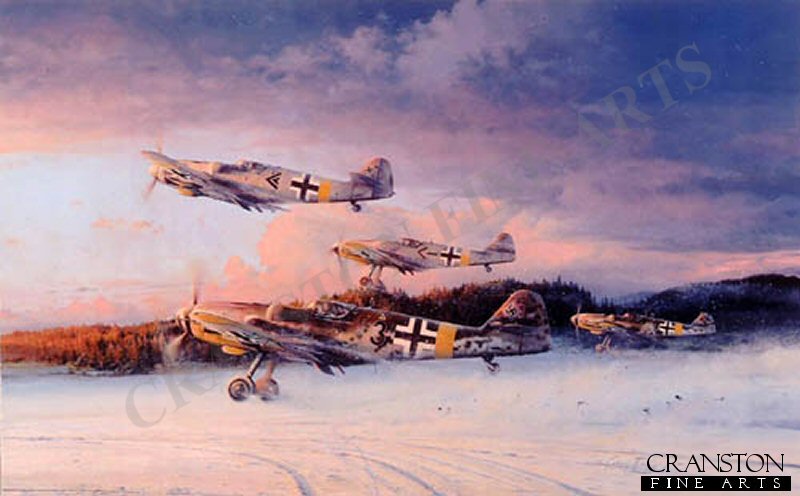
Eagles at Dawn by Robert Taylor. On Thursday, August 24, 1944 a 22-year old Oberleutnant Erich Hartmann powered his Mel09G fighter in a spectacular low pass over his squadrons airstrip in north-eastern Rumania, wagging his wings to the cheering Luftwaffe personnel on the ground below. The young flaxen-haired pilot had just become the first fighter Ace in history to bring down 300 enemy aircraft in combat. As World War II drew to its close, after three and a half years of continual aerial combat, this gifted young fighter pilot brought his final tally of aerial victories to 352, bringing down a Yak-7 during the last of his 1400 missions on May 8, 1945. He was the most successful fighter pilot of all time. In this dramatic rendition, we see captured a brilliantly colourful midwinter scene during the final phase of the war on the Eastern Front. Glinting in the sub-zero early morning sunlight as fresh snow begins to fall, and led by their Gruppenkommandeur Erich Hartmann, the Mel09G fighters of I./JG-53 scramble off the snow-covered airstrip at Veszprem in Hungary, February 1945. They will intercept waves of Russian fighters and bombers in the skies above Czechoslovakia in a last ditch attempt to repel the impending invasion of Germany. |
| Oberleutnant Gunther Seeger Aircraft details |
 Fw190 Manufacturer : Fokke-Wulf | Fw190 The Focke-Wulf 190 development project began in 1937. Conceived as a hedge against total dependence on the Messerchmitt 109, the 190 was designed by Kurt Tank utilizing a radial engine. This was against generally accepted design criteria in Germany, and many historians believe that the decision to produce a radial engine fighter was largely due to the limited manufacturing capacity for in-line, water-cooled engines which were widely used on all other Luftwaffe aircraft. Despite these concerns, Tanks design was brilliant, and the 190 would become one of the top fighter aircraft of WWII. The first prototype flew in mid-1939. The aircraft had excellent flying characteristics, a wonderful rate of acceleration, and was heavily armed. By late 1940 the new fighter was ordered into production. Nicknamed the butcher bird, by Luftwaffe pilots, early 190s were quite successful in the bomber interceptor role, but at this stage of the war many Allied bombing raids lacked fighter escort. As the war dragged on, Allied bombers were increasingly accompanied by fighters, including the very effective P-51 Mustang. The Allies learned from experience that the 190s performance fell off sharply at altitudes above 20,000 feet. As a result, most Allied bombing missions were shifted to higher altitudes when fighter opposition was likely. Kurt Tank had recognized this shortcoming and began working on a high-altitude version of the 190 utilizing an in-line, water-cooled engine. Utilizing a Jumo 12-cylinder engine rated at 1770-HP, and capable of 2,240-HP for short bursts with its methanol injection system, the 190D, or Long Nose or Dora as it was called, had a top speed of 426-MPH at 22,000 feet. Armament was improved with two fuselage and two wing mounted 20mm cannon. To accommodate the changes in power plants the Dora had a longer, more streamlined fuselage, with 24 inches added to the nose, and an additional 19 inches added aft of the cockpit to compensate for the altered center of gravity. By mid 1944 the Dora began to reach fighter squadrons in quantity. Although the aircraft had all the right attributes to serve admirably in the high altitude interceptor role, it was not generally focused on such missions. Instead many 190Ds were assigned to protect airfields where Me-262 jet fighters were based. This was due to the latter aircrafts extreme vulnerability to Allied attack during takeoff and landing. The 190Ds also played a major role in Operation Bodenplatte, the New Years Day raid in 1945 which destroyed approximately 500 Allied aircraft on the ground. The High Command was impressed with the 190Ds record on this raid, and ordered most future production of the Doras to be equipped as fighter-bombers. In retrospect this was a strategic error, and this capable aircraft was not fully utilized in the role for which it was intended. | ||||||||||||||||||||||||||||||||||||||||||||||||||||||||||||||||||||||||||||||||||||||||||||||||||||||||||||||||||||||||||||||||||||||||||||||||||||||||||||||||||||||||||||||||||||||||||||||||||||||||||||||||||||||||||||||||||||||||||||||||||||||||||||||||||||||||||||||||||||||||||||||||||||||||||||||||||||||||||||||||||||||||||||||||||||||||||||||||||||||||||||||||||||||||||||||||||||||||||||||||||||||||||||||||||||||||||||||||||||||||||||||||||||||||||||||||||||||||||||||||||||||
 Me109 Manufacturer : Messerschmitt Built : 33984 | Me109 Willy Messerschmitt designed the BF109 during the early 1930s. The Bf109 was one of the first all metal monocoque construction fighters with a closed canopy and retractable undercarriage. The engine of the Me109 was a V12 aero engine which was liquid-cooled. The Bf109 first saw operational service during the Spanish Civil War and flew to the end of World War II, during which time it was the backbone of the Luftwaffe fighter squadrons. During the Battle of Britian the Bf109 was used in the role of an escort fighter, a role for which it was not designed for, and it was also used as a fighter bomber. During the last days of May 1940 Robert Stanford-Tuck, the RAF ace, got the chance to fly an Me109 which they had rebuilt after it had crash landed. Stanford-Tuck found out that the Me109 was a wonderful little plane, it was slightly faster than the Spitfire, but lacked the Spitfire manoeuvrability. By testing the Me109, Tuck could put himself inside the Me109 when fighting them, knowing its weak and strong points. With the introduction of the improved Bf109F in the spring of 1941, the type again proved to be an effective fighter during the invasion of Yugoslavia and during the Battle of Crete and the invasion of Russia and it was used during the Siege of the Mediteranean island of Malta. The Bf109 was the main fighter for the Luftwaffe until 1942 when the Fw190 entered service and shared this position, and was partially replaced in Western Europe, but the Me109 continued to serve on the Eastern Front and during the defence of the Reich against the allied bombers. It was also used to good effect in the Mediterranean and North Africa in support of The Africa Korps. The Me109 was also supplied to several German allies, including Finland, Hungary, Romania, Bulgaria, Croatia, and Slovakia. The Bf109 scored more kills than any other fighter of any country during the war and was built in greater numbers with a total of over 31,000 aircraft being built. The Bf109 was flown by the three top German aces of the war war. Erich Hartmann with 352 victories, Gerhard Barkhorn with 301 victories and Gunther Rall with 275 kills. Bf109 pilots were credited with the destruction of 100 or more enemy aircraft. Thirteen Luftwaffe Aces scored more than 200 kills. Altogether this group of pilots were credited with a total of nearly 15,000 kills, of which the Messerschmitt Bf109 was credited with over 10,000 of these victories. The Bf109 was the most produced warplane during World War II, with 30,573 examples built during the war, and the most produced fighter aircraft in history, with a total of 33,984 units produced up to April 1945. Bf109s remained in foreign service for many years after World War II. The Swiss used their Bf109Gs well into the 1950s. The Finnish Air Force did not retire their Bf109Gs until March 1954. Romania used its Bf109s until 1955. The Spanish Hispanos flew even longer. Some were still in service in the late 1960s. | ||||||||||||||||||||||||||||||||||||||||||||||||||||||||||||||||||||||||||||||||||||||||||||||||||||||||||||||||||||||||||||||||||||||||||||||||||||||||||||||||||||||||||||||||||||||||||||||||||||||||||||||||||||||||||||||||||||||||||||||||||||||||||||||||||||||||||||||||||||||||||||||||||||||||||||||||||||||||||||||||||||||||||||||||||||||||||||||||||||||||||||||||||||||||||||||||||||||||||||||||||||||||||||||||||||||||||||||||||||||||||||||||||||||||||||||||||||||||||||||||||||||
| Oberleutnant Gunther Seeger Squadron details |
JG2 Country : Germany | JG2 Jagdgeschwader 2 was formed from parts of Jagdgeschwader 131 "Richthofen" on 1 May 1939 in Döberitz and its first commander was Oberst Robert Ritter von Greim. At the outbreak of the war JG 2 was tasked with defence of the Reich and based in the Berlin area under Luftgaukommando III. Stab and II. Gruppe were equipped with the Bf 109E and were located at Döberitz with 10.(N) staffel flying the Bf 109D in Straussberg. 10.(N) Staffel was one of the first night fighter units formed in the Luftwaffe. Later this staffel was expanded into IV.(N) Gruppe. This Gruppe gained the Luftwaffe’s first night kill over the RAF Bomber Command on the night of 25/26 on April 1940 when Ofw Förster shot down a Handley Page Hampden. The unit saw little combat until the Western offensive against France and the Low Countries from 10 May 1940 onwards. During the campaign against France, JG 2 was tasked with escorting raids and defending German airspace to the south of Heinz Guderian's Panzer forces which were encircling the French and the British Expeditionary Force further north. Leutnant Helmut Wick, who later became part of a trio of outstanding aces (including Adolf Galland from Jagdgeschwader 26 (JG 26) and Werner Mölders from Jagdgeschwader 51 (JG 51)) in the Battle of Britain, attained his first and the Geschwader's second kill on 22 November 1939, a French Curtiss Hawk Model 75. The first victory for the JG 2 was scored by Oberfeldwebel Kley (3. Staffel) at the same day. JG 2 took part in the Battle of Britain, operating Bf 109Es over the South Coast of England and the English Channel from bases in Cherbourg and Normandy. Major Helmut Wick emerged as one of the Battle’s top Luftwaffe aces, claiming 31 kills for a personal total of 56, before being killed (MIA) in action versus Spitfires of No. 609 Squadron in November 1940. Wick was seen to bail out successfully but was not found by German Air/Sea Rescue attempts. The Spitfire who dispatched him was immediately shot down by Oberleutnant Rudolf Pflanz. Ofw. Schnell, Ofw. Machold and Olt. Hans "Assi" Hahn also claimed heavily during this period, with 16 kills each. Some 42 JG 2 pilots were killed or made POW during the battle. | ||||||||||||||||||||||||||||||||||||||||||||||||||||||||||||||||||||||||||||||||||||||||||||||||||||||||||||||||||||||||||||||||||||||||||||||||||||||||||||||||||||||||||||||||||||||||||||||||||||||||||||||||||||||||||||||||||||||||||||||||||||||||||||||||||||||||||||||||||||||||||||||||||||||||||||||||||||||||||||||||||||||||||||||||||||||||||||||||||||||||||||||||||||||||||||||||||||||||||||||||||||||||||||||||||||||||||||||||||||||||||||||||||||||||||||||||||||||||||||||||||||||
JG53 Country : Germany | JG53 Pik-As was a Luftwaffe fighter-wing of World War II. It operated in Western Europe and in the Mediterranean. Jagdgeschwader 53 - or as it was better known, the "Pik As" (Ace of Spades) Geschwader - was one of the oldest German fighter units of World War II with its origins going back to 1937. JG53 flew the various models of Bf-109 throughout the second world war. | ||||||||||||||||||||||||||||||||||||||||||||||||||||||||||||||||||||||||||||||||||||||||||||||||||||||||||||||||||||||||||||||||||||||||||||||||||||||||||||||||||||||||||||||||||||||||||||||||||||||||||||||||||||||||||||||||||||||||||||||||||||||||||||||||||||||||||||||||||||||||||||||||||||||||||||||||||||||||||||||||||||||||||||||||||||||||||||||||||||||||||||||||||||||||||||||||||||||||||||||||||||||||||||||||||||||||||||||||||||||||||||||||||||||||||||||||||||||||||||||||||||
Known Victory Claims - Gunther Seeger | |||||||
DATE | PILOT | UNIT | JG | CLAIMED | LOCATION | TIME | FRONT |
| 08/06/1940 | Uffz. Günther Seeger | 3 | JG 2 | Morane 406 | SW Soissons | 21.09 | Western Front |
| 07/09/1940 | Uffz. Günther Seeger | 3 | JG 2 | Spitfire | SW Heyfield | 18.4 | Western Front |
| 07/09/1940 | Uffz. Günther Seeger | 3 | JG 2 | Spitfire | E. Heybridge | 18.57 | Western Front |
| 28/11/1940 | Uffz. Günther Seeger | 3 | JG 2 | Spitfire | Insel Wight | 15.07 | Western Front |
| 25/06/1941 | Fw. Günther Seeger | Stab | JG 2 | Spitfire | SE Calais | 12.57 | Western Front |
| 02/07/1941 | Fw. Günther Seeger | Stab | JG 2 | Blenheim | S. Paradiere SE Merville: 2500m | 12.45 | Western Front |
| 06/07/1941 | Fw. Günther Seeger | Stab | JG 2 | Spitfire | 10km E. Dover | 14.45 | Western Front |
| 10/07/1941 | Fw. Günther Seeger | Stab | JG 2 | Spitfire | SE Cassel | 12.15 | Western Front |
| 21/07/1941 | Fw. Günther Seeger | Stab | JG 2 | Spitfire | 5km SE Boulogne | 20.45 | Western Front |
| 23/07/1941 | Fw. Günther Seeger | Stab | JG 2 | Spitfire | W. Hesdin | 20.4 | Western Front |
| 23/07/1941 | Fw. Günther Seeger | Stab | JG 2 | Spitfire | 20km SW Berck-sur-Mer | 20.48 | Western Front |
| 23/07/1941 | Fw. Günther Seeger | Stab | JG 2 | Spitfire | 15km N. Calais | 13.25 | Western Front |
| 12/08/1941 | Fw. Günther Seeger | Stab | JG 2 | Spitfire | 10km NNW Calais: 4200m | 11.45 | Western Front |
| 16/08/1941 | Ofw. Günther Seeger | Stab | JG 2 | Spitfire | 10km NNW Calais | 19.42 | Western Front |
| 21/08/1941 | Ofw. Günther Seeger | Stab | JG 2 | Spitfire | W. Calais: 5500m | 10.24 | Western Front |
| 31/08/1941 | Fw. Günther Seeger | Stab | JG 2 | Spitfire | Le Trait bei Rouen: 4500m | 20.08 | Western Front |
| 20/09/1941 | Ofw. Günther Seeger | Stab | JG 2 | Spitfire | Sommemündung | 16.41 | Western Front |
| 21/09/1941 | Ofw. Günther Seeger | Stab | JG 2 | Spitfire | 10km ESE Dover | 16.42 | Western Front |
| 13/10/1941 | Fw. Günther Seeger | Stab | JG 2 | Spitfire | 10km W. Etaples | 15.4 | Western Front |
| 19/08/1942 | Ofw. Günther Seeger | 3 | JG 2 | Spitfire | 8km N. Dieppe: 50m | 7.2 | Western Front |
| 19/08/1942 | Ofw. Günther Seeger | 3 | JG 2 | Spitfire | 4km N. Dieppe: 50m | 11.33 | Western Front |
| 19/08/1942 | Ofw. Günther Seeger | 3 | JG 2 | Spitfire | 7km N. Dieppe: 800m | 11.39 | Western Front |
| 24/08/1942 | Ofw. Günther Seeger | 3 | JG 2 | Spitfire | 18km N. Boulogne | 12.2 | Western Front |
| 31/10/1942 | Ofw. Günther Seeger | 3 | JG 2 | Spitfire | Pl.Qu. 1276/05 Ost: 600m | 18.08 | Western Front |
| 28/11/1942 | Ofw. Günther Seeger | 11 | JG 2 | P-38 | - | - | Western Front |
| 02/12/1942 | Ofw. Günther Seeger | 11 | JG 2 | Spitfire | 10km W. Tebourda | 8.31 | Western Front |
| 03/01/1943 | Ltn. Günther Seeger | 6 | JG 53 | Boston | 30km SW Kairouan: 400m | 12.26 | Western Front |
| 03/01/1943 | Ltn. Günther Seeger | 6 | JG 53 | Boston | 30km SW Kairouan: 100m | 12.26 | Western Front |
| 03/01/1943 | Ltn. Günther Seeger | 6 | JG 53 | P-40 | 30km SW Kairouan: 100m | 12.21 | Western Front |
| 05/01/1943 | Ltn. Günther Seeger | 6 | JG 53 | Spitfire | 8km W. Jafna | 12.02 | Western Front |
| 22/03/1943 | Ofw. Günther Seeger | 7 | JG 53 | B-17 | Cap Vito: 8000m | 16.03 | Western Front |
| 31/03/1943 | Ofw. Günther Seeger | 7 | JG 53 | Mitchell | 35km NW Gabes: 30m | 13.57 | Western Front |
| 10/05/1943 | Ofw. Günther Seeger | 7 | JG 53 | P-38 | 2km S. Haranzeh: 7500m | 13.57 | Western Front |
| 21/05/1943 | Ofw. Günther Seeger | 7 | JG 53 | P-38 | 55km SW Marsala: 8000m | 12.15 | Western Front |
| 05/07/1943 | Ofw. Günther Seeger | 7 | JG 53 | B-17 | 17km S. Fl.Pl. Gerbini: 7000m | 11.37 | Western Front |
| 06/07/1943 | Ofw. Günther Seeger | 7 | JG 53 | Spitfire | 8km NE Ragusa: 800m | 15.05 | Western Front |
| 10/07/1943 | Ofw. Günther Seeger | 7 | JG 53 | Spitfire | - | 19.36 | Western Front |
| 10/07/1943 | Ofw. Günther Seeger | 7 | JG 53 | Spitfire | - | 19.32 | Western Front |
| 12/07/1943 | Ofw. Günther Seeger | 7 | JG 53 | Spitfire | 4km W. Avola: 2500m | 19.32 | Western Front |
| 12/07/1943 | Ofw. Günther Seeger | 7 | JG 53 | Spitfire | 4km W. Avola: 4000m | 19.35 | Western Front |
| 12/07/1943 | Ofw. Günther Seeger | 7 | JG 53 | Spitfire | 1km S. Syracuse: 2400m | 19.42 | Western Front |
| 16/08/1943 | Ofw. Günther Seeger | 7 | JG 53 | B-24 | Forenza: 6000m | 12.5 | Western Front |
| 19/08/1943 | Ofw. Günther Seeger | 7 | JG 53 | B-17 | 25km SW Foggia: 7000m | 12.15 | Western Front |
| 20/08/1943 | Ofw. Günther Seeger | 7 | JG 53 | Lightning | 5km NE Marsa: 2500m | 12.35 | Western Front |
| 22/08/1943 | Ofw. Günther Seeger | 7 | JG 53 | Marauder | 60km SW Insel Capri: 800m | 12.22 | Western Front |
| 10/11/1943 | Ofw. Günther Seeger | 7 | JG 53 | B-17 | 15km N. Firenze: 7500m [Frient] | 11.55 | Western Front |
| 16/12/1943 | Ofw. Günther Seeger | 7 | JG 53 | P-38 | 30km SE Padua: 7500m | 12.3 | Western Front |
| 29/01/1944 | Ofw. Günther Seeger | 7 | JG 53 | B-26 | - | 14.21 | Western Front |
| 29/04/1944 | Oblt. Günther Seeger | 4 | JG 53 | B-17 | HB-2: 7000m [SW Königslutter] | 11.1 | Western Front |
| 11/05/1944 | Oblt. Günther Seeger | 4 | JG 53 | B-17 | Raum Trier: 6000m | 18.46 | Western Front |
| 12/06/1944 | Oblt. Günther Seeger | 4 | JG 53 | B-24 | DR-1: 6000m [NW Rennes] | 10.21 | Western Front |
| 02/07/1944 | Oblt. Günther Seeger | 4 | JG 53 | Spitfire | 10km SE Caen: 1200m | 15.16 | Western Front |
| 09/07/1944 | Oblt. Günther Seeger | II. | JG 53 | P-47 | 10km SW Caen | 13.3 | Western Front |
| 09/07/1944 | Oblt. Günther Seeger | II. | JG 53 | P-47 | 10km SW Caen | 13.31 | Western Front |
| 22/08/1944 | Oblt. Günther Seeger | 7 | JG 53 | P-38 | SG 2: 4800m [Jussy N. Tergnier] | 19.27 | Western Front |
| 13/10/1944 | Oblt. Günther Seeger | 7 | JG 53 | P-47 | SQ-9: 2000m [N. Ramstein] | 15.44 | Western Front |
| 07/04/1945 | Oblt. Günther Seeger | 7 | JG 53 | Auster | - | 16.09 | Western Front |
| 13/04/1945 | Oblt. Günther Seeger | 7 | JG 53 | P-47 | - | 18.35 | Western Front |
Known Claims : 58
Contact Details
Sign Up To Our Newsletter!
This website is owned by
Cranston Fine Arts. Torwood House, Torwoodhill Road, Rhu,
Helensburgh, Scotland, G848LE Contact: Tel: (+44) (0) 1436 820269. Email: cranstonorders -at- outlook.com
Shipping Info
Terms and Conditions
Cookie Policy
Privacy Policy

Stay up to date with all our latest offers, deals and events as well as new releases and exclusive subscriber content!