|
|
|
|
|
|
|
|
|

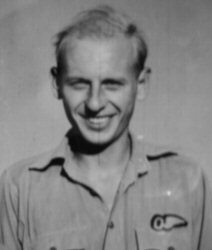
Flight Lieutenant Ray Harrington
Ray joined the RAF in 1941, completing his training in South Africa. In January 1944 he was posted to 603 Squadron flying Beaufighters in North Africa. Here he teamed up with navigator, Warrant Officer A.E. 'Bert' Winwood, and from where they launched attacks across the Mediterranean into Crete, Greece and the Aegean Islands against shipping, harbour installations and enemy aircraft with much success. In December 1944 they were posted to 235 Squadron Coastal Command, part of the Banff Strike Wing, converting to Mosquitos. In April 1945 they were shot down following a strike in the Kattegat, but avoided capture and with the help of the Danish resistance made it home, where they continued to fly again from Banff.


|
|
|
|
| Text for the above items : |
Top Dog by Robert Taylor. Completing a record 213 operational sorties with Bomber Commands Pathfinder Force, Mosquito LR503 became one of the most successful aircraft in the Royal Air Force during World War II. It flew first with 109 Pathfinder Squadron, and then 105 Pathfinder Squadron, completing more combat missions than any other Allied aircraft. |
Vital Support by Robert Taylor. Crucial to every squadron in the RAF were the unsung heroes of World War II - the ground crew. Without the vital support of these dedicated men who refuelled the aircraft, rearmed them, maintained them and kept them flying, the pilots and aircrew would, quite simply, never have got into the air. Robert Taylors drawing Vital Support shows ground crew bombing up a Mosquito of RAF Bomber Command. |
Strike and Strike Again by Robert Taylor. By the spring of 1945, Germanys once all-conquering submarine fleet, driven by allied forces from its bases in estern France, had fled to the relative safety of the Norwegian fjords - territory still remaining under German occupation since 1940. In one of Hitlers last stands, more than 100 U-Boats, merchant freighters, flakships, and other military vessels were hathered in the narrow fjords, laying up by day and sailing undercover of darkness. They were a menace that had to be dealt with. Tasked with the difficult job of eliminating this force were the Beaufighters and Mosquitos of RAF Coastal Commands Strike Wings based in Scotland. - Our job was to go after this shipping and sink it - recalled Wing Commader Colin Milson, C.O. of No. 455s Beaufighters. - The fjords were often just 200 - 300 yards across with cliffs rising vertically up 2000 feet, the deep water allowing the German shipping to get in beneath these high overhanging cliffs. This made for difficult and dangerous flying, exacerbated by the heavy flak and machine gun fire that always welcomed us. |
Dangerous Coast by Robert Taylor. Mosquitoes from RAF Coastal Command's Banff Strike Wing race through a deep-sided Norwegian fjord following a successful rocket strike against enemy coastal shipping. The de Havilland Mosquito was arguably the finest multi-role combat aircraft of World War II and, remarkably, one of the few front-line aircraft constructed almost entirely of wood - few other warbirds were built for so many different duties. Amongst its countless roles it formed the core of Coastal Command's legendary anti-shipping strike force, and it is this role that is the subject of this painting, paying tribute to the Mosquito crews of World War II. A large force of Mosquitoes from RAF Coastal Command's Banff Strike Wing exit a deep-sided fjord along Norway's rugged, heavily defended mountainous coast. In the distance, smoke and explosions reverberate from their successful rocket strike against enemy coastal shipping, destroying yet another cargo of iron ore destined for the furnaces of Germany's industrial war machine. Above them P-51 Mustangs provide top cover support should any patrolling enemy fighters decide to make an appearance. |

Ray Harrington signing Shell House Raiders
| Flight Lieutenant Ray Harrington Aircraft details |
 Beaufighter Manufacturer : Bristol Built : 5564 | Beaufighter BRISTOL BEAUFIGHTER The Bristol Beaufighter was a Torpedo Bomber and had a crew of two. with a maximum speed of 330mph and a ceiling of 29,000 feet. maximum normal range of 1500 miles but could be extended to 1750 miles. The Bristol Beaufighter carried four 20mm cannon in the belly of the aircraft and upto six .303in browning machine guns in the wings. it could also carry eight 3 -inch rockets, 1605 lb torpedo or a bomb load of 1,000 lb. The Bristol Beaufighter first flew in July 1939 and with some modifications entered service with the Royal Air Force in July 1940. In the winter of 1940 - 1941 the Beaufighter was used as a night fighter. and in March 1941 the aircraft was used at Coastal Command as a long range strike aircraft. and in 1941, the Beaufighter arrived in North Africa and used as a forward ground attack aircraft. The Bristol Beaufighter was used also in India, Burma and Australia. A total of 5,564 Beaufighters were built until production in Britain finished in 1945, but a further 364 were built in Australia for the Australian Air Force |
 Mosquito Manufacturer : De Havilland Built : 7781 | Mosquito Used as a night fighter, fighter bomber, bomber and Photo-reconnaissance, with a crew of two, Maximum speed was 425 mph, at 30,300 feet, 380mph at 17,000ft. and a ceiling of 36,000feet, maximum range 3,500 miles. the Mosquito was armed with four 20mm Hospano cannon in belly and four .303 inch browning machine guns in nose. Coastal strike aircraft had eight 3-inch Rockets under the wings, and one 57mm shell gun in belly. The Mossie at it was known made its first flight on 25th November 1940, and the mosquito made its first operational flight for the Royal Air Force as a reconnaissance unit based at Benson. In early 1942, a modified version (mark II) operated as a night fighter with 157 and 23 squadron's. In April 1943 the first De Haviland Mosquito saw service in the Far east and in 1944 The Mosquito was used at Coastal Command in its strike wings. Bomber Commands offensive against Germany saw many Mosquitos, used as photo Reconnaissance aircraft, Fighter Escorts, and Path Finders. The Mosquito stayed in service with the Royal Air Force until 1955. and a total of 7781 mosquito's were built. |
| Flight Lieutenant Ray Harrington Squadron details |
No.603 Sqn RAF Country : UK Disbanded 10th March 1957 Known Codes : , XT, RL, | No.603 Sqn RAF City of Edinburgh (Auxiliary) Gin ye daur - If you dare |
|
Contact Details |
|
Sign Up To Our Newsletter!
This website is owned by Cranston Fine Arts. Torwood House, Torwoodhill Road, Rhu, Helensburgh, Scotland, G848LE Contact: Tel: (+44) (0) 1436 820269. Email: cranstonorders -at- outlook.com
|
 |





